TheCEOVerse • Digital Edition
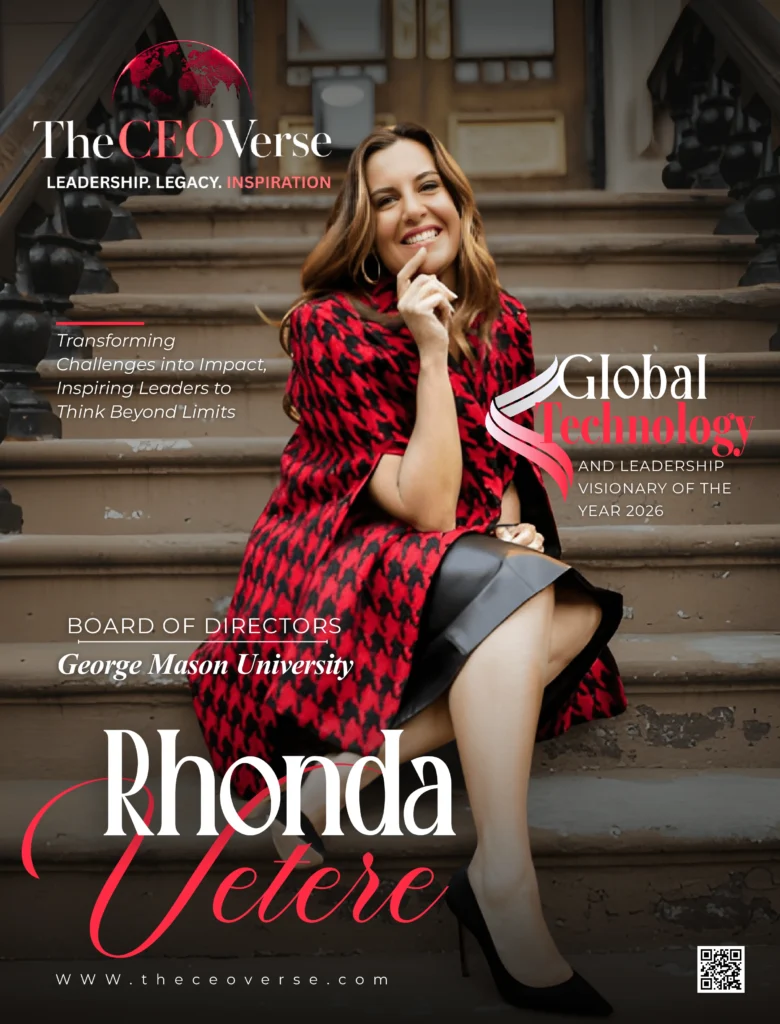
“Global Technology and Leadership Visionary of the Year 2026”
Cover story
Rhonda Vetere
Featured Profile - Rhonda Vetere
Rhonda Vetere: Transforming Challenges into Impact, Inspiring Leaders to Think Beyond Limits
There are careers built around titles, and then there are careers built around the ability to keep moving when circumstances become uncertain. Rhonda belongs firmly to the latter category. Across more than two decades of technology and executive leadership, she has operated at the intersection of business transformation, technology, global operations, and human performance. She has worked across finance, telecommunications, insurance, healthcare, retail, beauty, wellness, and investment banking; led technology organizations spanning continents; navigated complex mergers and acquisitions; and worked with professionals distributed across as many as 162 countries. Her professional journey has repeatedly placed her all over the globe. Some countries include London, India, Hong Kong, Latin America, and several places across the United States for work. The stakes were high there, the variables were numerous, and the margin for indecision was narrow.
At 12 years old, she watched her mother raise her as a single parent and carry the weight of doing everything herself. That experience became an early lesson in responsibility. Rhonda understood that she needed to work hard not simply for achievement, but to help create a different kind of future for both of them. That early understanding of work as responsibility would eventually become the foundation of a career defined by discipline, resilience, and an unusually strong appetite for challenge.
The Making of a Global Executive
Rhonda’s professional trajectory has never been confined to one industry or one geography. Her career has moved through some of the most demanding environments in modern business, including telecommunications, financial services, insurance, healthcare, beauty, wellness, and technology. She has held leadership positions associated with organizations such as JPMorgan Chase/Bank One, Barclays, HP Enterprise Services, AIG, Estée Lauder Companies, Santander Bank, nThrive/Pamplona Capital Management, and Herbalife Nutrition.
Such breadth matters because technology leadership at the highest level is rarely about technology alone. Being a Global CTO and CIO for Estée Lauder Companies (fashion beauty brands) must understand how technology affects capital allocation, customer experience, operating models, risk, talent, acquisitions, cost structures, and ultimately enterprise value. Her experience across industries has given her the ability to approach technology as a business instrument rather than an isolated corporate function. That distinction is central to her leadership philosophy. She is also a two-time best-selling author.
This people-centered perspective has been particularly important throughout her experience leading large and geographically dispersed teams. Managing thousands of professionals across different countries requires considerably more than technical competence. Cultural differences, communication styles, expectations, time zones, regulatory environments, and local business realities all influence how strategies are received and executed.
She learned to treat those differences not as obstacles to eliminate, but as realities to understand. Her experience leading teams of more than 20,000 people across continents has reinforced a simple principle: global leadership cannot be reduced to issuing instructions from headquarters. It requires listening, adaptation, clarity, and the ability to establish trust across boundaries. That mindset has become one of her most important competitive advantages.
Leading When the Stakes Are High
Some leadership lessons are learned when everything is going according to plan. The more valuable ones are learned when nothing is. Rhonda’s career has repeatedly placed her inside complex corporate transitions. She has been involved in more than 20 mergers and acquisitions and has worked through periods of significant organizational disruption, including the fallout surrounding Lehman Brothers, challenging moments at AIG, and the JPMorgan and Bank One merger.
These situations demand a particular kind of executive judgment. Mergers and acquisitions are often described in terms of financial logic: synergies, efficiencies, market expansion, cost structures, and growth opportunities. But the operational reality is far more complicated. Systems have to communicate. Cultures have to coexist. Employees need clarity. Customers cannot be allowed to feel the disruption. Leaders have to make decisions before every answer is available.
Technology becomes the connective tissue. Her experience in these environments has allowed her to develop a pragmatic understanding of transformation. Technology must support the strategic objective of the organization, while leaders must simultaneously manage the human implications of change. This balance between systems and people is perhaps the most distinctive characteristic of her approach.
She does not treat technology as an end in itself. Instead, technology becomes a means of creating agility, efficiency, resilience, and business value. One of the clearest examples came during her tenure as CTO of the Estée Lauder Companies, where she led a transformation of global IT operations and helped create a fully digital environment while generating approximately $28 million in annual savings and maintaining business continuity.
The figure is impressive. But the larger significance lies in what it represents. Technology leadership at this level is ultimately judged by whether it changes the economics and capabilities of an enterprise. Cost savings matter because they create room for investment. Digital infrastructure matters because it enables scale. Operational improvements matter because they make organizations more responsive.

The Human Side of Transformation
There is an irony at the heart of technology leadership: the more digital the enterprise becomes, the more important human leadership can become.
Automation can accelerate processes. Data can improve decisions. Artificial intelligence can expand capabilities. Cloud infrastructure can create flexibility. But none of these automatically produces alignment. People do.
That is why her leadership philosophy places significant emphasis on emotional intelligence, communication, transparency, metrics, and trust. Her experience across 162 countries has made cultural intelligence more than a leadership ideal; it is an operational necessity.
A strategy designed in one market cannot simply be transplanted into another and expected to perform identically. Global organizations must be able to maintain strategic consistency while allowing local intelligence to influence execution. That requires leaders who can move comfortably between the global and the local.
Rhonda’s own career has given her that perspective. She has lived and worked in locations including New York, Hong Kong, Singapore, London, Mumbai, and elsewhere across India. Such exposure inevitably changes the way an executive sees organizations. Geography stops being a collection of markets on a presentation slide and becomes a collection of people, cultures, expectations, and lived experiences.
The Corporate Athlete
Perhaps no element of Rhonda’s story illustrates her philosophy more vividly than endurance sport. Since 2016, she has completed more than 152 endurance races, encompassing marathons, triathlons, Ironman events, and other demanding challenges. She has competed in Ironman 70.3 events in places including Bahrain, Finland, and New Zealand, completed the Abbott World Marathon Majors, and undertaken extraordinary physical challenges that have taken her far beyond conventional athletic competition.
But the significance of sport in her life extends well beyond fitness. She sees endurance as a leadership discipline. The same qualities that allow an athlete to continue when fatigue sets in preparation, mental resilience, pacing, discipline, focus, recovery, and the ability to remain committed to a distant goal are also relevant to executive leadership. That idea informs her concept of the “Corporate Athlete.”
In a corporate environment, performance is rarely about one spectacular moment. It is about sustaining the ability to perform over time. Executives must make difficult decisions while managing pressure. Teams must remain productive during transformation. Organizations must absorb setbacks without losing direction.
The corporate athlete therefore understands that resilience is not simply the ability to push harder. It is the ability to manage energy, maintain perspective, prepare for adversity, and continue performing when circumstances are less than ideal.
Her own life provides an unusually convincing demonstration of the philosophy. She has balanced an extensive travel schedule reported at roughly 75 percent of her time with an extraordinary commitment to endurance sport. Her athletic achievements also carry a social purpose.
Her races and athletic activities have frequently supported causes involving veterans, first responders, mental health, people with disabilities, and inclusion. In 2025, she completed her seventh Abbott World Marathon Major while guiding Chris Nikic, who became the first athlete with Down syndrome to complete the six-star challenge in a single year. The moment captures something important about her approach to achievement.

From Achievement to Impact
The difference between achievement and impact is an important distinction in Rhonda’s story.
Achievement asks: What did you accomplish?
Impact asks: What changed because you did it?
Her professional achievements are substantial. She has been recognized among the Top 50 Most Powerful Women in Technology by the National Diversity Council, received a Stevie Award for Excellence in Transforming Business, and been recognized in lists highlighting women leaders and technology trailblazers. CIO Magazine named her Woman of the Year in 2025, while other organizations have recognized her as an influential voice in technology and leadership.
She has consistently invested time in students, emerging professionals, athletes, veterans, and individuals navigating transitions in their lives and careers. Her involvement with academic and professional advisory boards reflects a broader belief that experience becomes more valuable when it is shared. That commitment is also visible in her work around STEM.
Rhonda has been recognized as a Global STEM Ambassador in India and has supported initiatives designed to connect education, opportunity, technology, and sport. Her association with educational initiatives in Meghalaya, including the inauguration of the I Can I Will Academy and recognition through a biodiversity park, reflects a desire to extend her influence beyond conventional corporate boundaries.
For an executive who has spent much of her career inside large corporations, this outward-looking approach is significant. It suggests that leadership, in her view, does not end when the workday does.
Writing the Lessons Down
Her leadership philosophy has also found its way into her writing. She is the author of Grit & Grind: 10 Principles for Living an Extraordinary Life and co-author of Enterprise Service Management for Dummies.
The titles themselves reveal something about her perspective. “Grit” speaks to perseverance. “Grind” speaks to disciplined execution. Together, they suggest a philosophy in which ambition is inseparable from the willingness to do the work required to achieve it.
That message resonates with the broader arc of her career. Her story is not one of effortless success. It is a story of sustained performance across environments that demanded constant adaptation. Industries changed. Technology evolved. Organizations merged. Global teams became more complex. Expectations of executive leadership transformed. Through it all, the underlying principles remained remarkably stable.
Her books have allowed her to turn those lessons into frameworks that can be applied by other professionals. Grit & Grind, in particular, has been recognized among leadership and business reading lists and has been incorporated into academic curricula.

A Different Definition of Executive Presence
Traditional executive presence is often associated with authority: the ability to command a room, make decisive statements, and project confidence. She can operate in technology strategy and corporate transformation, but she can also speak the language of sport, education, mentorship, governance, and social impact. She can move from a discussion about digital infrastructure to a conversation about resilience. She can approach a boardroom problem with the same disciplined mindset she brings to an endurance race.
That range matters because today’s most difficult leadership challenges rarely fit neatly inside a single function. Cybersecurity is a technology issue, but also a governance issue. Digital transformation is a systems issue, but also a culture issue. Talent is an HR issue, but also a strategic issue. Innovation is a technology question, but ultimately a human one. Her career has placed her in the middle of these intersections.
Her completion of the NYU Law Board of Directors Academy in 2023 further reflects her interest in the governance dimensions of leadership and the responsibilities that come with influencing organizations at the highest level.
The Next Generation of Leadership
If there is a broader lesson in her career, it is that leadership should not be understood as a destination. The next generation of executives will inherit organizations that are more interconnected, more technologically dependent, and more culturally diverse than ever. They will have to lead through artificial intelligence, cybersecurity threats, geopolitical uncertainty, changing workforce expectations, and increasingly complex stakeholder demands.
Technical expertise will remain important. But technical expertise alone will not be enough. The leaders who thrive will be those who can connect technology with strategy, strategy with people, and performance with purpose. Rhonda’s own journey offers a useful model.
She has demonstrated that global leadership requires cultural intelligence. That transformation requires both systems thinking and empathy. That endurance is a strategic capability, not simply a physical attribute. And that professional success gains greater significance when it creates opportunities for others.
Her work with students, athletes, veterans, first responders, people with disabilities, and emerging leaders reflects that belief. It also brings her story full circle. The 12-year-old who watched her mother struggle understood early that work could change circumstances.
The executive who later led thousands of professionals across continents learned that leadership could change organizations. The athlete discovered that endurance could change what people believed was possible.
The Measure of a Life in Motion
Rhonda has consistently chosen environments that demand movement—business transformations, international assignments, organizational change, endurance competition, mentoring, education, and social impact. She appears most comfortable not when circumstances are easy, but when there is something difficult to solve, build, improve, or overcome.
That may be the most enduring characteristic of her leadership. She does not separate professional excellence from personal discipline. She does not separate technology from people. She does not separate achievement from purpose.
Instead, she treats them as parts of the same equation. Leadership is ultimately an exercise in responsibility: responsibility to the organization, to the people who depend on it, to the teams that execute its vision, and to the communities that can benefit from its success.
And behind all of those identities is the same fundamental lesson learned decades ago from watching her mother work relentlessly to build a better life: meaningful progress rarely arrives without effort.
Today, Rhonda has transformed that lesson into a leadership philosophy of her own. It is visible in the boardroom, where transformation requires courage. And it is visible in the people she continues to mentor, encourage, and help move toward possibilities they may once have considered out of reach. In an era that often celebrates speed, her story offers a more durable idea of success.