TheCEOVerse • Digital Edition
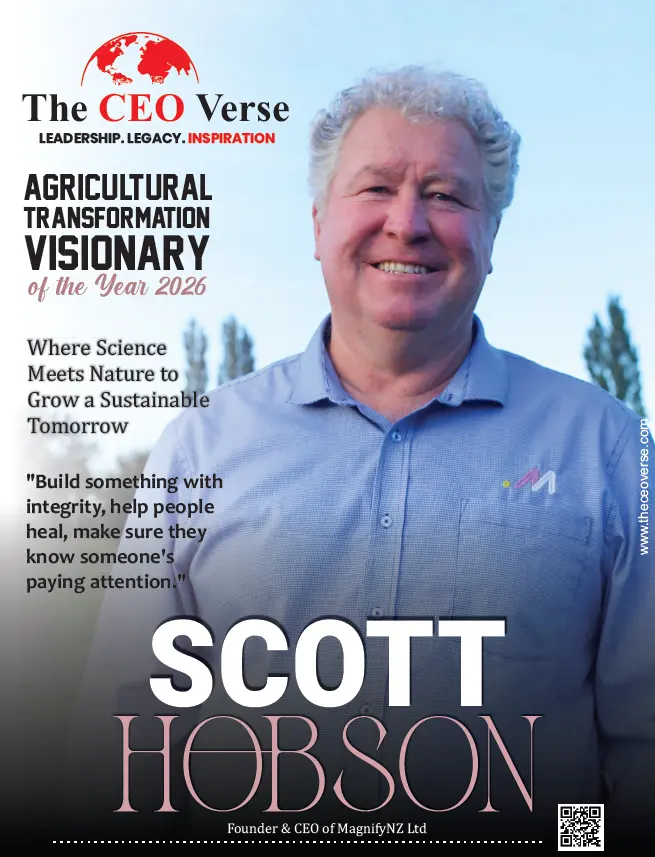
“Agricultural Transformation Visionary of the Year 2026”
Cover story
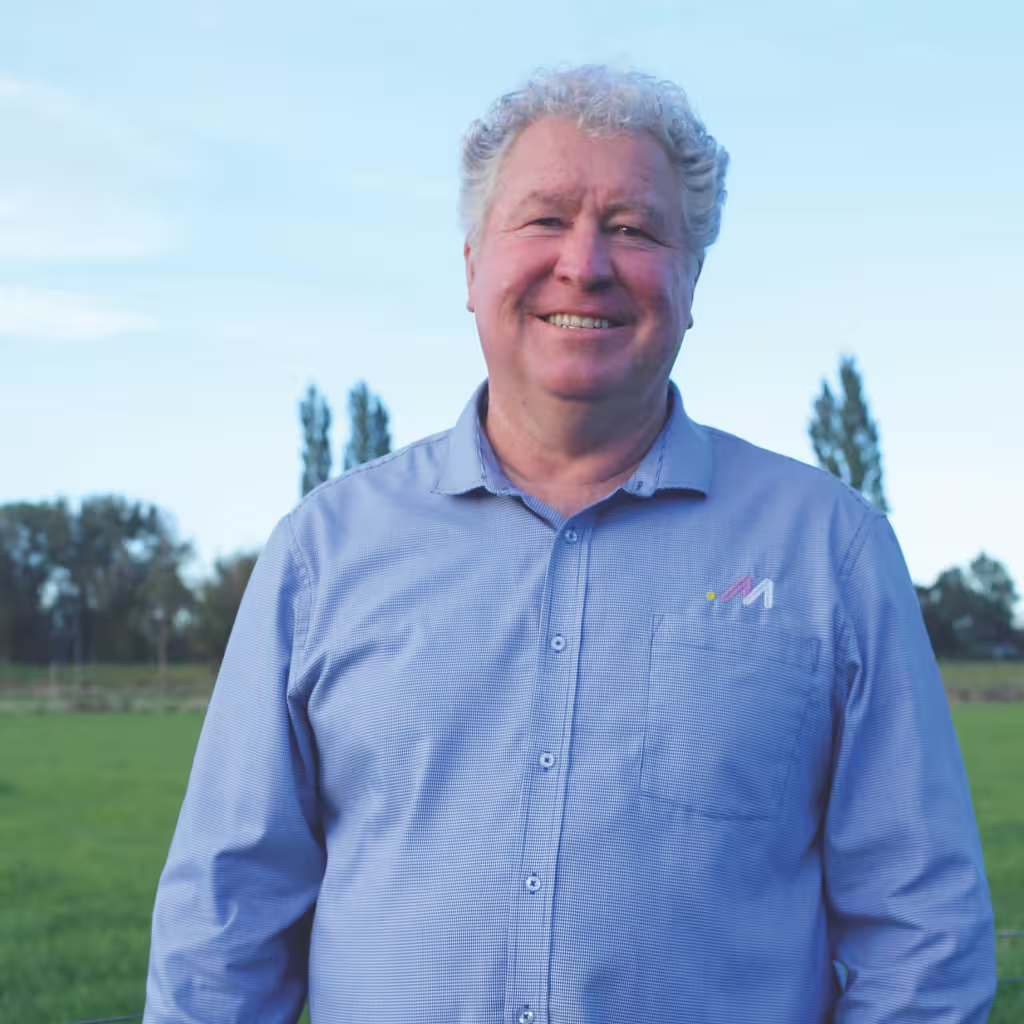
Scott Hobson
Featured Profile - Scott Hobson
From Fertiliser Industry to Soil’s Defender
Scott Hobson did not arrive at regenerative agriculture through a conference or a trend. He left it, came back, and saw it differently the second time.
Hobson studied agricultural science in the late 1980s. After graduating, he left agriculture entirely; the economy made that decision easier than it should have been, jobs were scarce in the sector and he went where the work was. When he returned, he had spent time with Native American elders, an experience he describes as foundational. Their oral tradition carried warnings about industrial farming’s direction that, to him, mapped uncomfortably well onto what chemical-dependent agriculture had become. He did not linger there long before turning back to the soil.
The fertiliser industry, where he eventually worked, operates on a straightforward commercial principle: sell more fertiliser. Hobson grew increasingly uncomfortable with that logic. The post-war promise that chemicals would eliminate disease had not delivered. Disease had increased. Input volumes had increased. Twenty per cent of the earth’s topsoil had been lost in three decades. The math was not difficult.
He prayed for a direction. What came back, in time, was the foundation of MagnifyNZ Ltd.
Listening to What Soil Cannot Say
Hobson’s approach to decision-making includes what he calls deep listening, an attentiveness to subtler signals alongside the conventional ones: a sense of agitation, of deadness or vitality in a place, a shift that doesn’t have an obvious source. He developed this over years, partly through his time with the elders, partly through staying open to what more rational frameworks tend to filter out.
He is precise about one thing, though. Field measurements, comparisons, peer-reviewed work, these remain central to how MagnifyNZ operates, and the intuitive side runs alongside the scientific rather than replacing it. When he looked for solutions to dead or diseased soil, he looked for what would restore balance, then checked whether the numbers backed it up. That combination has taken MagnifyNZ in directions competitors didn’t follow, and kept it off paths that looked commercially sensible but would have failed.

Numbers That Chemicals Could Never Produce
The milestone MagnifyNZ returns to most often is also its most verifiable. Dairy farms using the company’s products have maintained an increase of up to 25% in production with no fertiliser applications for two decades, an outcome the team has tracked across its client base over that time. It sits outside what Hobson says the conventional inputs model would predict.
Soil diseases were another area where the company built its reputation quietly. Cases that chemicals had failed to resolve, where farms had been managing rather than fixing the problem, responded to MagnifyNZ’s inoculants instead, a biological mechanism that works with the soil system rather than overriding it.
The result that drew the most external attention was a significant reduction in nitrate leaching, achieved while increasing production by more than 20%. It was independently studied and shared internationally, a standard environmental claims in this industry rarely meet. It changed the conversations Hobson could have with farmers and potential partners.
The Three Things He Refused to Compromise
Hobson describes his own determination as a kind of bloody-mindedness, not the kind that ignores evidence, but the kind that refuses to follow an industry down a path whose outcomes are already visible and already poor.
Alongside that is something quieter: a belief that asking for help from something larger than himself would, in time, produce a direction worth following. Solutions have arrived when he has asked for them, slowly but surely, and that track record has made the belief difficult to set aside.
The third quality is attentiveness to gut feeling, treated not as a vague comfort but as an active guide. It has kept him off paths that would have looked rational and been wrong, and he credits it with keeping MagnifyNZ focused on what it can actually succeed at.
Living Bacteria, Dead Soil, and a Policy That Proved It
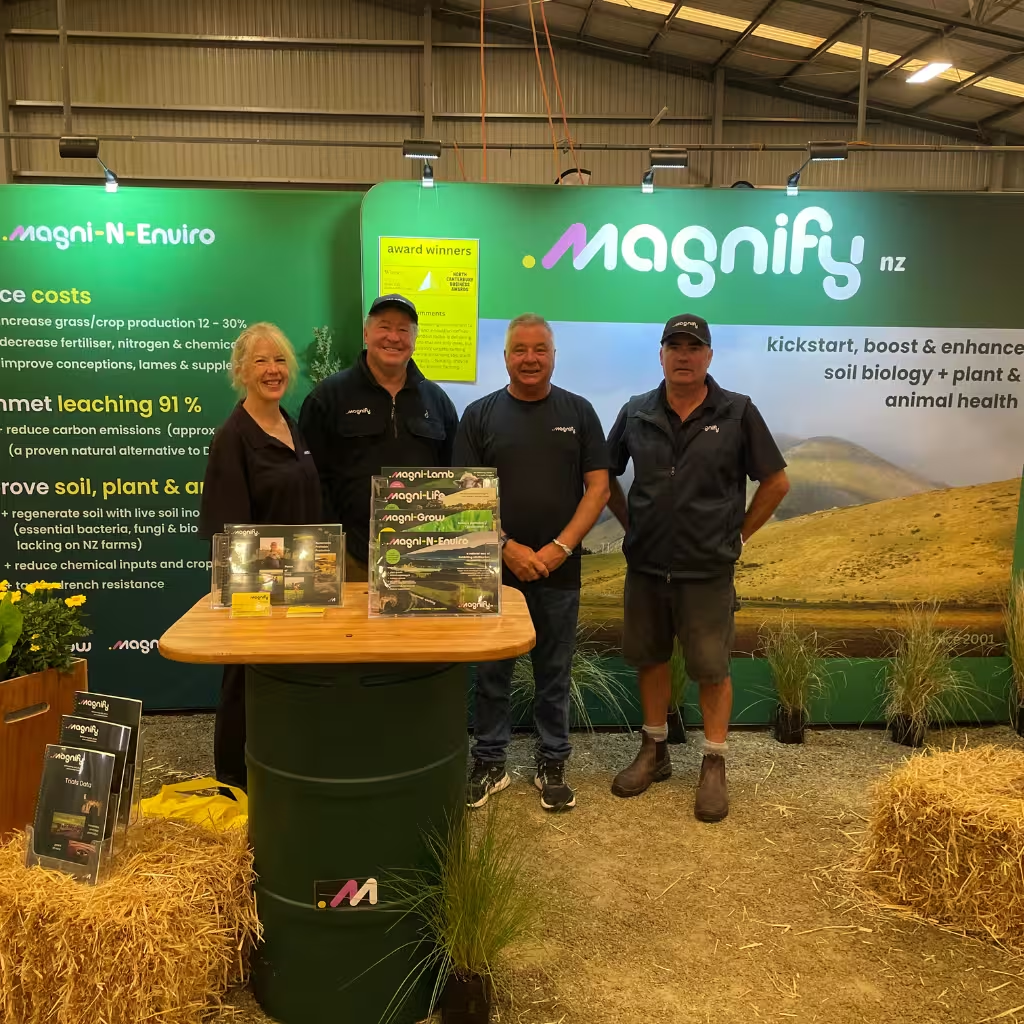
MagnifyNZ manufactures and sells inoculants, living beneficial bacteria and fungi, for soil, plants, and animals. The category isn’t new, and the market has no shortage of products making broad claims. What sets MagnifyNZ apart is the discipline behind checking those claims.
Soil bacterial populations shift throughout a single day; the dominant species at 9am aren’t necessarily dominant by afternoon. That makes it genuinely hard to know whether a biological product is working until it’s tested in real conditions over time. New sales reps are encouraged, by policy, to run field comparisons wherever they can, including head-to-head against competing products when the chance arises. Over years, that has built a clear picture of where MagnifyNZ’s products perform better and where they don’t, an honesty about performance that’s rarer in agricultural inputs than it should be.
Twenty-Four Years of Data, Now Going Global
MagnifyNZ has spent 24 years measuring. Four distinct breakthroughs in product performance have come out of that period, each shifting what the company believed was possible. The nitrate leaching study, the most recent and most significant, represents the culmination of that work, and Hobson believes it may be a world-leading result in its category.
The study has been published. The next phase is promotion and distribution, moving from a company whose results are known domestically to one whose results are accessible to farmers, distributors, and regulators in other markets. That’s a different kind of effort than product development.
What the company needs now are the partnerships to put that work in front of the right people. Twenty-four years of field work does not sell itself.
Growth That Cannot Happen Without Partners
MagnifyNZ’s direction for the next five years is continued growth, built on distribution partnerships. Without them, the product stays regional regardless of performance.
Building something that works is a scientific and agricultural problem. Building a distribution network across international markets is a commercial and relational one, with different skills and different risks. A company that spent two decades refining its biology now has to spend time on logistics, contracts, and market entry.
Fighting Resistance Without Fighting the Industry
The most persistent obstacle MagnifyNZ has faced is cultural rather than technical. An industry that has built its identity and economics around chemical inputs doesn’t welcome evidence that biological alternatives can deliver strong results. Farmers who have spent careers being told to add more fertiliser, more pesticide, more intervention, aren’t immediately receptive to a company telling them to add living bacteria instead. The resistance is structural, not personal.
Regulatory timelines and industry-wide policy settings have also shaped how quickly farmers are willing to act, often favouring the status quo over proactive change, and that broader environment has made the shift slower than it might otherwise be.
Hobson’s response has been to find the farmers with a different mindset rather than fight the resistance head-on, publishing results in agricultural magazines and contributing to a conversation that’s slowly shifting. Others are pushing a similar message, and the cumulative effect is working, even if slowly.
The Advice No Business School Will Ever Give
Hobson’s advice centres on the limits of analytical thinking. Science has a long history of presenting rules that later turn out wrong or only partially right, and relying solely on left-brain analysis, the kind business schools treat as the primary tool of leadership, means missing most of what he’d call wisdom. The consequences of that gap tend to land on the generations that follow rather than the current one.
Large companies are a particular problem in his view. Government funding and policy support flows toward corporations and cooperatives that, by his estimate, are decades behind small innovative businesses in their thinking, a result of institutions optimising for scale and maintaining the status quo rather than outcomes.
The mindset that treats nature as a resource to be managed rather than a system to be understood is, in his framing, central to the climate crisis. It’s the context MagnifyNZ operates in every day. The line that’s become the company’s guiding logic: when you magnify nature, you magnify your future.