
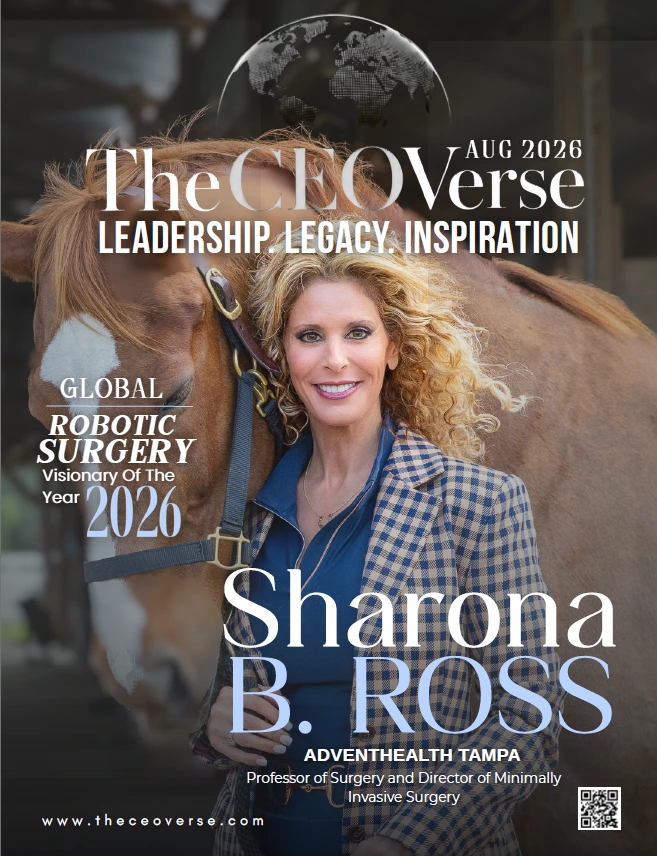
TheCEOVerse • Digital Edition
“Global Robotic Surgery Visionary Of The Year 2026”
Cover story
Sharona B. Ross
Featured Profile - Sharona B. Ross
Sharona B Ross: Shaping the Future of Surgery Through Fearless Innovation and Visionary Leadership
Some careers are defined by milestones while others are defined by mindsets. Dr. Ross belongs to the latter category. A rare class of leaders whose influence cannot be measured solely by the positions they have held, the institutions they have served, or the innovations they have pioneered. Their true impact lies in changing the way an entire profession thinks.
For more than two decades, she has stood at the forefront of one of medicine’s most transformative eras. As robotic surgery, minimally invasive procedures, artificial intelligence, and digital healthcare continue to reshape the future of medicine, she has emerged as one of the most respected voices ensuring that innovation never loses sight of its ultimate purpose: the patient.
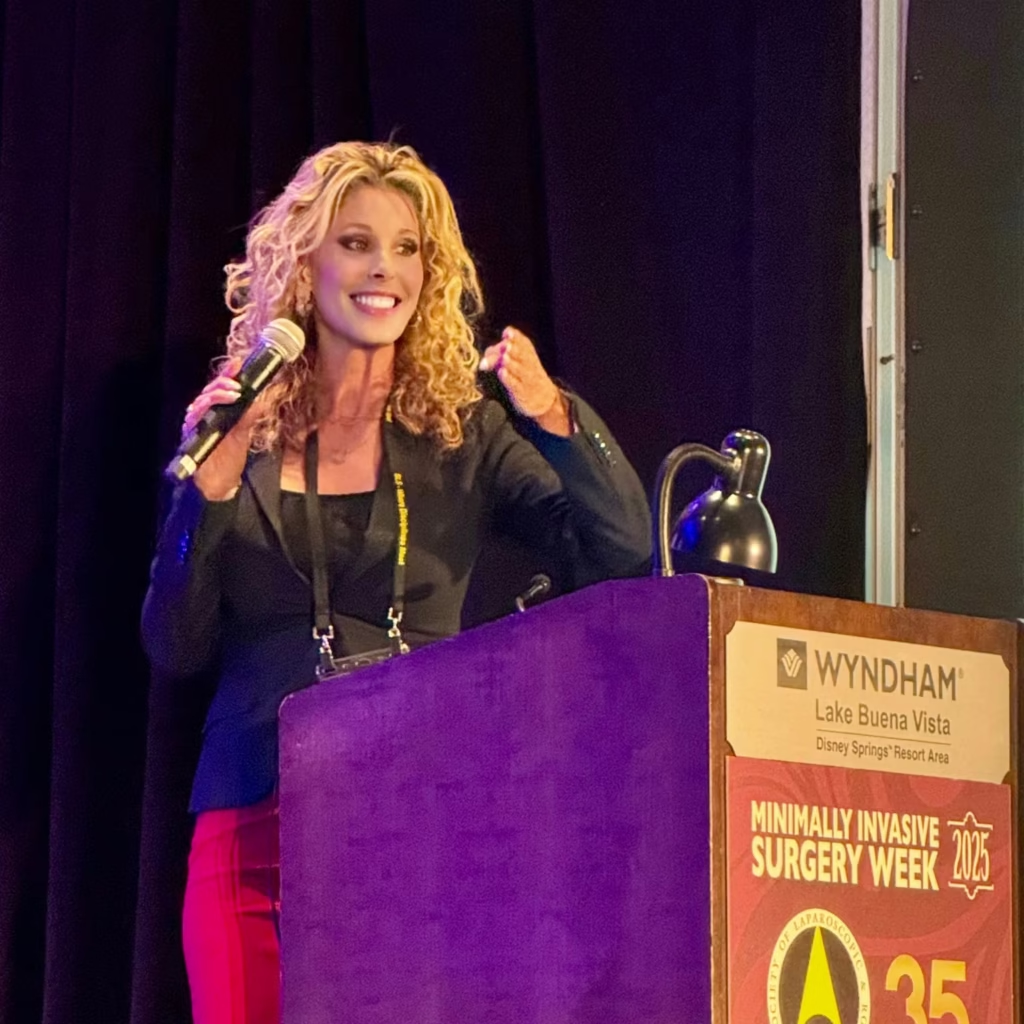
Today, she is recognized globally as a surgeon, educator, researcher, innovator, mentor, and healthcare leader. Serving as President of the Society of Laparoscopic and Robotic Surgeons, Past President of the Society of Robotic Surgery, Professor of Surgery, Director of Advanced GI and HPB Fellowship Programs, and an internationally respected authority in advanced minimally invasive surgery, her contributions extend far beyond the operating room. They influence how future surgeons are trained, how emerging technologies are evaluated, and how healthcare systems prepare for the next generation of surgical excellence.
Yet to define Dr. Ross solely by an impressive collection of leadership positions would overlook the very essence of her journey. Her life’s work has never been about mastering technology. It has been about redefining humanity through technology. That distinction has quietly become the foundation upon which her entire career has been built.
Innovation Begins with Empathy
The modern world often celebrates innovation as an end in itself. Healthcare, perhaps more than any other industry, is captivated by the promise of robotics, artificial intelligence, digital surgery, machine learning, and precision medicine. Every year introduces newer platforms, faster systems, and increasingly sophisticated technologies designed to improve surgical outcomes. Dr. Ross welcomes this evolution. But she also challenges its priorities.
Throughout her career, she has consistently argued that innovation should never begin with technology. It should begin with a patient. That philosophy has become the intellectual compass behind every initiative she has pursued. Whether pioneering minimally invasive surgical techniques, advancing robotic-assisted procedures, leading multidisciplinary collaborations, or mentoring future surgeons, she has remained committed to a deceptively simple question:
Patient-centric Focus
If innovation cannot reduce suffering, restore dignity, improve recovery, or make surgery safer, then technological sophistication alone holds little meaning. This perspective has distinguished Dr. Ross throughout a profession where innovation is often measured by novelty rather than necessity.
For her, the most successful medical breakthrough is not the one that receives the greatest recognition. It is the one patients may never fully notice because it quietly makes their recovery easier, their pain less severe, and their confidence stronger. That is the kind of innovation she has dedicated her career to creating.
Redefining What Surgical Leadership Means
Few physicians successfully navigate the worlds of clinical excellence, academic research, organizational leadership, technological innovation, and global education simultaneously. She has spent her career intentionally refusing to choose between them.
Her leadership philosophy is rooted in the belief that modern medicine cannot evolve through isolated expertise. The future belongs to collaborative intelligence where surgeons, engineers, researchers, scientists, educators, healthcare executives, and technology developers work together toward a common objective. Not innovation for innovation’s sake. Innovation for better patient care.
This philosophy explains why her influence extends well beyond the operating room. As an educator, she has trained future generations of surgeons to think critically rather than simply operate skillfully. As a researcher, she has contributed to advancing evidence-based surgical practice. As a leader of international surgical societies, she has helped shape conversations surrounding robotics, digital surgery, surgical education, and healthcare innovation across continents.
As a mentor, she has invested as much energy in developing people as she has in developing procedures. These seemingly different roles are, in reality, expressions of a single belief: medicine advances fastest when knowledge is shared rather than protected.
Her numerous leadership positions across leading surgical organizations, academic institutions, and global professional societies reflect not only professional accomplishment but also a sustained commitment to advancing surgical science through education, collaboration, and innovation.
Building Legacies
There is an unmistakable consistency that runs throughout every stage of Dr. Ross’s professional life. Regardless of whether she is operating, teaching, speaking, researching, or leading an international organization, her focus remains remarkably unchanged.
She builds people. Ask her about success, and the conversation rarely centers on awards or recognition. Instead, she speaks about mentors. About colleagues. About multidisciplinary collaboration. About students who will eventually surpass their teachers. About creating environments where innovation becomes sustainable because leadership itself becomes transferable.
It is an unusually generous philosophy in an era often defined by individual achievement. She openly acknowledges that none of her accomplishments were achieved alone. Every advancement has been shaped by surgeons willing to share ideas. Scientists willing to challenge assumptions. Engineers determined to solve impossible problems. Industry partners committed to responsible innovation. Patients who entrusted her with their care. Family members whose unwavering support made extraordinary professional commitments possible.
When Life Rewrites the Teacher
There are moments in every remarkable career when professional knowledge collides with personal experience. For Dr. Ross, that moment arrived unexpectedly. After spending decades helping patients navigate some of the most challenging moments of their lives, she suddenly found herself confronting vulnerability from the opposite side of medicine.
A devastating bicycle accident transformed one of America’s leading surgeons into a critically injured patient almost overnight. For someone whose professional identity had been built upon precision, control, resilience, and service, the experience altered far more than her physical condition.
It transformed her perspective. Recovery became more than rehabilitation. It became education. The experience reinforced something she had always believed intellectually but would now understand personally: that healing extends far beyond successful procedures. Patients carry fear, uncertainty, hope, frustration, and resilience into every stage of recovery.
Experiencing that reality firsthand deepened her empathy and strengthened her conviction that exceptional healthcare is measured not only by clinical outcomes but also by the compassion with which those outcomes are delivered. The accident, as she has reflected, renewed her gratitude for family, colleagues, mentors, and the privilege of practicing medicine while reaffirming that resilience is discovered through purpose rather than comfort.
That experience would become one of the defining chapters of her life not because it interrupted her career, but because it refined her purpose. The surgeon who had spent decades transforming the future of surgery would emerge with an even deeper understanding of the people she had devoted her life to serving. And in doing so, she would begin writing the most meaningful chapter of her remarkable journey one not defined solely by innovation, but by resilience, humanity, and an unwavering belief that medicine’s greatest advances will always begin with compassion.
Where Innovation Starts Saving Lives
Medicine has always progressed through curiosity. Every breakthrough that transformed healthcare from anaesthesia and antibiotics to laparoscopic surgery and organ transplantation began with someone willing to ask a difficult question: Can this be done better? For Dr. Sharona B. Ross, that question has served as the driving force behind an entire career dedicated to challenging convention not to disrupt medicine for the sake of novelty, but to improve the experience of those who place their lives in the hands of a surgeon.
Innovation, in her world, is never measured by complexity. It is measured by compassion. Throughout her career, she has remained remarkably consistent in her belief that the purpose of technology is not to impress physicians but to empower patients. The operating room may continue evolving with robotics, artificial intelligence, augmented visualization, and digital decision-support systems, yet the objective remains timeless: safer procedures, faster recoveries, fewer complications, and better quality of life.
That unwavering patient-first philosophy has allowed Dr. Ross to become one of the leading architects of modern minimally invasive and robotic surgery, a field that has fundamentally changed surgical care across the globe.
While many view robotic surgery as one of healthcare’s newest technological frontiers, she sees it differently. For her, robotics is simply another instrument. The surgeon’s judgment, experience, ethics, and compassion remain irreplaceable. Technology may extend the surgeon’s capabilities. It should never replace the surgeon’s responsibility.
Leading the Evolution of Modern Surgery
The evolution of surgery has never been solely about developing better instruments. It has always been about developing better outcomes. This distinction explains why Dr. Ross’s contributions extend beyond mastering sophisticated surgical platforms. Her influence lies equally in helping define how these technologies should be integrated into clinical practice, evaluated through evidence, and taught to future generations.
As one of the early pioneers in advanced minimally invasive and robotic surgery, she has consistently worked at the intersection of clinical expertise and technological advancement. Her practice encompasses some of the most technically demanding procedures involving the foregut, pancreas, liver, biliary tract, stomach, adrenal glands, and gastrointestinal system areas where precision is not simply desirable but essential. Her work has contributed to expanding the possibilities of minimally invasive surgery while improving recovery times, reducing postoperative complications, and enhancing patient outcomes.
Power of Collective Intelligence
History rarely remembers breakthroughs exactly as they occurred. There is often a tendency to attribute revolutionary progress to a single visionary individual. Healthcare tells a different story. Every meaningful advancement emerges through collaboration. Dr. Ross has spent much of her professional life building precisely these collaborative ecosystems.
Surgeons contribute clinical insight. Biomedical engineers translate those insights into technology. Scientists validate new concepts through rigorous research. Industry partners develop scalable solutions. Healthcare organizations create pathways for implementation. Educators ensure knowledge reaches future generations.
Only when every discipline contributes does innovation become sustainable. This multidisciplinary philosophy has become one of the defining characteristics of her leadership. Rather than positioning surgeons as passive users of technology, she has consistently advocated for physicians to become active participants in designing the future of medicine. Surgeons understand nuances that algorithms cannot yet appreciate. They recognize subtle anatomical variations. They anticipate complications before they occur. They appreciate emotional realities invisible within data. Without their voices, innovation risks becoming technologically brilliant but clinically disconnected.
For this reason, Dr. Ross has repeatedly emphasized that surgeons deserve a meaningful seat at the innovation table not because they resist change, but because they ensure change remains grounded in patient care. It is a philosophy that continues influencing collaborations between healthcare institutions, academic centers, technology developers, and medical industries worldwide.
Education as the Highest Form of Leadership
There is an interesting paradox surrounding expertise. The more accomplished an individual becomes, the greater the temptation to protect knowledge. She has spent her career doing precisely the opposite. She believes knowledge acquires its greatest value only when it is shared. Her role as Fellowship Director, Professor of Surgery, international lecturer, researcher, and mentor reflects this conviction.
Operating successfully on hundreds or thousands of patients creates impact. Teaching hundreds of surgeons who will collectively care for hundreds of thousands creates transformation. This multiplier effect has become central to her life’s work. Inside operating rooms, lecture halls, simulation laboratories, and international conferences, she has helped cultivate a generation of surgeons capable of combining technical precision with thoughtful decision-making.
Her mentorship extends beyond procedural instruction. She encourages younger physicians to remain intellectually curious. To question assumptions. To embrace constructive criticism. To understand that excellence in surgery requires continuous learning rather than permanent certainty. As medicine becomes increasingly specialized, Dr. Ross believes future leaders will need more than exceptional technical skills. They must become communicators.
Innovation with a Human Face
Perhaps the greatest misconception surrounding technological advancement is the belief that machines inevitably diminish human connection. Dr. Ross believes precisely the opposite. When thoughtfully implemented, innovation creates more space for humanity. Less postoperative pain means patients spend less time suffering. Smaller incisions often translate into quicker recoveries. Greater surgical precision can reduce complications. Better visualization allows surgeons to operate with increased confidence. Digital technologies can improve decision-making while enhancing patient safety. Each technological advancement ultimately serves one purpose.
Helping people return to their families, careers, and everyday lives sooner. This perspective explains why she has never viewed robotics as an engineering achievement alone. She sees it as an extension of compassionate care. Technology, in her philosophy, should never become the center of healthcare. Patients remain the center. Everything else revolves around them. That conviction has become even more relevant as artificial intelligence begins reshaping clinical decision-making across healthcare.
Preparing Surgery for Tomorrow
Few periods in medical history have witnessed technological acceleration comparable to the present. Artificial intelligence is becoming increasingly integrated into diagnostics. Digital platforms are reshaping surgical planning. Robotic systems continue expanding procedural capabilities. Predictive analytics are enhancing clinical decision-making.
Yet despite these extraordinary developments, Dr. Ross remains convinced that the defining challenge of future healthcare will not be technological capability. It will be human wisdom. The future belongs not to those who simply invent new tools. It belongs to those who understand when, why, and for whom those tools should be used. That philosophy has become the hallmark of her leadership.
It is why colleagues across disciplines value not only her surgical expertise but also her ability to unite innovation with responsibility. It is why students view her not simply as an accomplished surgeon but as a mentor who teaches them how to think rather than merely what to do. And it is why patients continue to remain at the very heart of every innovation she champions. For Dr. Sharona B. Ross, the future of surgery is unquestionably exciting. But it will never be defined by robotics alone. Nor by artificial intelligence. Nor by digital platforms. Its true legacy will be determined by whether these remarkable advances continue to preserve the one element medicine can never afford to lose: its humanity.
When the Healer Needed Healing
For physicians, healing is often viewed through the lens of responsibility. For someone whose identity had long been intertwined with caring for others, the sudden shift from caregiver to care recipient challenged assumptions that years of medical experience alone could never have revealed. Recovery demanded a different kind of courage one that required patience instead of control, vulnerability instead of certainty, and trust instead of expertise.
It would become one of the most defining chapters of her life. Not because it interrupted her journey. But because it deepened it.
The accident and subsequent recovery profoundly reshaped Dr. Ross’s perspective on resilience, leadership, and patient care, reinforcing her commitment to compassion while inspiring the philosophy behind her forthcoming book, Sustainable Excellence.
Redefining Strength Through Vulnerability
Modern leadership often celebrates resilience as an ability to remain unaffected by adversity. Dr. Ross’s journey offers a very different understanding. Resilience is not the absence of hardship. It is the willingness to be transformed by it.
Before the accident, empathy had always been central to her surgical practice. She understood fear because she had witnessed it in thousands of patients. She appreciated uncertainty because she had helped families navigate it every day. But becoming a patient herself introduced an entirely different dimension. She experienced the emotional vulnerability that accompanies dependency. She understood firsthand the quiet anxiety that exists between diagnosis and recovery. She rediscovered the profound comfort offered by a physician who listens before speaking. These experiences did not change her philosophy.
They strengthened it. Returning to surgery after such a life-altering event required far more than physical rehabilitation. It demanded renewed confidence, extraordinary discipline, and an unwavering commitment to reclaiming the profession she loved. Yet rather than viewing recovery as a return to her previous life, she embraced it as an opportunity to become an even more compassionate surgeon, educator, and leader.
The experience reminded her that every patient carries an invisible story into the operating room. Pain is rarely confined to anatomy. Healing is rarely confined to medicine. True care requires acknowledging both. It is this deeper understanding that now informs every interaction she has with patients, students, colleagues, and future surgeons.
Changing Surgery by Changing Its Culture
Throughout history, surgery has often been associated with technical mastery, endurance, and unwavering confidence. These qualities remain essential. Yet Dr. Ross believes the future of surgical leadership requires something more. It requires humanity.
Her vision extends beyond advancing robotic platforms or refining minimally invasive techniques. She is equally committed to reshaping the culture surrounding surgical education and professional development. This commitment is perhaps most evident in her unwavering advocacy for women in surgery.
Long before diversity became a widely discussed leadership priority, Dr. Ross recognized that countless talented young women were quietly choosing different career paths not because they lacked capability, but because they lacked visible examples of what was possible. Rather than simply acknowledging the problem, she decided to build solutions.
She founded the Women in Surgery Initiative, creating opportunities for mentorship, professional guidance, and meaningful conversations around the realities of surgical careers. Soon followed the Women in Surgery Career Symposium, where aspiring surgeons could engage directly with experienced professionals, challenge outdated stereotypes, and begin imagining themselves within a profession that had historically appeared inaccessible.
Recognizing that mentorship should not be limited by geography, she later expanded these efforts through the Women in Surgery & Innovation App, providing aspiring surgeons with direct access to educational resources, research opportunities, mentors, and peer networks across the globe. These initiatives reflect her belief that leadership is measured not only by personal success but by the opportunities created for others. Empowering women is not about creating separate pathways. It is about ensuring every talented individual has the opportunity to walk through the same doors.

The Multiplier Effect of Mentorship
Every accomplished leader can usually identify someone who believed in them before the world did. Dr. Ross often speaks with profound gratitude about the mentors who shaped her career. They challenged her thinking. Expanded her perspective. Demanded excellence. Most importantly, they demonstrated that leadership is less about authority than about service.
Those lessons now define her own approach to mentorship. She encourages young physicians to remain intellectually restless. To ask difficult questions. To welcome criticism. To pursue excellence without sacrificing kindness. Technical brilliance may earn professional recognition. Character earns trust. In many ways, she sees mentorship as medicine’s greatest investment. Every student she teaches will eventually teach another. Every fellow she trains will influence thousands of future patients. Every young surgeon encouraged to pursue innovation responsibly becomes another steward of the profession’s future.
Knowledge, when shared generously, becomes exponential. This explains why she continues dedicating extraordinary energy to education despite an already demanding clinical and leadership schedule. She understands that the future of surgery will never depend solely on today’s innovators. It will depend on tomorrow’s leaders.
Success That Outlives Achievement
Professional recognition occupies a curious place within Dr. Ross’s philosophy. She deeply appreciates the honors she has received. But she does not mistake recognition for purpose. Awards celebrate the past. Purpose builds the future. Throughout her career, she has consistently emphasized that no meaningful accomplishment belongs to a single individual.
Every innovation has emerged through collaboration. Trusted colleagues have strengthened every leadership opportunity. Family, friends, mentors, students, and patients have supported every professional milestone. This perspective explains why humility remains one of the defining characteristics of her leadership.
Despite her extraordinary achievements, she continues describing herself as “a student of medicine.” It is not modesty. It is conviction. Medicine evolves too quickly for certainty. The most accomplished physicians remain lifelong learners. That mindset continues to drive her work today, whether advancing robotic surgery, mentoring future leaders, developing educational initiatives, or contributing to global conversations about the future of healthcare.
A Legacy Written Through People
There is an important distinction between building a career and building a legacy. A career measures personal achievement. A legacy measures collective transformation. Dr. Ross has spent her professional life pursuing the latter. Her surgical innovations have advanced patient care. Her leadership has influenced international surgical organizations. Her research has expanded scientific understanding.
Her educational initiatives have shaped future generations. Her advocacy has opened doors for countless women pursuing careers in surgery. Yet if asked how she hopes to be remembered, the answer is remarkably simple. Not for the procedures she perfected. Not for the positions she held. Not even for the technologies she helped advance. She hopes to be remembered for the people she inspired.
For the surgeons who became better teachers. For the students who became courageous innovators. For the colleagues who discovered the power of collaboration. For the patients whose lives were improved not only through technical excellence but through compassion.
Because in the end, she believes the greatest innovation in medicine will never be found inside a machine. It will always be found within the people courageous enough to use knowledge in the service of humanity. And perhaps that is the truest measure of leadership, not how many lives one touches personally, but how many future healers one inspires to continue the work long after one’s own hands have left the operating room.
Designing the Future Without Losing the Human Touch
Every era of medicine is remembered by its defining breakthroughs. The nineteenth century transformed surgery through anesthesia. The twentieth century revolutionized it through antibiotics, imaging, and organ transplantation. The twenty-first century is witnessing another extraordinary transformation, one powered by robotics, artificial intelligence, digital platforms, predictive analytics, and unprecedented computational capabilities.
The possibilities are remarkable. Machines can process data at unimaginable speeds. Artificial intelligence can identify patterns invisible to the human eye. Digital technologies are reshaping diagnostics, surgical planning, and clinical decision-making. Operating rooms are becoming increasingly intelligent, interconnected, and data-driven. To many, these innovations represent the future of healthcare. They represent something slightly different. They are tools.
The future of surgery, she believes, will never be determined by the sophistication of its technology alone. It will be determined by the wisdom with which that technology is applied. Throughout her career, Dr. Ross has embraced innovation with extraordinary enthusiasm, while simultaneously advocating for something equally important: responsibility.
Innovation without evidence can compromise trust. Innovation without ethics can compromise safety. Innovation without compassion can compromise medicine itself. That balance has become one of the defining characteristics of her leadership. She has consistently reminded colleagues across the global surgical community that technology should never dictate the future of healthcare. Patients should.
The Human Mind Behind Artificial Intelligence
Few industries are experiencing technological disruption as rapidly as healthcare. Artificial intelligence is now capable of supporting diagnosis, predicting surgical outcomes, analyzing imaging, optimizing workflows, and assisting physicians in ways that were unimaginable only a few years ago.
The excitement is justified. So is the responsibility. Rather than viewing AI as a replacement for clinical expertise, she sees it as an extension of human capability. Algorithms may recognize patterns. Robots may enhance precision. Digital systems may improve efficiency. Yet none of these innovations can replicate intuition developed through decades of experience. None can comfort an anxious patient before surgery. None can inspire confidence through empathy. None can replace the moral judgment required when every decision carries profound human consequences.
Medicine has always combined science with humanity. The science continues evolving. The humanity must remain constant. This conviction explains why Dr. Ross continues advocating for thoughtful integration of emerging technologies rather than unquestioning adoption. Progress should always be guided by clinical evidence, multidisciplinary collaboration, ethical responsibility, and measurable improvements in patient outcomes. The ultimate objective is not technological sophistication, but safer, more compassionate, and more effective care for every patient.