
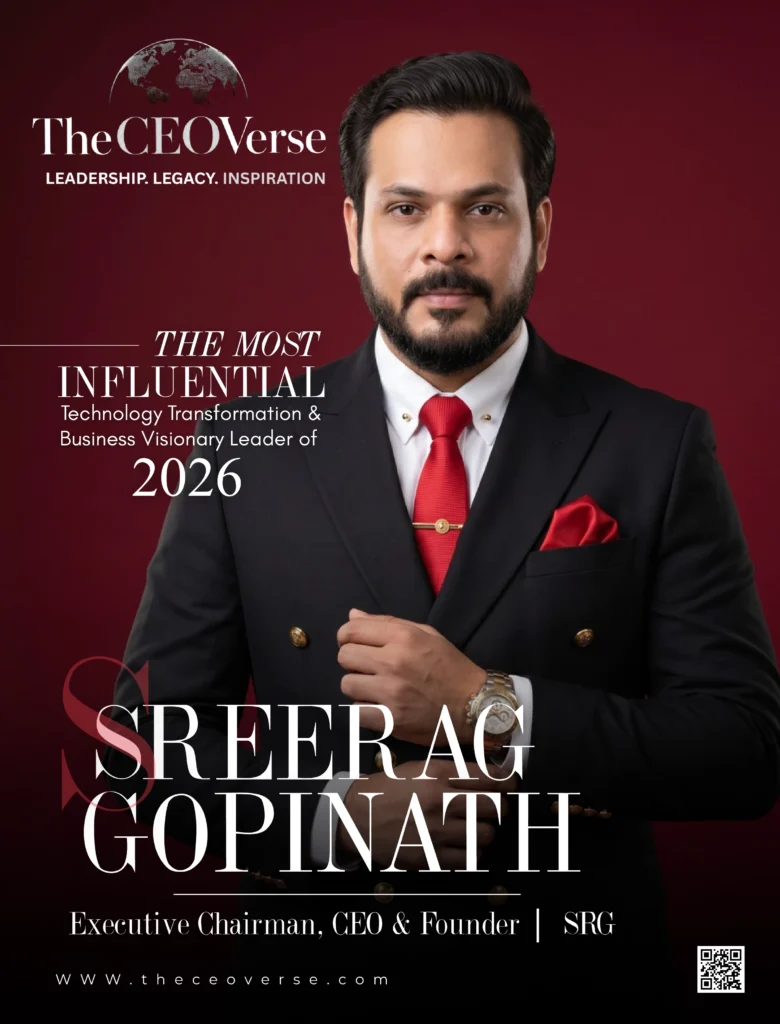
TheCEOVerse • Digital Edition
“The Most Influential Technology Transformation & Business Visionary Leader of 2026”
Cover story
Sreerag Gopinath
Featured Profile - Sreerag Gopinath
Sreerag Gopinath P C: Building the Enterprise Beyond Conventional Limits
Some careers are defined by titles. Others are defined by the questions they teach a leader to ask. For Sreerag Gopinath P C, the defining question has been how to make an organization more intelligent. That distinction sits at the heart of his professional journey and, ultimately, at the heart of SRG. As Executive Chairman, CEO & Founder of SRG, he brings together disciplines that businesses have traditionally kept apart: technology and strategy, cybersecurity and innovation, analytical rigor and creative design, human judgment and artificial intelligence. His conviction is that the next generation of enterprise will not be created by adding technology to yesterday’s structures. It will be created by rethinking the structure itself. That conviction did not emerge from a single moment.
It was built over nearly two decades of professional experience spanning India, the United States, and Japan, through increasingly complex technology environments, global programs, enterprise transformations, and leadership responsibilities. His career progressed from hands-on technical work and cybersecurity to program governance, portfolio management, enterprise strategy, and executive decision-making. Each stage offered a different view of how organizations function and, equally importantly, where they struggle to convert capability into sustained advantage.
Over time, one realization became increasingly clear: organizations do not necessarily become more capable simply because they become larger.
They become more capable when their intelligence, people, systems, and decisions work in concert. That insight became the foundation for SRG.
A Career Designed by Curiosity
Sreerag’s professional evolution is significant because it was not confined to one corner of the technology ecosystem. He developed technical depth, but continued moving toward the larger business picture. Software and cybersecurity provided an understanding of the systems beneath enterprise operations. Global program and portfolio responsibilities introduced the realities of execution, governance, resources, and competing priorities. Executive strategy brought those dimensions together and demanded an understanding of the organization as a whole. The result was a form of leadership built across the enterprise continuum.
He was habitual to constantly examining what happened when technology, strategy, people, processes, and creativity were designed to reinforce one another. That perspective matters in today’s business environment. Technology is advancing at a pace that makes conventional organizational boundaries increasingly difficult to maintain. Artificial intelligence can analyze information continuously, automate processes, identify patterns, support decisions, and create new forms of productivity. Yet the existence of powerful technology does not automatically produce a powerful enterprise.
Sreerag’s response to this changing environment was not to view AI as another technology category. He began thinking about it as a foundational component of the enterprise itself. That distinction would become central to SRG.
Initiating SRG
SRG was born from the belief that the enterprise of the future needs a different operating architecture. Conventional digital transformation often focuses on improving an existing process, modernizing a legacy system, or adding technology to a business that was fundamentally designed around older assumptions. Sreerag’s proposition is more ambitious. He asks questions like:
- What if intelligence were considered part of the enterprise’s foundation from the beginning?
- What if AI did not sit at the edge of the organization, waiting to be called upon for individual tasks, but operated as a native layer of organizational capability?
- What if cybersecurity was designed into products and operations rather than treated as an additional safeguard?
- What if strategic thinking and creative communication were treated as complementary rather than separate?
- What if every successful operating method could be captured and transformed into a repeatable system?
These questions form the architecture behind SRG.
The company brings artificial intelligence, enterprise strategy, cybersecurity, operational frameworks, creative design, and human capability into a unified model. AI functions as what Sreerag describes as native “Staff” and “Stratagem,” supporting autonomous operations, real-time alignment, proactive decision-making, and risk mitigation.
But the objective is not to create a business where machines replace people.

Rethinking the Meaning of Scale
Perhaps the most important idea in Sreerag’s worldview is that scale and headcount are not synonymous. For generations, businesses have associated scale with organizational expansion. More customers meant more employees. More markets meant more offices. More revenue meant more layers of management. AI-native enterprises challenge that equation.
A highly capable individual equipped with intelligent systems can potentially accomplish work that once required an entire team. A three-person organization with the right technology, intellectual property, automation, partnerships, and operating architecture can reach markets and create value at a level that would previously have required substantially greater human infrastructure.
In an AI-native enterprise, human capability can become the scarce and therefore most valuable resource. Leaders can concentrate on judgment, creativity, relationships, strategic decisions, and innovation while intelligent systems absorb increasing amounts of repetitive analysis and operational coordination. The result is a different relationship between organizational size and organizational impact. A company does not necessarily have to become larger to become more powerful. It needs to become more intelligent.
This is also why Sreerag places such emphasis on codification. If an organization discovers an effective way of solving a problem, that knowledge should not remain dependent on the individual who discovered it. It should become a playbook, framework, workflow, or intelligent system that can be reproduced.
Turning Experience into Institutional Intelligence
The philosophy of codification is rooted in something Sreerag learned throughout his career: exceptional performance cannot depend permanently on individual heroics. That requires converting experience into institutional intelligence. At SRG, this principle informs the development of repeatable and scalable playbooks. Operational knowledge is intended to become part of the system rather than remain locked inside individual expertise.
The idea is especially relevant in an AI-first environment.
Artificial intelligence can execute based on information, but its effectiveness depends on the quality of the systems surrounding it. If organizational knowledge is fragmented, decision-making becomes fragmented. If processes are unclear, automation simply accelerates confusion. Codification therefore becomes a prerequisite for intelligent scale.
Where Technology Meets Imagination
There is another dimension to Sreerag’s approach that distinguishes SRG from a conventional technology narrative. He does not see analytical excellence and creative excellence as opposing forces. The modern enterprise has historically separated them. Strategy belongs to one room. Technology belongs to another. Branding and creative work enter later to communicate what has already been decided. SRG approaches the relationship differently.
Its “SRG-Design” philosophy brings strategic rigor together with high-impact visual storytelling, drawing inspiration from the sophistication of the entertainment industry while maintaining enterprise discipline. The objective is not visual spectacle for its own sake. It is to make strategic ideas clearer, more compelling, and more capable of influencing markets. This is important because leadership is ultimately an exercise in communication.
A strategy that exists only inside a spreadsheet cannot mobilize an organization. A technically sophisticated product that cannot establish an emotional connection may struggle to become a category leader. The fusion of art and science therefore becomes strategic rather than decorative.

The Architecture of an AI-Native Enterprise
Sreerag’s approach is not limited to putting AI into existing workflows. It involves rethinking the relationship between intelligence and execution. At SRG, AI is positioned at the core of organizational intelligence, supporting autonomous operations, proactive decision-making, continuous analysis, and risk mitigation. Alongside it sits a governance model designed to balance plan-driven discipline with agile speed and adaptability. Cybersecurity is integrated into product architecture rather than treated as an afterthought.
This combination reflects a broader belief: intelligence without governance can create risk, while governance without adaptability can create inertia. The modern enterprise needs both. It needs enough structure to maintain accountability and enough flexibility to respond to change. It needs enough technology to accelerate execution and enough judgment to determine where acceleration is appropriate.
It needs enough automation to remove friction and enough human involvement to preserve context. His model attempts to hold those tensions together rather than resolving them by choosing one side.
Leadership Is an Ecosystem
The story behind SRG is also a story about people. He is clear that leadership is never created in isolation. His journey has been influenced by family and early mentors who established foundations of work ethic, intellectual curiosity, resilience, and integrity. Later, senior leaders across organizations including Oracle, KPMG, and Wipro entrusted him with significant portfolios and global transformations, challenging him to develop greater strategic discipline and clarity.
Those experiences were complemented by teams of engineers, project managers, strategists, designers, and collaborators. This is where his concept of “Tribes” becomes significant.
Traditional organizational structures often divide people according to function. A strategist may sit with strategists. Engineers collaborate primarily with engineers. Designers are brought into projects at a later stage. Sreerag’s model seeks to remove those boundaries.
Cross-functional teams can bring technical intelligence, strategy, project execution, and creative thinking into the same environment. The purpose is not merely collaboration.
Partnerships That Expand Possibility
The same principle applies beyond SRG’s internal structure. Sreerag views partnerships as an essential part of building a modern enterprise network. The source material describes a model that moves beyond conventional vendor-client relationships toward long-term, mutually beneficial alliances across national and cultural boundaries.
This is increasingly relevant in an AI-driven economy. No single organization will possess every technology, skill, market relationship, or form of expertise required to innovate continuously. The winning enterprise may therefore be the one that can orchestrate the strongest ecosystem. That means knowing what should be built internally. Scale emerges from orchestration.

The Recognition of a Larger Direction
Sreerag’s recognition among the Most Inspiring CEOs of 2025 by The Portfolio Magazine arrives against this broader backdrop. For him, the value of recognition is less about celebrating a finished achievement and more about reinforcing responsibility and momentum. Leadership at this level cannot be separated from stewardship. Recognition raises expectations. It creates an obligation to continue evolving and, equally importantly, to share knowledge with the leaders who are coming next.
Professionally, the recognition also arrives as SRG continues developing its broader product vision. The questionnaire notes that 18 of 31 envisioned product initiatives have already been developed, including platforms such as SRG Enterprise-Next.
That trajectory reflects the larger ambition behind the organization: moving beyond advisory thinking toward building tangible capabilities that can help enterprises address operational bottlenecks and rethink what they can achieve.
The Human at the Center of a Machine
For all the discussion surrounding artificial intelligence, perhaps the most human aspect of Sreerag’s philosophy is his insistence that AI should expand human capability rather than eliminate human judgment. It may be a competition between organizations that know how to combine them effectively and those that do not. This is where Sreerag’s concept of digital maturity becomes more interesting than a simple measure of technological sophistication.
An organization is not digitally mature merely because it possesses advanced technology. It is digitally mature when technology enables people to think better, decide faster, create more freely, manage risk more intelligently, and operate with greater clarity. That is the standard SRG seeks to pursue.
A New Definition of Leadership
His professional journey can ultimately be understood as a progression in perspective. He began close to the technology itself. He moved toward understanding the enterprise around it. He learned to navigate complex global initiatives and also developed an appreciation for governance, strategy, resilience, and execution. He saw the limitations of fragmented organizational thinking and recognized the transformative potential of artificial intelligence.
SRG brings together disciplines that are usually separated. It treats AI as native capability rather than peripheral software. It treats codification as a mechanism for turning individual excellence into institutional strength. It treats creative design as part of strategic influence. It treats cybersecurity as foundational. It treats partnerships as extensions of capability. And it treats human judgment as something technology should amplify, not replace.
The implications extend beyond one organization. They point toward a broader shift in how enterprises may be built. In that future, the most important measure of scale may not be the number of employees. It may be the amount of value a small group of exceptional people can create. The most important technology may not be the one with the longest feature list. It may be the one that disappears into the operating fabric of the organization and makes everything around it more intelligent.
The strongest leader may not be the person who controls the most people. It may be the person who can bring together human judgment, technology, creativity, and purpose with enough clarity to make all of them more powerful. That is the direction Sreerag Gopinath P C is pursuing. SRG has already moved from concept to architecture, from architecture to products, and from products toward a broader enterprise vision. With 18 of 31 envisioned product initiatives developed, the next stage is increasingly about translating that architecture into market impact. The question now is not whether technology will reshape the enterprise. Protect what matters. Give creativity a seat at the strategic table. Let AI expand human capability.