
TheCEOVerse • Digital Edition
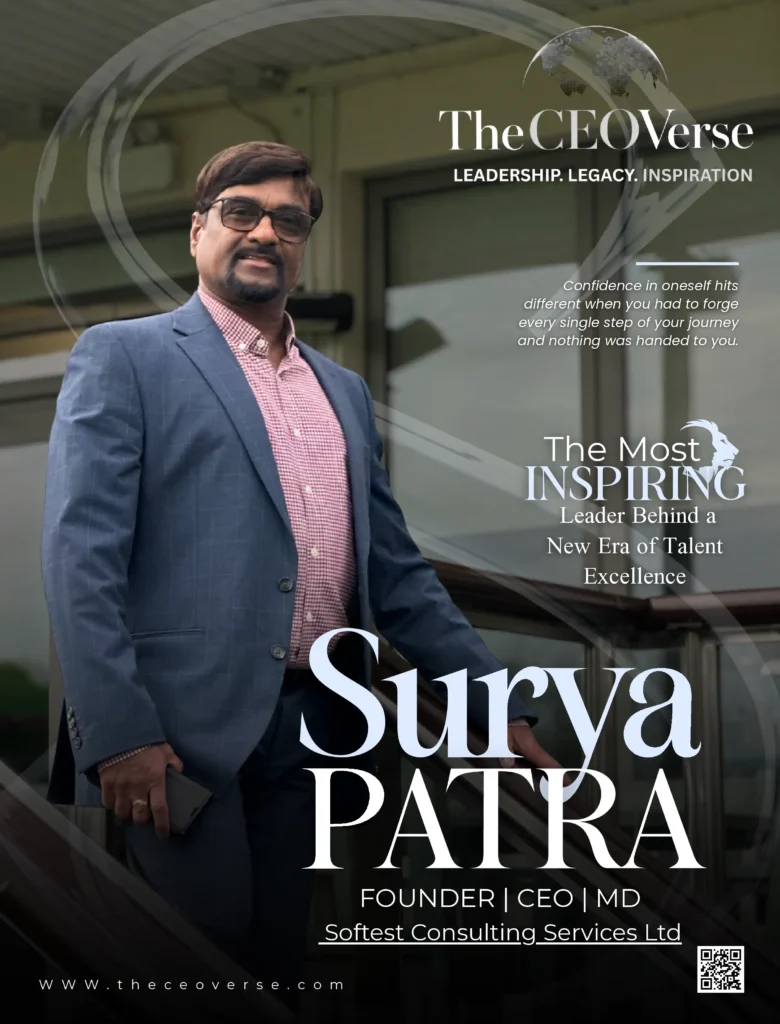
“The Most Inspiring Leader Behind a New Era of Talent Excellence”
Cover story
Surya Patra
Featured Profile - Surya Patra
Surya Patra: The Inspirational Leader Behind a New Era of Talent And Excellence In 2026
Confidence in oneself hits different when you had to forge every single step of your journey and nothing was handed to you. Surya Patra, Founder, CEO and Managing Director of Softest Consulting Services Limited, carries that confidence with the unbreakable poise of someone who is the sole author of their own resilience. That kind of certainty doesn’t announce itself in the way he speaks or the way he leads his six country recruitment business from Dublin. It shows up instead in the patience of a man who has spent more than three decades starting over in new industries, new countries, and new versions of himself. And who has come to see that pattern not as instability, but as the very engine of his growth.
Today, Surya sits at the helm of a company that has grown its client base fourfold since 2022, expanded revenue by 180 percent in three years, and sustained a 94 percent client retention rate across markets as different as Dublin and London. He was recently named Entrepreneur of the Year 2026 by the Confederation of Indian Communities in Ireland, has been counted among the Top 10 Indian Business Leaders in Europe, and has been profiled by Enterprise World and Business Today Global. Yet ask him where his story really begins, and he doesn’t reach for any of that. He reaches instead for a small town called Banpur.
Where It All Began
Banpur is not a place that appears often in the biographies of European business leaders. It is a modest town in Odisha, India, where Surya grew up in a middle class household. One where, in his own words, “money was modest but the belief in education was not.” His parents made real sacrifices to keep their children in school properly, and that early arithmetic, that opportunity is something you earn rather than inherit, never left him. It became the operating principle of everything that followed.
He trained as a mechanical engineer, a degree that shaped him less through what it taught him and more through how it taught him to think. Engineers, he says, are trained to take an intimidating problem and break it down into pieces small enough to actually solve. That instinct followed him into every job that came next, and there were many of them. Over more than thirty years, Surya worked his way across manufacturing, engineering, consulting, financial services, banking, telecoms, pharmaceuticals and software technology. First in India, then the UK, and eventually Ireland, picking up a CFA and an MBA along the way, on top of his original engineering qualification.
Each industry left its mark. Each one taught him a different language, a different definition of quality, and perhaps most importantly the discomfort of starting from zero again in front of a new team, a new market, a new set of expectations. By the time he settled in Ireland, Surya had spent years on both sides of a broken system. Watching good companies lose good people because hiring had become a transaction, a résumé matched mechanically to a job description. And living the other side of that transaction himself, as a first generation professional trying to be seen as more than a list of qualifications.
In 2018, in Dublin, those two experiences finally collided and became something concrete, namely Softest Consulting Services. Surya is careful about how he frames that moment. He didn’t set out to build a recruitment company so much as to build the kind of hiring relationship he wished he had received. One where a candidate’s potential counted for as much as the words on their CV. Everything that has happened since has been, in his telling, an attempt to make that idea real, one placement at a time.
From Struggle to Strength
If Banpur gave Surya his values, Dublin is where he had to prove they could survive contact with reality. The hardest chapter of his journey, he says without hesitation, was the first couple of years of building Softest as a first generation immigrant entrepreneur in a country that owed him nothing. Credibility isn’t handed over, it’s built one conversation, one placement, one kept promise at a time. All while learning an unfamiliar regulatory system, an unfamiliar business culture, and, as he puts it candidly, “a new way of being seen.” There is a specific pressure in being simultaneously the public face of your company and the outsider still earning a seat at the table.
Just as that footing was beginning to feel solid, COVID-19 arrived and tested everything at once. For more than a year, new business dried up almost entirely, and the business Softest already had was shrinking beneath its feet. It would have been easy, in that moment, to read the crisis as proof that the whole venture had been a mistake. Instead, Surya and his team used the enforced stillness to get disciplined. Studying the market more closely, building their brand quietly rather than loudly, and trusting that better conditions would eventually return. They didn’t simply survive the pandemic, they emerged from it with a sharper sense of exactly who they were and what they stood for.
What changed inside Surya during that period is, by his own admission, harder to describe than what changed in the company’s balance sheet. He stopped equating resilience with refusing to be shaken, and started understanding it instead as the discipline of learning faster than the market around him was changing. It reinforced a belief he still repeats to his team today. That persistence, consistency and perseverance are not clichés but compounding assets. Not long after those difficult early years, he says, Softest began to see daylight, and brighter times followed.
The Vision Behind the Innovation
Ask Surya what actually differentiates Softest in a crowded recruitment market, and he doesn’t point to a piece of software or a proprietary algorithm. He points to a refusal. The refusal to treat recruitment as a transaction. Much of the industry, he argues, is still built around matching keywords on a CV to keywords in a job description. Softest was built around a simpler, harder idea. The business is placing people, not filling positions, which means understanding a candidate’s story as much as their skillset, and a client’s culture and trajectory as much as their immediate vacancy.
That philosophy shows up in concrete habits. His teams go deep into a client’s business before a search ever opens, mapping where a company is headed technologically rather than just what it needs today. A necessity, given that the specialised technical talent Softest places across FinTech, InfoTech, banking and healthcare tends to be scarce and hard to source in the open market. With candidates, the firm behaves less like a vendor and more like a career partner, helping people prepare for interviews, negotiate offers and understand where the market is actually moving. Technology, in this model, is not the star of the show. It is the tool that frees Surya’s team from administrative drag so that time can flow back into the parts of the job no algorithm can replace. The conversations, the judgment calls, the read on cultural fit.
The results speak plainly enough. Between 2022 and 2025, Softest’s revenue grew 180 percent, its client base across Europe and the UK grew fourfold, and the company has held a 94 percent average client retention rate while operating across six countries. One case in particular illustrates the model in action. A mid-sized FinTech provider in Ireland, weighed down by legacy systems and fragmented data, saw its hiring time cut in half and its retention rise by 30 percent after Softest rebuilt how the company approached technical hiring. Numbers like that, Surya notes, only appear when the people placed genuinely want to stay. And that outcome, more than any internal process, is the real competitive edge.
That same conviction is why “people first” isn’t confined to paying clients at Softest. The firm runs free career advice, CV reviews and mentoring sessions for jobseekers who owe it nothing, and Surya himself speaks and podcasts regularly on careers, startups and the Irish job market. Not as marketing, but because he considers it dishonest to claim people come first only when a placement fee is attached. It also, he adds with some pragmatism, keeps the business sharp. Those unpaid conversations are often where Softest first senses which way the market is turning.
Wisdom Forged by Experience
Surya is unusually candid about the mistakes that shaped him, and two in particular still guide his decisions today. The first was a planning error. Early in his career, he set clear objectives and milestones without stress testing the outcomes he actually needed or the risks sitting between him and them. An objective, he has come to believe, only tells you where you want to go. It offers no guarantee you’ll arrive. Planning for results and their attendant risks, rather than for goals alone, became a discipline he now applies to every decision at Softest.
The second lesson was subtler and took longer to unlearn. The habit of waiting. Waiting for validation from others. Waiting for the right moment. Waiting for every condition to align before acting. Surya has come to see that kind of waiting as fear dressed up as caution. Several of his most consequential decisions, including the leap into entrepreneurship itself, came from moving before he felt fully ready, trusting that clarity would follow the action rather than precede it. Had he waited for certainty, he says plainly, he would still be waiting.
There was a third, quieter reckoning as well, this one about leadership itself. In Softest’s early years, Surya believed that strong leadership meant having every answer. That a founder’s job was to be the most certain voice in any room. Unlearning that took longer than he’d like to admit. The truth, he now believes, runs closer to the opposite. Leaders who build something lasting are the ones willing to say “I don’t know, let’s figure it out when we get there,” and who treat authority as something earned fresh each day rather than granted permanently by a title. That belief now shapes how he runs Softest. Listening before deciding, asking better questions rather than assuming he already holds the answers, and building a culture where colleagues don’t hesitate to tell him when he’s wrong.
Voices That Shaped Him
Every leader has an origin chorus, and Surya’s begins, unsurprisingly, with his parents. The two people who gave what they could toward his education and who taught him, mostly through example, that character outlasts circumstance. It’s a debt, he says, that can never be fully repaid, only passed forward. His school teachers added to that foundation, instilling in him the confidence to imagine himself building something of consequence one day.
Beyond family and early teachers, Surya has drawn heavily on the leadership writing of John C. Maxwell, whose observation that “the happiest people are those who have invested their time in others” has become something close to a personal creed. A reminder that business, at its core, is about people rather than transactions. He is equally direct in crediting his clients and candidates for shaping him. Every person who trusted Softest with a career decision, and every client who took a chance on an unproven company in its early days, taught him something about what earning trust genuinely requires. His team, he adds, continues that education daily. Their questions keep him honest, and their commitment reminds him why the company exists in the first place. If there is a single thread connecting everyone who has guided him, Surya says, it is that each one showed him leadership by lifting others up rather than standing above them.
Stronger Together
Softest, in Surya’s telling, has never been a one person achievement, regardless of whose name sits on the door. The milestones that define the company, a footprint across six countries, a client base that has quadrupled since 2022, retention holding at 94 percent, all are the product of a team that genuinely believes in people first hiring rather than simply reciting the phrase in a mission statement. Among the partnerships he values most are the long client relationships Softest has sustained with organisations including NTT Data, Mastercard, HCL, Optum and Wipro. The companies that kept returning not because Softest was the cheapest option on the table, but because it understood their culture and technical needs well enough to place people who actually stayed.
Those extended relationships, Surya says, taught him what partnership really means in this line of work. Not a single successful placement, but the accumulated trust of getting it right, and being honest on the occasions it doesn’t go to plan, sustained over years. Internally, he credits his team’s willingness to challenge him, rather than simply execute his instructions, as the very thing that allowed Softest to survive periods like the COVID downturn and keep growing afterward. A founder’s vision, he argues, only becomes real when the people around him treat it as their own, build on it, and occasionally push back against it. He tries to hire and lead with that principle in mind, building teams around empathy, curiosity and shared ownership. Because, in his view, a business that depends entirely on one person’s energy is not a business built to last.
Recognition That Confirms the Harder Path
Awards, for Surya, land differently depending on when they arrive in a journey, and his most recent recognitions arrive at a moment when the distance travelled is unmistakable. Softest has grown from a company that could not win new business in its early years, and again during the pandemic, into one operating across six countries with retention rates most firms would envy. Being named Entrepreneur of the Year 2026 by the Confederation of Indian Communities in Ireland, alongside recognition as one of the Top 10 Indian Business Leaders in Europe and features in Enterprise World and Business Today Global magazines, does not read to him as a finish line. It reads instead as confirmation that the less glamorous choices, including building slowly, protecting culture, staying close to clients rather than chasing volume, were the correct ones all along.
That body of recognition has continued to grow. NIT Rourkela’s Student Alumni Relations Cell spotlighted his journey as a Mechanical Engineering alumnus of 1988, tracing his path from modest beginnings to a global enterprise. Business Talkz Magazine put his story on its cover under the headline “Building Trust, Talent and Technology Across Borders.” He has also been invited to speak with students through platforms like Generation Ireland and Career Ireland, sharing what he has learned about navigating a fast changing technology and careers landscape with the next generation preparing to enter it.
For Surya, this visibility carries a responsibility rather than simply a sense of pride, particularly toward the Indian diaspora community in Ireland and toward the immigrant entrepreneurs watching to see whether this path is actually survivable. That sense of obligation is precisely why he continues to invest time in free career advice, mentoring services, and individual CV reviews, and in the talks and podcasts he gives on careers and the Irish job market. Professionally, Softest’s stated goal for 2026 is easy to say and considerably harder to execute. Stay fast enough to keep innovating, while remaining steady enough to stay true to why the company began. Expanding into new markets responsibly, without diluting the culture that earned it this recognition in the first place.
Service Beyond the Business
Ask Surya about his proudest work, and he will eventually steer the conversation away from Softest’s balance sheet entirely. In India, the same conviction that shaped his childhood in Odisha now supports a school for street children in Bhubaneswar. Managed by PECUC, the Sradha Bhawan Learning Center for Children on the Street provides psychosocial support, play, yoga, preparatory education and parental counselling to children who began life with far less stability than Surya himself had. It is, in his words, an extension of the same belief in education and opportunity that shaped him as a child in a middle class household, offered now to children who never had that starting point at all.
In Ireland, the instinct shows up differently but traces back to the same root. Softest runs free career advice, CV review and mentoring sessions for jobseekers who are not clients and never need to become one. Surya speaks and podcasts regularly, on his own channel and with other platforms, about careers, the Irish job market, and what it takes to build a working life as a newcomer. None of that activity shows up in Softest’s revenue figures, and Surya considers that beside the point entirely. He built the company believing that leadership means helping people build better careers, full stop, not only the careers that happen to arrive with a placement fee attached. The geography changed, he says, from a middle class household in India to a recruitment firm in Ireland, but the underlying conviction never did. People, given a fair chance and someone willing to spend an hour on them, tend to rise to meet it.
A Word for the Next Generation
When younger professionals ask Surya for advice, his answer rarely changes. Take the risk before you feel ready for it. He is candid that he has never once felt fully prepared for whatever came next. Changing careers across unrelated industries, moving countries, founding Softest, surviving a pandemic year with almost no new business coming in. Readiness, in his experience, is not something that arrives on its own. It arrives because you moved first and built it under pressure. Every difficult moment, he believes, is an opportunity, but most people leave that opportunity unopened.
Staying inside a comfort zone, he warns, is the quietest way to kill ambition, precisely because you don’t notice it happening until years have already passed. His advice to anyone starting out is to stop waiting for perfect conditions, because they never arrive. And to start when things still feel messy, understanding that leadership was never about knowing everything but about having the courage to keep moving and keep learning from what goes wrong. He is equally insistent about building a career around trust rather than speed. Short term wins are tempting, especially early on, but trust is the one asset that compounds over a working life. Run hard, he says, stay curious, keep your values intact even when cutting a corner would be easier. And remember that lifting the people around you is, in the end, how you lift yourself.
Where the Vision Leads
If there is one idea Surya hopes readers carry away from his story, it is a line he did not coin but has tried to build a career around. We make a living by what we get, but we make a life by what we give. Business can look, on the surface, like it is only about numbers. Revenue, retention, growth percentages, and for a long time, he admits, he measured himself that way too. But the numbers Softest is proudest of are always downstream of something more human. A candidate who found work that actually matched their potential, a client who calls before even opening a formal search because the trust is already there, a team member who grew into a role they weren’t sure they were ready for.
Success that doesn’t improve someone else’s life along the way, in his experience, is fairly hollow. Whatever stage a reader finds themselves at, perhaps starting a career, starting a company, or simply wondering whether the harder path is worth taking, Surya’s honest answer is that it usually is, provided it is built around people and aimed at solving real problems. Stay curious. Lead with integrity even when it costs something. And remember that the most lasting impact anyone leaves behind comes from the people they helped along the way. A lesson that took Surya Patra from a modest household in Banpur to boardrooms across Europe, and one he is still, by his own account, learning to live by every day.