
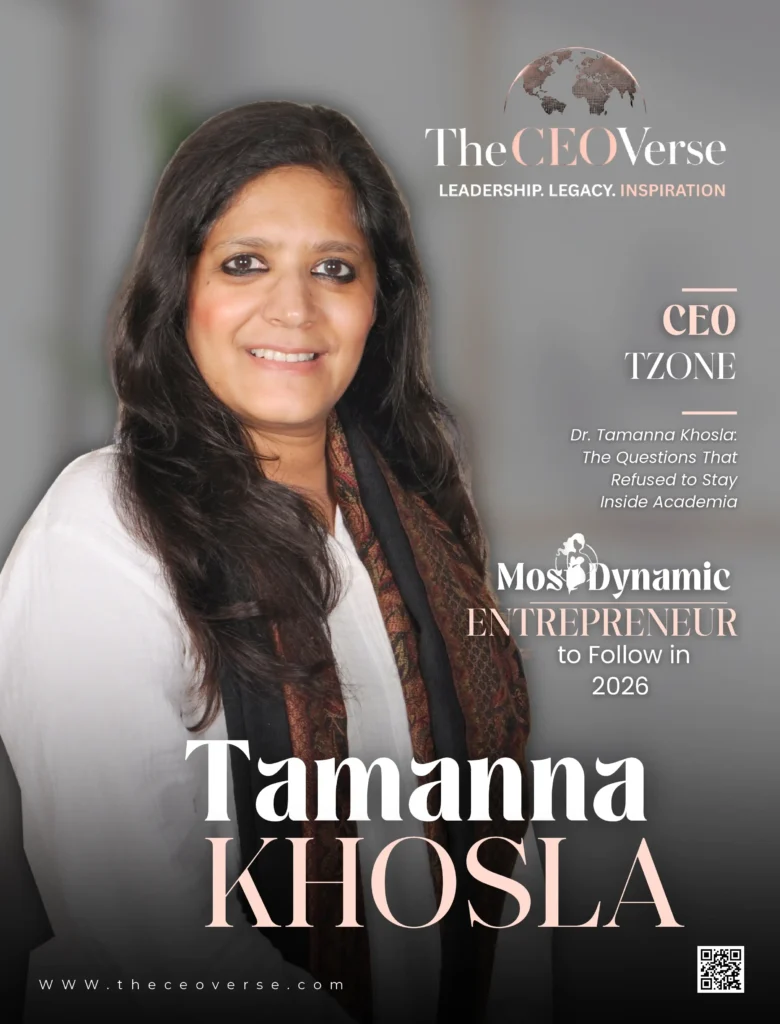
TheCEOVerse • Digital Edition
“The World’s Most Inspiring Healthy Homes Expert to Watch in 2026”
Cover story
Tamanna Khosla
Featured Profile - Tamanna Khosla
Dr. Tamanna Khosla: The Questions That Refused to Stay Inside Academia
Some questions become academic subjects. Others become the work of a lifetime.
The Questions That Shaped a Different Intellectual Path
Dr. Tamanna Khosla’s intellectual journey began with an interest in science, but by her senior secondary years, her attention had shifted toward political science and the humanities. At Lady Shri Ram College, her engagement with feminism and international relations began taking shape, opening a wider line of inquiry into politics, society, and the forces that influence people’s lives.
Her master’s studies at Jawaharlal Nehru University took those interests further. Questions surrounding politics, oppression, and gender became increasingly central to her thinking. By the time she reached her M.Phil and PhD, law and philosophy had also become important parts of that intellectual framework.
The progression was not simply from one academic subject to another. Each stage added another way of examining questions about power, freedom, oppression, and society.
Her doctorate eventually led to a teaching position at Delhi University. That chapter, however, ended abruptly. Khosla says academic hostility led to her removal and that a group within the system subsequently made it difficult for her to secure another academic position.
The end of that academic chapter did not bring her intellectual work to a close. She went on to write ten books, earn a law degree, and establish herself beyond the university system as a public intellectual, legal scholar, and feminist thinker.
The institution changed. The questions remained.
Faith Became the Foundation Behind Difficult Choices
For Khosla, difficult decisions are not guided solely by professional frameworks or analytical methods. Faith has remained the most dependable foundation behind her choices.
She describes her belief in a higher power and spiritualism as an enduring force that has helped her determine which path to take when circumstances have been uncertain or difficult.
That belief has remained consistent across different chapters of her life. Academic challenges, professional changes, and personal struggles have not altered the central place faith holds in the way she understands her journey.
Alongside that faith, Khosla identifies a belief in the goodness of people as another influence on her decisions. Together, these convictions provide the foundation from which she approaches both people and situations.
An Instinct for Reading People and Possibilities
One of the abilities Khosla considers important to her decision-making is her capacity to read people accurately without making that process obvious.
It is a quiet skill rather than an outward display. She observes people, situations, and relationships, allowing those observations to inform the way she understands what is happening around her.
That same habit of observation extends into the way she approaches problems.
Khosla believes she often reaches a possible solution before others have fully articulated the problem itself. She connects that ability to continuous learning rather than treating it simply as intuition.
For her, almost anything can become a source of knowledge. People from different countries and generations can offer insight. Unexpected situations can reveal something useful. Even organisms can become subjects from which she learns.
The approach is broad by design. Rather than restricting learning to formal education or familiar sources, Khosla remains attentive to knowledge wherever she encounters it.
Looking Beyond the Immediate Problem
Constant learning has shaped the way Khosla thinks about problems, particularly her tendency to look beyond the issue immediately in front of her.
Instead of waiting for every aspect of a problem to become fully defined, she believes that observation and accumulated knowledge can reveal possible directions earlier.
That way of thinking connects her different intellectual interests. Political science, feminism, international relations, philosophy, law, and her understanding of people have each provided different perspectives through which questions can be examined.
The result is an intellectual approach that values breadth as much as depth.
For Khosla, learning is not something that ends with a degree or a particular professional position. It is an ongoing process of observing, absorbing, questioning, and developing an understanding from whatever the world presents.
A Research Organization for Unconventional Thinkers
The institution Khosla now hopes to create reflects that expansive approach to knowledge.
Her proposed research organization is intended to bring together what she describes as “nerds and geniuses” from anywhere in the world. The aim is to create a space where people with exceptional intellectual ability can work together on questions that extend well beyond conventional boundaries.
Its proposed scope is deliberately broad. The organization would examine contemporary global challenges while also considering questions that extend toward extraterrestrial possibilities.
Alongside these areas of inquiry, Khosla wants the institution to develop new philosophical and legal frameworks and examine oppression across race, class, gender, geography, and society.
The breadth of the vision reflects the breadth of the questions that have shaped her own intellectual journey.
Rather than limiting the work to a single discipline, the proposed organization would create room for different kinds of thinkers to contribute to difficult questions from different perspectives.
Financial Resources as the Foundation for the Work
For the next five years, Khosla’s focus is largely on creating the financial foundation required to make the proposed institution possible.
The objective is to secure sufficient resources to bring together the people she believes are capable of building the organization alongside her. Financial limitations, in her view, should not prevent talented minds from pursuing meaningful work or deprive them of the resources necessary to explore difficult questions.
The financial objective therefore supports a larger intellectual purpose.
The goal is to create enough stability for the right people to concentrate on their work rather than constantly having to secure the means required to do it.
For Khosla, establishing that foundation is an important step toward turning the proposed research organization from an idea into a working environment for unconventional thinkers.
The Experience Behind the Questions
The questions Khosla studies are also connected to experiences she describes as deeply personal.
She speaks of severe oppression within her own family as well as within Indian society and academia. According to her account, these experiences continued across decades, and she describes navigating much of that struggle as a woman without support from those around her.
Those experiences form an important part of the context behind her continuing interest in oppression and the structures through which power operates.
Race, class, gender, geography, and society are not simply categories within the research organization she envisions. They are areas through which she wants to examine the ways oppression can operate and how philosophical and legal thinking might address such questions.
Through these difficult periods, Khosla identifies God as her primary source of help.
Faith therefore remains closely connected to both her personal experience and the way she continues to approach her intellectual work.
Learn From Excellence Without Losing Your Own Path
Khosla’s advice to people seeking influence in this field is built around a balance between learning from others and maintaining intellectual independence.
She does not believe people should envy those who are more intelligent or accomplished. Instead, she encourages them to study such people, learn from their work, and use that knowledge to develop their own understanding.
But learning should not become imitation.
Another person’s work belongs to that person, and Khosla believes it should remain theirs. Studying excellence should help an individual discover and strengthen their own path rather than simply reproduce somebody else’s.
That distinction reflects the broader philosophy behind her own intellectual development. Her work has been influenced by multiple disciplines and experiences, but she has continued to develop an individual perspective across them.
Building Freedom Around Ideas, Not Money
Khosla applies a similar distinction to financial resources.
She recognizes that money matters, particularly when the objective is to build an institution capable of supporting exceptional thinkers and meaningful research. At the same time, she does not want financial resources to become the central reason for creating something that is ultimately intended to advance freedom and egalitarianism.
For her, money is a means to create the conditions for intellectual work, not the purpose of that work.
Exceptional thinkers should have access to resources and the freedom required to pursue difficult ideas without unnecessary restrictions. That is the culture she hopes the proposed institution will carry forward.
The ambition is therefore not simply to gather talented people in one place. It is to provide the intellectual and financial conditions that allow them to pursue questions that might otherwise remain unexplored.
The Questions Continue Beyond Academia
Dr. Tamanna Khosla’s career has moved through science, political science, humanities, feminism, international relations, philosophy, law, academia, authorship, and public intellectual work.
The path has changed considerably.
The central questions have not.
Power, freedom, oppression, gender, society, and the structures that shape human experience continue to connect the different chapters of her work. Her academic position at Delhi University ended, but the intellectual pursuit that had developed through her education and research continued through books, legal scholarship, public thought, and now the vision for a research institution.
The proposed organization represents another stage in that journey.
Its purpose is to bring together unconventional thinkers, provide them with the resources required to work, develop philosophical and legal frameworks, and examine difficult questions across race, class, gender, geography, society, and even possibilities beyond Earth.
For Khosla, intellectual independence does not mean learning alone. It means having the freedom to learn from others, develop one’s own ideas, and pursue meaningful questions without unnecessary limitations.
Her journey began with questions that gradually moved her from science toward politics, philosophy, law, and the study of oppression.
Those questions eventually moved beyond the boundaries of a conventional academic career.
They are now shaping the institution she hopes to build.