
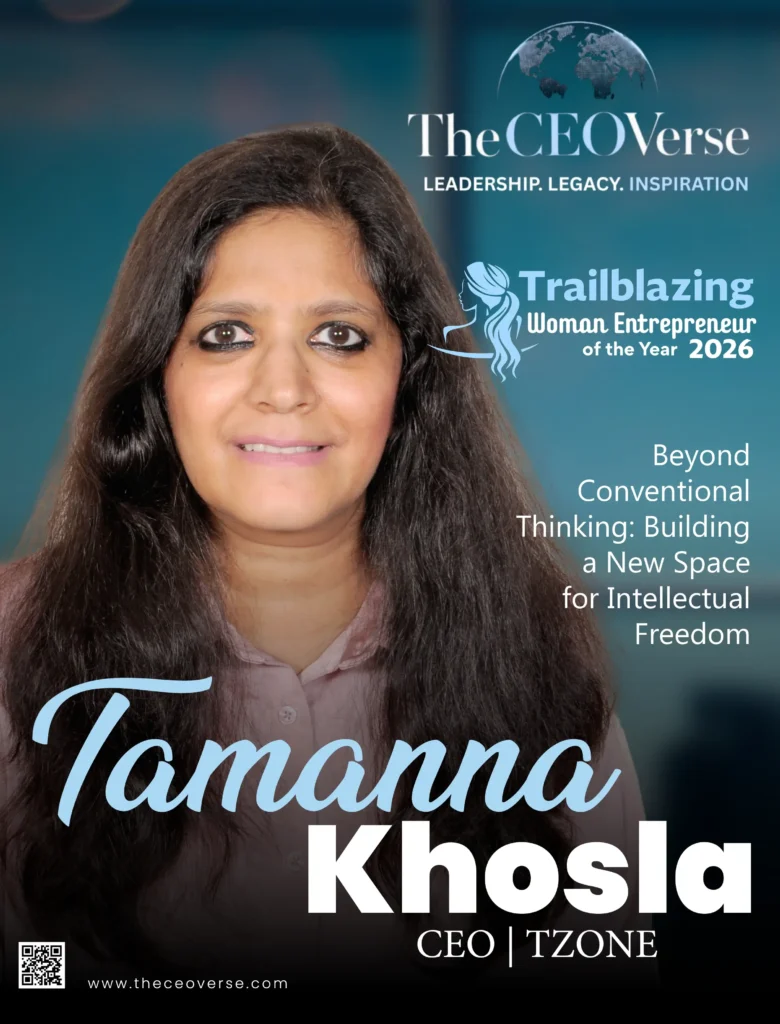
TheCEOVerse • Digital Edition
“Trailblazing Woman Entrepreneur of the Year 2026”
Cover story
Tamanna Khosla
Featured Profile - Tamanna Khosla
Beyond Conventional Thinking: Building a New Space for Intellectual Freedom
Some careers are defined by the institutions people lead. Others are shaped by the questions they refuse to abandon. Tamanna Khosla’s journey belongs to the latter. Moving across science, political science, feminism, international relations, philosophy and law, she has developed an intellectual perspective that challenges conventional boundaries and examines the structures influencing human freedom and society.
Her professional path has not followed a predictable trajectory. From her academic years at leading institutions to authorship, legal scholarship and public intellectual work, each chapter has added another dimension to her understanding of power, oppression and human experience. Now, as CEO of TZONE, her ambitions extend towards creating an environment where unconventional thinkers can explore questions that traditional academic structures may not always accommodate.
An Intellectual Journey Across Disciplines
Khosla’s early academic interests were rooted in science. However, by her senior secondary years, her attention had shifted towards political science and the humanities. At Lady Shri Ram College, her engagement with feminism and international relations began shaping a broader interest in the relationship between politics, society and individual experience.
Her master’s studies at Jawaharlal Nehru University expanded that perspective. Questions concerning political structures, oppression and gender became increasingly important to her research. As she progressed through her M.Phil and PhD, law and philosophy also became integral to the way she examined these subjects.
This progression was not simply an academic movement between disciplines. Each field offered a different framework for understanding questions of power, freedom and inequality. Together, they shaped a way of thinking that values multiple perspectives rather than relying on a single intellectual tradition.
Following her doctorate, Khosla took up a teaching position at Delhi University. That chapter came to an abrupt end. She describes experiencing academic hostility that resulted in her removal and says that subsequent difficulties within the academic system made securing another university position challenging.
The experience changed the direction of her professional life, but it did not end her intellectual pursuits. She went on to write ten books, earn a law degree and continue her work beyond the university environment as a public intellectual, legal scholar and feminist thinker.
Her institutional circumstances changed, but the questions that had driven her education and research remained central to her work.
Faith as a Source of Direction
For Khosla, professional and personal decisions are influenced by more than analytical reasoning. Faith has remained a central source of direction, particularly during periods when circumstances have been difficult or uncertain.
She describes her belief in a higher power and spiritualism as a dependable foundation that has helped her navigate important choices throughout her journey. This conviction has remained consistent through academic challenges, professional transitions and personal struggles.
Her belief in the goodness of people also influences how she approaches relationships and situations. Together, faith and trust in human goodness provide an important foundation for her outlook.
Rather than viewing difficult experiences only through the lens of professional setbacks, Khosla places them within a broader understanding of purpose, belief and personal conviction.
The Value of Observation and Continuous Learning
Khosla considers the ability to understand people and situations an important part of effective decision-making. She describes this as a quiet capacity to observe individuals, relationships and circumstances without necessarily making the process visible to others.
Her approach to problem-solving is closely connected to this habit. She believes that continuous learning and careful observation can sometimes reveal possible solutions before a problem has been fully articulated.
For her, knowledge is not limited to formal education, academic research or established professional networks. People from different countries and generations can offer valuable perspectives. Unexpected situations can become learning experiences, and even organisms can provide opportunities to observe and understand.
This openness allows her to draw connections across subjects that might otherwise appear unrelated. Political science, feminism, international relations, philosophy and law each contribute different perspectives to her thinking.
Khosla sees learning as a continuous process rather than something completed through degrees or professional achievements. Observing, questioning, absorbing new information and developing independent interpretations remain essential to her intellectual development.
An Ambitious Vision for Unconventional Research
The proposed research organisation Khosla hopes to establish reflects the breadth of her intellectual interests. She envisions bringing together what she describes as “nerds and geniuses” from across the world, creating an environment where people with exceptional intellectual abilities can work collaboratively on questions that extend beyond conventional academic boundaries.
Its intended scope is deliberately expansive. The organisation would explore contemporary global challenges while also considering questions that reach towards extraterrestrial possibilities.
Another important dimension would involve developing new philosophical and legal frameworks. Khosla wants the institution to examine oppression across race, class, gender, geography and society, bringing different disciplines and perspectives into conversations about complex human challenges.
The proposed organisation is not intended to be confined to a single field of research. Its broader purpose is to create space for unconventional thinkers to approach difficult questions without being restricted by traditional disciplinary divisions.
This vision reflects the intellectual path that has shaped Khosla herself. Her interests have developed across several academic and professional areas, and she now wants to create an environment where others can pursue similarly expansive lines of inquiry.
Securing the Foundation for a Larger Ambition
Turning this vision into a functioning institution requires substantial financial resources. Over the next five years, Khosla’s primary focus is on establishing the financial foundation necessary to bring the proposed organisation to life.
The objective is to secure sufficient resources to assemble the people she believes can build the institution alongside her. She wants talented thinkers to have access to the support and resources required to pursue meaningful work, without financial limitations becoming an unnecessary barrier to intellectual exploration.
For Khosla, financial stability is not the final ambition. It is an enabling condition for something larger.
The proposed institution will need the right people, an environment that supports independent thinking and the resources to sustain ambitious research. Establishing these foundations is therefore an important step towards turning the idea into a practical reality.
Her approach places financial planning in service of intellectual freedom, ensuring that the institution’s future work is not defined solely by the limitations of available resources.
Personal Experience and the Study of Oppression
Khosla’s interest in oppression is connected not only to her academic work but also to experiences she describes as deeply personal.
She speaks of severe oppression within her own family and in wider Indian society and academia. According to her account, these experiences continued over decades, and she describes navigating much of this struggle as a woman without support from those around her.
These experiences have contributed to the questions that continue to shape her intellectual interests. The structures of power, the ways inequality operates and the circumstances that restrict individual freedom are subjects she approaches through both personal reflection and academic inquiry.
This background also informs the research organisation she envisions. Its proposed focus on race, class, gender, geography and society reflects her intention to examine oppression through multiple dimensions rather than treating it as a single, isolated issue.
Throughout difficult periods, Khosla identifies God as her primary source of support. Faith continues to influence how she understands her experiences and approaches the work she hopes to pursue.
Learning From Others Without Becoming Their Reflection
Khosla’s advice to people seeking to develop influence in intellectual and research-driven fields centres on learning from excellence while maintaining individual independence.
She encourages people not to envy those who possess greater intelligence or have achieved more in their fields. Instead, they should study their work, understand their thinking and use those insights to strengthen their own capabilities.
However, learning should never become imitation.
She believes that another person’s work should remain recognised as their own. Studying accomplished thinkers should help individuals develop their perspectives, not simply reproduce someone else’s ideas or achievements.
This distinction reflects her own intellectual development. Her work has been influenced by several disciplines and experiences, yet she has continued to build an individual perspective through the connections she makes between them.
For Khosla, intellectual growth requires both openness and independence: the willingness to learn from others and the confidence to develop a different point of view.
Resources Should Serve Freedom, Not Define It
Khosla recognises that financial resources are essential to building an institution capable of supporting exceptional thinkers and meaningful research. However, she does not want money to become the central motivation behind an initiative intended to advance freedom and egalitarianism.
For her, financial resources are a means of creating the conditions in which intellectual work can flourish. They should provide talented people with the opportunity, stability and independence to explore difficult questions without unnecessary restrictions.
The proposed institution is therefore intended to be more than a gathering of highly capable individuals. It should offer an environment where people can work on ideas that might otherwise remain unexplored because of limited resources or conventional institutional boundaries.
This distinction between financial means and intellectual purpose is central to the culture Khosla hopes to establish. The value of the organisation will ultimately depend on the freedom it creates for people to question, investigate and contribute.
A Future Defined by Questions Still Worth Asking
Tamanna Khosla’s journey has moved through science, political science, humanities, feminism, international relations, philosophy, law, academia, authorship and public intellectual work. Each stage has changed the context in which she pursues her interests, but the central questions have remained remarkably consistent.
Power, freedom, oppression, gender and the structures that influence society continue to connect her different areas of work. The end of her academic position at Delhi University did not end that pursuit. Instead, it led her towards new forms of intellectual contribution through books, legal scholarship and the vision for a research organisation.
Her proposed institution represents the next stage of that journey. By bringing unconventional thinkers together, supporting their work and encouraging the development of philosophical and legal frameworks, she hopes to create an environment for examining questions that cross established boundaries.
For Khosla, intellectual independence is not about working in isolation. It means having the freedom to learn from others, develop original ideas and pursue meaningful questions without unnecessary limitations.
Her ambition extends beyond building an organisation. It is about creating the conditions in which independent thinking, collaboration and the pursuit of knowledge can continue to develop.
The questions that once carried her beyond the boundaries of conventional academic disciplines are now shaping a larger vision: a space where ideas are not limited by traditional structures, and where intellectual freedom becomes the foundation for exploring what comes next.