TheCEOVerse • Digital Edition
“The Quantum Visionary Redefining the Future of Healthcare”
Cover story
Trey Rutledge
Featured Profile - Trey Rutledge
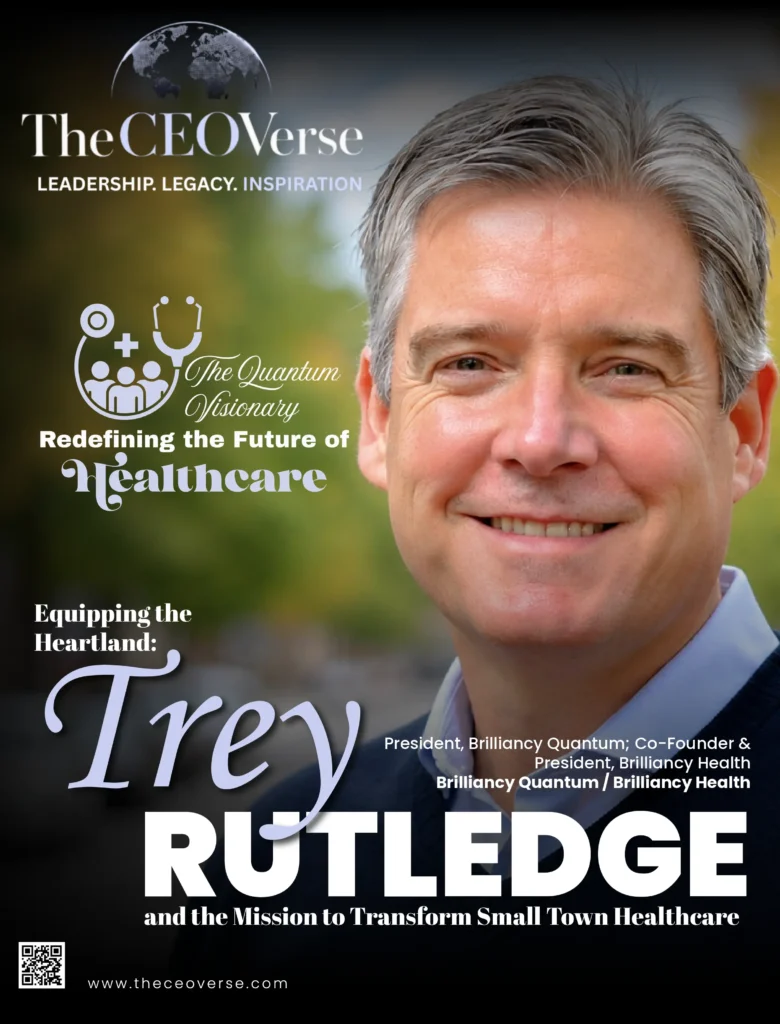
Equipping the Heartland: Trey Rutledge and the Mission to Transform Small Town Healthcare
Trey Rutledge, President of Brilliancy Quantum and Co-Founder & President of Brilliancy Health, is bringing the world’s most advanced decision tools to the rural hospitals that need them most.
Where the Story Starts: A Mound, a Crowd, and a Lesson
Long before he talked about quantum platforms or decision intelligence, Trey Rutledge’s world was a patch of dirt raised a few inches above the field. It began in Olathe, Kansas, where a boy learned the geometry of a baseball diamond the way other children learn the layout of their own neighbourhood. It carried him to Baton Rouge, Louisiana, and to the pitcher’s mound of a Louisiana State University program that, in 1993, climbed all the way to the College World Series title. Rutledge was the starting pitcher on that team.
To the outside world, a championship ring is a trophy. To Rutledge, it was a classroom. He studied business administration at LSU in the 1992–1993 academic year, but the more lasting curriculum was taught by the game itself. Two coaches stand out in his memory, Lloyd Simmons and Skip Bertman, men who drilled into their players that preparation is not a virtue to be admired but a requirement to be met. Talent, he learned, is only useful inside a team. And the difference between winning and losing is rarely decided on the days when the plan works. It is decided on the days when it breaks.
The recognition that followed was the kind most athletes spend a lifetime chasing. An invitation arrived to join the U.S. Olympic Baseball Team. The Cincinnati Reds organization signed him, and he ranked among their Top 30 prospects. Yet the path that led to Lawrence, Kansas, and to some of the most advanced computing research in the Midwest was not a straight line from the mound. It was a long, winding road with several surprising turns, and each turn left something behind that he still carries.
Before the Mound: The Wanderer’s Classroom
Rutledge’s formal education reads like the map of a restless, curious young man. He studied Psychology at the University of Nebraska-Lincoln in 1990 and 1991, then moved to Seminole State College in Oklahoma, where he earned an associate degree in business administration with baseball woven through his days. From there he went to LSU. Three schools in three years, three states, three very different cultures.
It would be easy to call this a scattered start. Looking back, it was more like a quiet apprenticeship in two subjects that would define his career. How people think, and how organizations work. Psychology taught him that behind every purchase order, every contract, and every clinical decision sits a human being with fears, habits, and hopes. Business administration taught him how those human beings arrange themselves into enterprises. Years later, when he began building technology for hospitals, he would find that the two subjects were really one.
The Scoreboard Disappears
Every athlete eventually faces the same quiet question. What comes after the game? For Rutledge, the answer was not a gentle landing. He walked away from a world of clear scoreboards, where every inning ends with a number and every season with a record, and stepped into one where results are slower, messier, and dependent on other people’s trust.
He spent more than two decades in sales and business development, and he describes that stretch as a long apprenticeship in commercial reality. There were no highlight reels in it. There were meetings that went nowhere, deals that took years to ripen, and customers who needed to be earned one small promise at a time. Trust, he discovered, is built in increments and lost in an instant. A pitcher can strike out the side and still lose a game. A salesperson can win a pitch and still lose a relationship.
This was the hard reorientation of his life, and it is easy to underestimate how much it shaped him. The athlete who once measured himself against an opponent’s bat now had to measure himself against a customer’s problem. The question changed from “Can I beat them?” to “Can I help them?” That shift, subtle as it sounds, is the hinge on which his later career turns.
A Chain of Blocks and a Chain of Trust
In February 2019, Rutledge joined Dragonchain, the Bellevue, Washington, blockchain company, as Director of Business Development and Strategic Partnerships. The role was demanding and, in many ways, a perfect fit for a man who had spent decades learning what it takes to bring a new idea into a skeptical room. He was responsible for establishing and managing enterprise accounts, training sales staff, and building the sales toolkit that allowed a technical story to travel from engineers to executives.
He stayed for more than five years, until July 2024, and the experience left lasting marks. Dragonchain’s work on hybrid, quantum resistant blockchain gave him an early look at a problem that most of the business world had not yet noticed, that the cryptographic locks protecting the world’s digital life may one day be picked by quantum machines. He also earned a Certified Smart Contract Practitioner credential, a quiet signal that he was determined to understand the technology he was selling, not merely describe it.
Most of all, Dragonchain taught him to think about technology as something that either earns trust or fails. Frontier tools, he came to believe, matter only when they solve concrete operational problems for real organizations. It was a principle that would soon meet its proving ground.
The Watching Years: When Capability Outran Courage
If there is a chapter in Rutledge’s career that he describes as a struggle, it is not a single dramatic collapse. It is a pattern he watched repeat. In the blockchain years and in other deep technology settings, he saw capable teams lose momentum while waiting for perfect technical maturity or complete market certainty. The technology was ready enough. The people were smart enough. What was missing was the willingness to move before every question had been answered.
That experience produced what he calls the lesson he still carries. Waiting for perfect conditions is itself a decision, and often the more expensive one. Organizations that treated uncertainty as a reason to delay rather than a condition to navigate with disciplined experiments watched their windows of opportunity close. For a former pitcher, the logic was familiar. The best prepared hurler still has to adjust when the hitters adjust, and the game does not pause while you decide whether you feel ready.
The Market Failure in Plain Sight
Around the time these lessons were settling in, Rutledge began to see a problem that none of the dazzling technology he had worked with seemed to touch. In America’s small towns, Critical Access Hospitals, Rural Health Clinics, and the emergency medical services that serve them were being asked to do the same work as major urban systems, with a fraction of the tools, staff, and margin. Roughly 60 percent of rural hospitals operate at financial risk. Most healthcare software, meanwhile, had been designed for organizations with nine figure IT budgets.
It was a mismatch so large that it barely needed explaining. A small hospital in a farming community cannot hire a team of data scientists. It cannot run a multi year replacement of its core systems. It cannot afford to gamble on an experiment that fails. And yet the people inside those walls are saving lives every day, often in places where the next closest hospital is a long drive away.
Here Rutledge’s separate threads pulled together. The discipline of the athlete, the patience of the salesman, the trust first thinking of the blockchain years, and a growing fascination with quantum computing, artificial intelligence, and complexity science. He saw not a technology problem but a human one. The people saving lives in small towns, he decided, deserve the same calibre of tools as any major metropolitan system.
A Partnership Forged in Complexity
No founder builds alone, and Rutledge is quick to say so. His co-founder, Phil Abraham, had already done something remarkable. Applying complexity science methodologies in real healthcare settings, including Loma Linda, Abraham had shown that large, durable improvements in outcomes and profitability were possible without disrupting the sacred relationship between doctor, nurse, and patient. It was the proof point Rutledge needed. The improvement was not theoretical, and it did not require hospitals to tear themselves apart in order to get better.
Together they founded Brilliancy Health, and the wider Brilliancy Quantum family, at the KU Innovation Park in Lawrence, Kansas. Brilliancy Quantum was established in May 2024, with Rutledge as Co-Founder and President. Brilliancy Health followed in April 2026. The leadership team grew to include Mark A. Mona and Alex Blandin, who bring complementary strengths in commercial strategy, quantum enhanced technology, and the realities faced by first responders. Every product the group builds still starts with a single question. How will this improve people’s lives?
Designing for the Real World
What happens when a company is built around a hospital that has no money, no spare staff, and no patience for disruption? The answer shaped every architectural choice Brilliancy made. Rutledge calls the constraints a gift. They did not limit the work, they clarified it.
The first rule was to connect to what hospitals already run rather than asking them to replace it. The second was a success based business model, so that fees track measurable improvement and no hospital bears large upfront licensing risk. The third was to treat explainability and clinician trust as design requirements rather than afterthoughts. A clinician who cannot understand why a system made a recommendation will, rightly, ignore it.
The thin margins, the unpredictable reimbursement, and the fragmentation between EMS, fire, command, clinical, and revenue cycle systems were not obstacles to be wished away. They were the specification. And the same instinct that had once told him to adjust mid inning without abandoning the fundamentals now told him how to build software for the places that most needed it.
Inside the Luminous Engine
The portfolio that grew from these principles is deliberately modular. SwiftAuth tackles prior authorization and denial management, a quiet source of financial pain for many providers. The Nex family connects EMS, fire, and command operations. Axia and related clinical workflow tools ease the daily burden on clinicians, and PocketMD puts support in the palm of the hand. Above them all sits the Luminous layer, the connective tissue that lets the pieces work as one.
Beneath it runs the Luminous Decision Intelligence Architecture, a blend of agentic AI, dynamic knowledge graphs, ontological structure, complexity science methods, and selective use of quantum platforms. In Rutledge’s own professional description, it enables quantum enhanced clinical decision support, quantum encrypted agentic systems for secure health data exchange, intelligent automation of patient journeys, and process optimization that improves care quality, efficiency, and personalization while upholding ethical AI principles.
The results, as reported by the company, are the kind that matter to a hospital administrator. Documented outcomes include large lifts in first pass authorization rates, improved collections, and a reduced documentation burden. Drawing on the validated complexity science methodology, the work points to roughly $60,000 per bed per year in additional profit. For a 25 bed Critical Access Hospital, that can be the difference between keeping the doors open and facing closure. Impact is designed to arrive in weeks, not years.
Quantum Without the Hype
Rutledge has a rule that he repeats with the calm of a man who has seen too many technology fads. Refuse to chase technology for its own sake. Quantum computing is exciting, and he is among its most committed advocates in the region. But he is equally insistent that it must earn its place.
That conviction lives in the Quantum AI Innovation Lab at KU Innovation Park, where hybrid quantum classical approaches can be validated before they ever reach production. Brilliancy’s partnerships with quantum platform providers give the team access to real systems for optimization, molecular work, and post quantum security, rather than pure theory. The goal is straightforward. AI and quantum should strengthen human judgment, not replace it.
His commitment extends beyond his own company. Since October 2022, Rutledge has served as a subcommittee member with the IEEE Standards Association, on the Subcommittee on Cybersecurity for Next Generation Connectivity Systems. His focus there is quantum cybersecurity. Reviewing and researching post quantum cryptographic algorithms and polymorphic ciphers, and contributing to the work on a standards framework for quantum cyber security. It is unglamorous, painstaking work, the kind of thing that rarely makes headlines but quietly decides whether the digital world of the 2030s will be safe.
The Wider Canvas
Although healthcare is the heart of the mission, Rutledge’s vision stretches across industries. Brilliancy Quantum applies frontier technologies to challenges in aerospace, agriculture, and logistics as well. He leads strategic consortia with Fortune 100 alliances focused on AI and intellectual property licensing, oversees Brilliancy AI, whose no code AI agents are designed to integrate with enterprise platforms such as SAP and MyWave.ai, and nurtures global partnerships aimed at inclusive solutions.
The word “inclusive” appears again and again in his language, and it is not decoration. The thread that connects a rural hospital in Kansas to a global consortium is the belief that powerful tools should not be reserved for the powerful. His professional record, spanning more than thirty years of strategic leadership, has taught him that the organizations with the least are usually the ones with the most to gain.
Voices That Shaped the Man
Ask Rutledge who shaped him and he does not reach for a single name. He reaches for layers. The first was the coaches, Simmons and Bertman, and the teammates who taught him that preparation and collective execution are non-negotiable. The second was the long line of commercial mentors and customers who taught him that trust accumulates slowly and evaporates quickly.
Then there is Phil Abraham, whose operational experience inside healthcare systems supplied the proof that big improvements were possible without breaking clinical relationships. The KU Innovation Park community and the partners across the quantum ecosystem built the collaborative environment where the work could be tested and validated. And, most of all, he credits the hospital CEOs, clinicians, and EMS leaders who sit where his team sits across the table. Their constraints and feedback have repeatedly steered the company’s efforts, often away from what looked clever and toward what actually worked.
An Ecosystem, Not a Product
Vision, in Rutledge’s telling, becomes operational only through orchestration. The work is not a solo product, he insists, it is an ecosystem. Internally, the pairing of complexity science, modular AI platforms, blockchain orchestration, and deep rural care expertise creates capabilities that none of the team members could assemble alone. Externally, the KU Innovation Park coalition provides both the physical infrastructure and a public-private model for the Innovation Lab.
In 2026, the company convened the first Brilliancy Health Summit at KU Innovation Park. The idea was elegantly simple. Put rural hospital leaders, clinicians, researchers, and technology partners in the same room. The event drew policymakers as well, including Senator Roger Marshall, MD, a sign that the conversation about rural healthcare is no longer confined to the places that feel its pain most acutely. It was a gathering designed not to sell a product, but to start something larger.
Teaching the Next Team
Perhaps the most telling thing about Rutledge is what he considers infrastructure. When asked what deserves more attention than it usually receives, he points not to an algorithm but to education. Without a next generation that understands both the technology and the human systems it must serve, he argues, the tools will not be adopted responsibly or at scale.
That conviction is the root of the Luminary Academy, a program through which he mentors emerging leaders in quantum computing, artificial intelligence, blockchain, and cybersecurity. It is the coach in him, perhaps, speaking up again. A man who once learned the value of preparation from Skip Bertman now spends part of his working life preparing others, building university partnerships and talent pipelines so that the people who inherit these powerful tools know how to use them with care.
The same belief runs through his professional mission statement. Technology should empower humanity. For Rutledge, the phrase is not a slogan. It is a test applied to every project, every partnership, and every product that carries the Brilliancy name.
What He Believes
Strip away the technical vocabulary and Rutledge’s philosophy is strikingly plain. Integrity, curiosity, service, and long term thinking are the four values he returns to, because, in his experience, they have proved more durable than any particular technology wave. Fundamentals matter more than theatrics, a belief inherited directly from the baseball diamond, where the flashiest play rarely wins the game and the cleanest execution often does.
He is equally clear about the traps. Flashy capability that clinicians do not understand, or that demands they abandon systems they already depend on, will be rejected regardless of its technical elegance. Technology without earned trust and clear human outcomes does not stick. Those are not abstract warning, they are scars from watching good ideas die for want of humility.
Pearls of Wisdom
When he addresses young leaders, Rutledge’s counsel is compact. Start with the problem and the people, not the technology. Stay curious and willing to experiment, but anchor every effort to measurable improvement in someone else’s life. Surround yourself with people whose strengths complement your own. Treat trust as something that must be continuously earned, never assumed.
And do not wait for perfect conditions. Constrained environments, he has found, often produce better design than comfortable ones. The scoreboard that ultimately matters, he says, is whether the work made outcomes better for the people who depend on it. It is a striking image from a man who once lived by literal scoreboards and who now argues, with the authority of experience, that the most important ones are never posted in a stadium.
Beyond the Milestone
For Rutledge, recognition is useful only if it expands the capacity to serve. Professionally, he sees it as strengthening the ability to help rural and community hospitals put the substantial Rural Health Transformation funding available from 2026 to 2030 to work in lasting ways rather than as temporary fixes. The funding is a rare opportunity, and he worries that without the right tools and partners, it could be spent on patches rather than foundations.
The road ahead has several clear markers. The company aims to complete a more unified connected platform across EMS, fire, command, clinical, and revenue cycle workflows. It plans deeper hybrid quantum classical validation inside the Innovation Lab, expansion across the Midwest, and continued growth of talent pipelines through the Luminary Academy and university partnerships. On a personal level, recognition reinforces his obligation to keep the work human centered and explainable, and to mentor those who will carry it forward.
The Last Pitch
There is a moment in every baseball game when the pitcher stands alone on the mound, the crowd quiet, the batter waiting. Everything he has practiced comes down to a single motion. Trey Rutledge has stood in that moment in front of a national audience, and he has stood in smaller, quieter versions of it in boardrooms, hospital conference rooms, and research labs.
What has changed is the question he asks when he steps up. It is no longer about winning the inning. It is about whether a small town nurse, a rural EMS crew, or a Critical Access Hospital administrator will be handed a better tool tomorrow than they had today. From a mound in Baton Rouge to an innovation park in Lawrence, his answer has stayed remarkably consistent. Technology should adapt to humans and improve lives, not the reverse.
When frontier capability is paired with practical integration, transparency, and a relentless focus on outcomes, he believes, rural healthcare can be strengthened, along with the communities that depend on it, and complexity can be turned into better decisions. That is the work, and for Trey Rutledge, it is the mission.