TheCEOVerse • Digital Edition
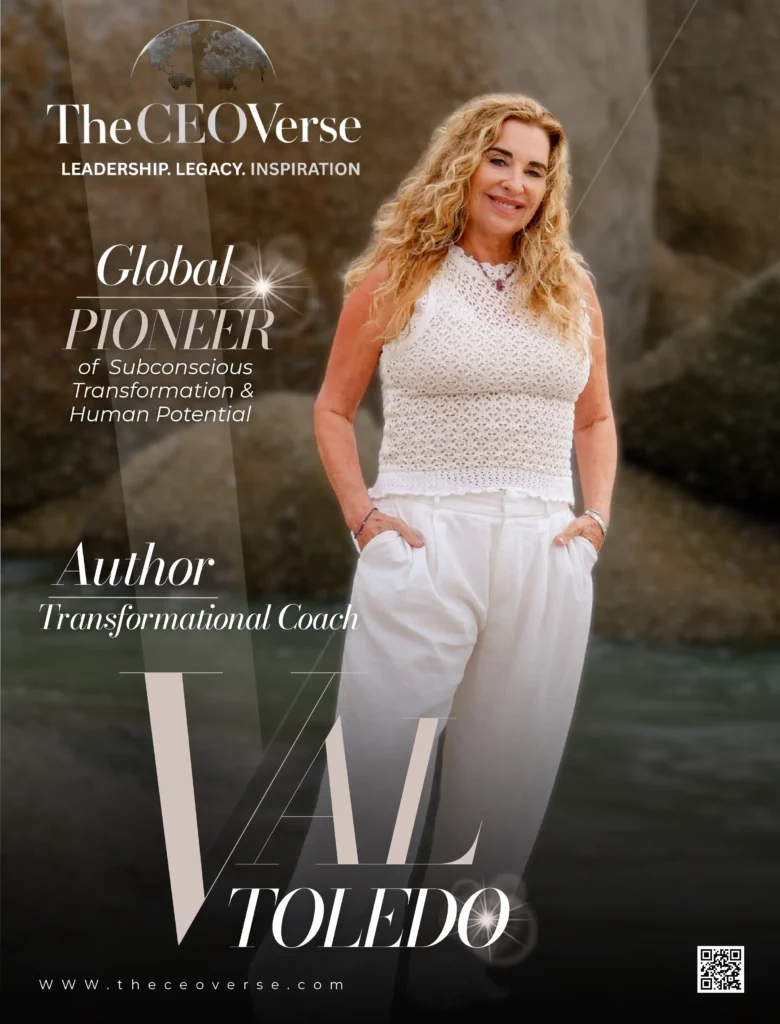
“Val Toledo — Global Pioneer of Subconscious Transformation & Human Potential 2026”
Cover story
Val Toledo
Featured Profile - Val Toledo
Val Toledo: The Architect of an Upward Spiral
From Searching for Herself to Helping Others Find Themselves
Oftentimes, the path of one’s life and professional career tends to begin with deliberate planning and consideration. But for Val Toledo, her journey appeared to take shape with a persistent curiosity that never seemed to escape her mind. Why do we keep repeating the same patterns, even when we know they are hurting us? Long before she became an author, transformational coach, corporate trainer, educator, and advocate for disadvantaged children, Toledo was on her own route of trying to understand the invisible forces that shape a person’s life. Her story, as she tells it, did not begin in certainty. It began in vulnerability.
She describes returning to the story of her beginnings as a difficult act of remembrance. A time when she felt lost, untethered and painfully alone, when her sense of worth was uncertain and her inner voice had become little more than a whisper. Yet, rather than allowing those experiences to become a permanent identity, Toledo eventually began treating them as a chapter. Something that had shaped her, but did not have to define her. This belief would become central to everything she later built.
Today, Toledo is best known as the author of The Upward Spiral and The Upward Spiral – Journey into Action, alongside The Frequency Alchemy Diary, and as an alignment and transformational coach whose work focuses on personal empowerment, subconscious patterns and lasting change. Her professional journey has also encompassed corporate training, leadership development, adult literacy, education, community development and workshops designed to help people move from reactive patterns towards more conscious choices. But to understand Val Toledo’s work, it is necessary to look beyond the titles. Because the real story is not about becoming a coach. It is about becoming the person who could eventually help others change.
A Beginning Shaped by Questions, Not Answers
Toledo’s early professional life was not confined to a single discipline. Her career developed across education, corporate environments and personal development. Fields that, on the surface, might appear unrelated but gradually converged around one central theme, that is human potential. She developed experience in adult literacy and remedial education, eventually creating an English Bridging training programme for immigrant refugees in South Africa. Her work in education exposed her to people whose potential was often greater than their circumstances suggested. In the corporate world, that same observation took another form.
Toledo developed and managed programmes including an Adult School Education Programme, an Affirmative Action Career Path Programme and an Employee Work Productivity Training Programme. She also created and implemented a culture change process centred on self worth and productivity. Rather than relying solely on criticism, hierarchy or conventional command and control leadership, the approach placed emphasis on co creation, collaboration and allowing people to participate in building a healthier organisational culture. It was an important evolution. The more Toledo worked with people, the more she noticed that performance problems were rarely just performance problems. Behind the employee struggling to progress could be a belief that they were not capable. Behind the leader who could not delegate could be fear. Behind the individual repeatedly making the same destructive decisions could be an old emotional pattern they had never consciously examined. And, behind many organisations struggling with culture could be something even more fundamental, people who did not feel valued.
Toledo’s career therefore began moving beyond the question of What should people do differently?
She became increasingly interested in the deeper question.
What is happening inside us that causes us to behave the way we do?
That question would eventually become the intellectual and philosophical foundation of her life’s work.
When Professional Experience Became Personal Discovery
The transition from corporate trainer and educator to transformational author did not happen overnight. It grew out of years of observation, research and self examination. Toledo has spent more than 17 years researching and refining processes around personal transformation, emotional awareness, subconscious patterns and behavioural change. Her work draws from a broad range of interests and disciplines, including emotional intelligence, behavioural psychology, meditation, kinesiology, healing modalities and subconscious reprogramming. Yet her approach is not presented as an abstract academic theory. It is rooted in lived experience.
Toledo’s first book, The Upward Spiral, is described as an autobiographical account of her own transformation. In interviews, she explains that the experiences and “curve balls” life threw at her contributed to what she calls a “wounded ego” or “chip”, an internal programme that influences emotional responses, beliefs, choices and behaviour. This concept became one of the defining ideas in her work.
The “chip”, in Toledo’s framework, is like an invisible operating system. It is shaped by experiences, emotional conditioning and beliefs accumulated throughout life. It can influence how people respond to relationships, challenges, opportunities and even themselves without them fully recognising what is happening.
The consequence is familiar to anyone who has ever asked the following.
Why am I doing this again?
Why do I keep choosing the same kind of relationship?
Why do I react this way when someone criticises me?
Why do I sabotage opportunities I genuinely want?
Why do I know what I should change, but still struggle to change it?
For Toledo, these questions became more than philosophical curiosities. They became the beginning of a practical framework. Her answer was that sustainable transformation requires more than changing surface behaviour. It requires becoming conscious of the programme beneath the behaviour.
The Birth of the Upward Spiral
Eventually, Toledo turned those years of personal reflection and professional experience into a philosophy she called The Upward Spiral. At its heart is a deceptively simple idea. People can spiral upward or downward depending on the emotional and behavioural patterns they repeatedly reinforce. The philosophy seeks to help people identify destructive and reactive patterns and replace them with constructive and proactive ones. The Upward Spiral has aptly been recognized as a ten step process intended to help individuals fine tune their energy, unfold their potential and move towards their greatest capabilities. The metaphor is powerful because a spiral is not a straight line. Real transformation rarely is. People make progress, fall back, learn, adjust and begin again. They encounter the same emotional triggers at different stages of their lives, but ideally meet them with greater awareness each time. Toledo’s philosophy consequently does not frame transformation as becoming perfect. It frames transformation as becoming conscious. That philosophy became the backbone of her books, coaching, workshops and speaking engagements. And, in a sense, it also became the story of her own career.
The Four Hundred Copies That Nearly Became a Lesson in Fear
Every entrepreneur eventually faces a moment when an idea must leave the safety of imagination and meet the judgement of the outside world. For Toledo, that moment arrived with the publication of The Upward Spiral. The story is particularly revealing because publishing the book forced Toledo to confront the very fears she was writing about. She had chosen to self publish. The manuscript represented years of personal exploration, research and emotional work. It was not simply a business product, it contained her story. Then came launch day.
Val Toledo recalls the anxiety surrounding the launch, including the fear of failure and uncertainty about how people would respond. She had hundreds of printed copies in front of her, but what she could not predict was whether anyone would want to read the story she had spent so much time gathering the courage to tell. That is the paradox of entrepreneurship. Sometimes the hardest product to launch is the one in which you have invested the most of yourself. But Toledo moved forward. The launch became a pivotal moment in her journey, reinforcing a lesson that would later sit at the centre of her coaching philosophy. Courage does not necessarily mean the absence of fear. Sometimes courage simply means moving anyway.
The experience also reinforced something fundamental about her relationship with purpose. The book had not been written merely to become a commercial object. It had been written because Toledo believed the lessons contained within her own journey could help another person understand theirs. That distinction would become essential as The Upward Spiral evolved from a book into a wider transformational ecosystem.
From Book to Methodology
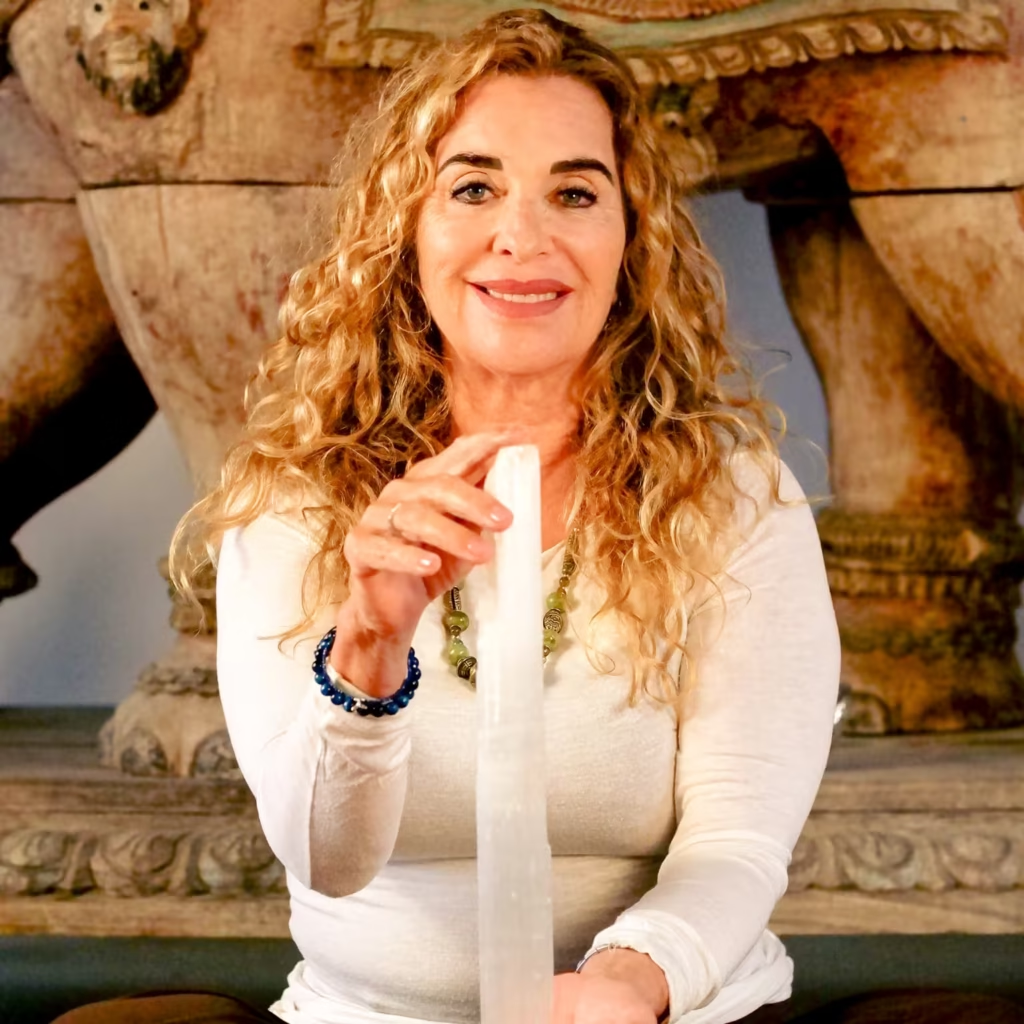
One of Toledo’s most significant achievements has been transforming a personal story into a repeatable framework. Many autobiographical books inspire readers. Far fewer become methodologies. The Upward Spiral was developed into coaching and workshop material, allowing Toledo to work directly with individuals rather than simply communicating with them through the page. Her public materials describe one on one alignment coaching, group journeys, workshops, corporate wellness and leadership sessions, meditation practices and other tools built around the philosophy. This is where Toledo’s corporate background becomes particularly relevant.
Her work is not exclusively about individual spirituality or personal reflection. It also intersects with leadership, organisational culture and workplace wellbeing. For executives, the premise has a distinctly practical dimension.
Leadership is shaped by behaviour.
Behaviour is shaped by emotional responses.
Emotional responses are often shaped by beliefs and conditioning.
Therefore, understanding the individual behind the leader becomes part of understanding the organisation.
Toledo’s approach encourages people to examine the internal patterns that influence external decisions, a perspective that can be particularly relevant in an era when companies increasingly recognise that psychological safety, emotional intelligence, purpose and employee wellbeing influence organisational performance. Her work seeks to bridge the gap between inner development and outer performance. The result is a style of transformational coaching that is simultaneously personal and organisational.
The Diary: When Transformation Had to Become Daily
There was, however, a problem. Coaching can create breakthroughs, but people eventually leave the coaching room. The real test begins the next morning. That realisation helped inspire The Frequency Alchemy Diary, which Toledo describes as emerging from her experience of working closely with coaching clients. She observed that people could experience profound insights during sessions but still needed a practical mechanism to continue applying those insights in daily life. The diary therefore became an extension of the coaching relationship.
Its purpose is not simply to tell readers what to think. It encourages daily reflection, awareness, intentional practice and ongoing engagement with the principles of The Upward Spiral. It is essentially a tool for personal alignment, emotional grounding and spiritual expansion through consistent inner work. This emphasis on repetition is important. Transformation is rarely created by one extraordinary moment. It is created through ordinary moments repeated consistently. A thought noticed, a reaction interrupted, a belief questioned, a choice reconsidered, and a commitment renewed. Eventually, a difficult day survived without returning to an old pattern. In this sense, the diary reflects a larger philosophy that has remained consistent throughout Toledo’s career. Meaningful change has to become a practice.
Education as a Form of Transformation
Perhaps the most revealing part of Val Toledo’s story is that her transformational philosophy has never been limited to people who can afford coaching. Her work in education tells another side of the story. Toledo has nearly three decades of experience in adult literacy, according to ABC for Life, and began her career in remedial education. She later developed an English Bridging programme for immigrant refugees in South Africa and became involved in initiatives supporting disadvantaged children.
In 2007, she and Lola Kramer established ABC for Life, a community based educational initiative in Hout Bay. The idea was simple but ambitious. Children who had fallen significantly behind in school needed an opportunity to catch up rather than being defined by their academic difficulties. ABC for Life developed programmes around literacy and foundational learning, including English, Mathematics, reading initiatives, individual learner support, career guidance and after school programmes. The organisation’s work was born from a belief that a child struggling academically is not necessarily a child without potential. Sometimes, the child simply needs the right intervention at the right time. That value mirrors Toledo’s work with adults. Whether the individual is a corporate professional carrying years of self doubt or a child struggling because of gaps in education, the underlying principle is remarkably similar. Potential is often present long before circumstances allow it to become visible.
ABC for Life: A Legacy Beyond the Coaching Room
ABC for Life represents one of the most tangible dimensions of Toledo’s service. The organisation’s stated mission has centred on helping children overcome literacy barriers and build the confidence and skills necessary for further education and employment. Its work has been connected with schools in underserved communities in Cape Town. One of its early stories involved a 14 year old boy who had left school and was living on the streets. That encounter became part of the impetus behind the organisation’s founding. The programme has subsequently reached hundreds of learners and relied on teachers, volunteers, community partners and donations to continue its work. For Toledo, service is therefore not an accessory to her career. It is embedded within it. Her professional journey moves between seemingly different worlds, corporate boardrooms, coaching sessions, books, workshops and classrooms, but the underlying purpose remains consistent. To help people recognise and develop their potential. That consistency may be one of the strongest indicators of authentic leadership.
A Different Definition of Leadership
Toledo’s philosophy also challenges the traditional definition of leadership. Leadership, in her work, does not begin with a job title but with self awareness instead. She puts emphasis over certain principles including empathy over sympathy, maintaining clear boundaries, encouraging clients to take responsibility for their own journeys, protecting confidentiality and maintaining personal balance so that she can support others without bringing her own unresolved baggage into the process. These principles reveal that Toledo is not positioning transformation as dependence. But quite the opposite. Her stated aim is to give people tools with which they can eventually navigate their own lives. That is a particularly relevant philosophy for modern leadership. The strongest leader is not necessarily the person who makes everyone dependent on them. It is often the person who helps other people become more capable. This principle also explains why Val Toledo has extended her work beyond private coaching into workshops, corporate training and self directed tools. The objective is scale, not simply in the commercial sense, but in the human sense. How many people can be empowered to continue the process without needing someone to carry them?
From Fear and Guilt to Courage and Neutrality
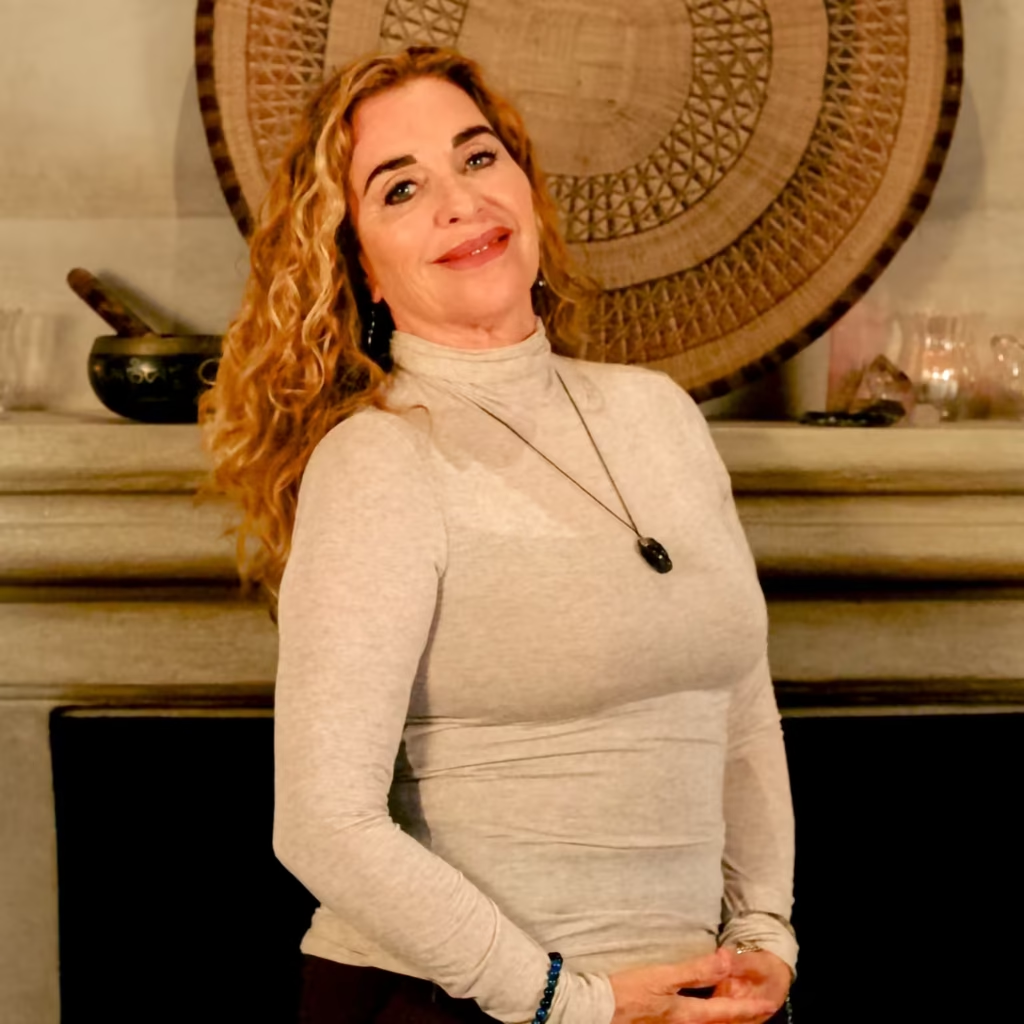
At the centre of Toledo’s worldview is another recurring theme. The choice between reacting from fear and responding from a more conscious state. She speaks of maintaining a resonance of love and gratitude rather than fear and guilt, while her broader work repeatedly emphasises courage, awareness and responsibility. The idea of neutrality is equally important. Neutrality, in Toledo’s view, is not emotional indifference. It is the ability to create enough distance between stimulus and response to choose consciously. For a leader, that can mean not sending the angry email. For a parent, it can mean not repeating an inherited pattern. For an entrepreneur, it can mean making a decision from clarity rather than panic. For an individual healing from a difficult past, it can mean understanding that the past explains certain reactions without having to dictate the future. This is where Toledo’s work moves beyond conventional motivational language. Motivation says Do better. Transformation asks you to Understand what is driving you first.
The Author Who Writes Like She Speaks
Toledo’s writing style reflects her broader perspective.
She explains that she deliberately writes in a casual, conversational manner, as though she is speaking directly to the reader. She prefers accessible language and a style that feels like real life rather than a polished performance. That choice is extraordinary. Personal transformation can easily become buried beneath complicated terminology. Toledo instead attempts to make her framework practical. Her books are positioned as journeys rather than academic manuals, allowing readers to move through concepts while simultaneously examining their own lives. The Path Of The Upward Spiral tells the story. The Path Of The Upward Spiral – Journey Into Action pushes the reader further into practical application. And The Path Of The Upward Spiral – The Frequency Alchemy Diary takes the process into daily practice. Together, the works create something resembling a progression.
Understand yourself.
Recognise your patterns.
Take action.
Practise consistently.
Create a new way of living.
It is this progression that has allowed Toledo to build a body of work rather than a single successful book.
Recognition for a Philosophy That Began in Private
For years, Toledo’s work developed through personal study, coaching, education and service. Increasingly, however, that work has received public recognition. In the 2025 African Excellence Awards, The Upward Spiral was recognised with the title Life Coaching Author of the Year 2025 – South Africa. The recognition is notable because it reflects the convergence of the two identities that define Toledo’s professional life, that is author and coach. One informs the other. The books provide the philosophy. The coaching provides the lived application. The workshops provide community. And her education work provides a tangible expression of service.
Her work has also attracted media and podcast attention, including conversations around healing, growth and the concept of the wounded ego. In 2025, she appeared on Chasing the Insights to discuss why healing and growth matter and how her Upward Spiral philosophy addresses subconscious patterns. Her work in personal transformation and conscious living has also been widely celebrated, further expanding the reach of her ideas beyond her immediate professional circles.
The Entrepreneurial Lesson Behind the Spiritual Work
For a business audience, perhaps the most compelling part of Toledo’s story is not the terminology of frequencies, energy or consciousness. It is the entrepreneurial architecture underneath it. Val Toledo has taken something deeply personal and developed it into intellectual property. She has transformed experience into a book. The book into a methodology. The methodology into coaching. Coaching into workshops. Workshops into digital and self directed tools. And her broader worldview into a platform capable of reaching people through multiple channels. That is a sophisticated form of personal brand entrepreneurship. It demonstrates an increasingly important principle in the modern knowledge economy.
Expertise becomes scalable when experience is transformed into a framework.
Toledo’s framework gives her work continuity.
A reader can encounter The Upward Spiral.
A coaching client can experience the methodology directly.
A workshop participant can work through it collectively.
A diary user can practise it independently.
A corporate team can engage with related principles around leadership, wellbeing and emotional intelligence. Each is a different entry point into the same ecosystem.
What Makes Her Journey Different
There is no shortage of authors and coaches promising transformation. What distinguishes Toledo’s story is the unusual breadth of the environments in which she has attempted to apply her philosophy. She has worked with adults. Children. Immigrant refugees. Corporate employees. Leaders. Individuals seeking personal transformation. Communities dealing with educational inequality. That range has continually challenged her own perspective against real life. A theory can sound compelling in a book. It becomes much more demanding when applied to a child struggling to read, an employee struggling to advance, a leader struggling with culture or an individual confronting deeply ingrained emotional patterns. Toledo’s career has repeatedly placed her in those spaces. And that may explain why the idea of service is so prominent in her work. Transformation, in her view, is not merely self improvement for its own sake. The ultimate purpose is contribution. When one person becomes more conscious, the impact can move outward. Onto family, colleagues, organisations, communities and future generations.

The Work Ahead: From Individual Change to Collective Impact
Toledo’s current work continues to expand around alignment coaching, group programmes, workshops, corporate wellness, leadership sessions, daily practice tools and self directed learning. Her website also describes offerings around meditation, energy practices and other modalities that sit within her broader transformational framework. Her ambition is therefore no longer confined to publishing books. The larger project is to create a culture in which transformation becomes something people practise rather than something they occasionally seek. This carries huge weight as a seminar can inspire someone for a weekend, a book can change someone’s perspective for a month. But lasting transformation requires the individual to carry the work into ordinary Tuesday mornings, difficult conversations, disappointing outcomes and unexpected challenges. That is why Toledo repeatedly returns to practice. The spiral has to be climbed one step at a time.
A Story Still Being Written
There is something so perfectly aligned about Val Toledo being an author. Her life, in many ways, is structured like a book. The early chapters contain uncertainty. The middle chapters contain questions. The turning point arrives through self examination. Then comes the decision to transform personal experience into something that might serve others. The later chapters expand from individual transformation into education, leadership, coaching, writing and community service. And the story is not finished.
Val Toledo clearly aims to continue to develop her work and reaching a wider audience. She has also discussed other writing projects, including a manuscript exploring the sacredness of mother and child and broader issues surrounding the vulnerability and protection of mothers and children. That unfinished quality is perhaps the most appropriate conclusion to her story. Because the philosophy of The Upward Spiral does not promise a final destination. It proposes movement. Again and again.
The Woman Behind the Spiral
It would be easy to reduce Val Toledo to a list of professional descriptions. Author. Then transformational coach. A Corporate trainer. Educator and mentor. Motivational consultant. A founder and trustee. And an award winning writer. But those titles tell only part of the story. The more interesting story is what connects them. A woman who once struggled to understand her own internal world eventually devoted her career to understanding human potential. An educator who saw children falling behind built programmes to help them catch up. A corporate trainer who saw the relationship between self worth and productivity developed culture change programmes. An author who wrote about transformation turned her philosophy into a coaching methodology. A coach who watched people experience breakthroughs created tools to help them continue the work after the session ended. And a professional who could have focused entirely on personal success chose to remain involved in community education and service. That is the thread running through Val Toledo’s journey. Not success for its own sake. Not transformation as a fashionable word. But the unshakeable belief that people can become more than the patterns that have previously defined them.
And the Journey Continues Upward
In an age of instant answers, Toledo’s philosophy offers a slower proposition. Look inward. Notice the pattern. Question the belief. Take responsibility. Choose differently. Practise and begin again. The language may be spiritual, psychological, philosophical or transformational depending on which part of her work one encounters. But beneath the terminology is a profoundly human idea. The past may influence us, but it does not have to remain in charge. That belief has shaped Toledo’s books, her coaching, her corporate work, her educational initiatives and her service to communities. It has also shaped the architecture of her professional life. Her story began with the search for her own sense of self. It expanded into a search for the mechanisms behind human behaviour. That search became a book. The book became a methodology. The methodology became a career. And the career became a vehicle for service. Perhaps that is the real meaning of an upward spiral. Not that life suddenly becomes easy. Not that setbacks disappear. But that every experience, including success, failure, fear, uncertainty, pain and discovery, can eventually become material for another step upward.
Val Toledo’s journey is ultimately a story about what happens when a person refuses to let their most difficult chapters become their final ones. She took the patterns that once held her back and turned them into questions. She took those questions and turned them into research. She turned that research into a philosophy. She turned the philosophy into books. And she turned the books into tools intended to help others write their own next chapter. For every other person, that may be the most compelling lesson in her story. Because the strongest form of leadership is not simply the ability to rise. It is the ability to create a path that helps others rise with you. And that, in essence, is the journey Val Toledo continues to call The Upward Spiral.