
Shein’s Hong Kong IPO Puts a $26.5 Billion Price Tag on a Retail Giant’s Next Chapter
A dramatic valuation reset is putting Shein’s growth story under a new spotlight as the fast-fashion giant prepares to begin trading in Hong Kong.
Shein is heading toward one of the most closely watched listings in Hong Kong this year, but the company entering the public markets is worth far less than the private-market giant investors once believed they were backing.
Read Time : 9 minutes
Social Share :
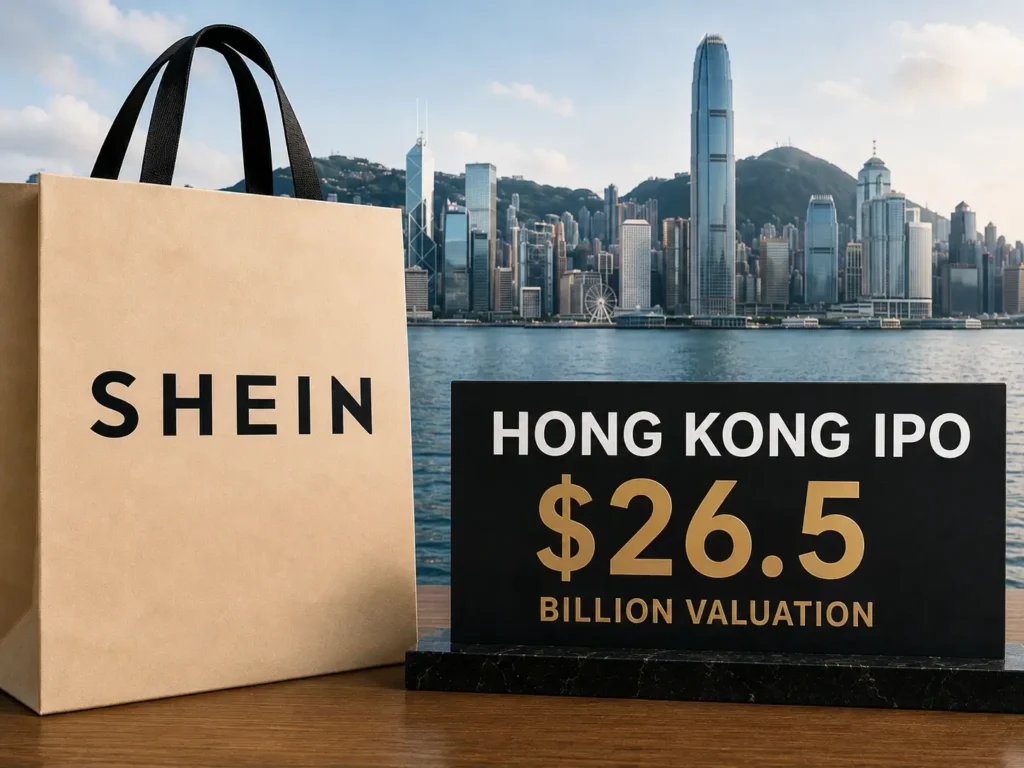
The online fast-fashion retailer is set to price its Hong Kong initial public offering at around HK$48.56 per share, near the midpoint of its marketed range. The offering is expected to raise approximately $1.7 billion, putting Shein’s valuation at around $26.5 billion, according to Reuters.
That number tells a much bigger story than the size of the IPO itself.
From a $100 Billion Darling to a $26.5 Billion Public Company
At its private-market peak in 2022, Shein was valued at nearly $100 billion. A subsequent 2023 funding round valued the company at approximately $66 billion.
Its Hong Kong IPO therefore represents a significant reset in expectations.
At roughly $26.5 billion, Shein would enter public markets at only about one-quarter of its 2022 peak valuation.
For investors, the question is no longer simply whether Shein can continue growing.
The bigger question is whether the extraordinary growth that made Shein one of the world’s most valuable private companies can be recreated in a much more demanding environment.
The End of the Hyper-Growth Era?
Shein built its global business around an exceptionally fast retail model.
The company combines digital-first customer acquisition with rapid product launches, data-driven merchandising and a highly responsive supply chain. Its model helped it reach consumers across roughly 160 countries, offering products at extremely low prices.
But the environment around that model has changed.
Competition in online fashion has intensified. Consumer spending has become more selective. Operating costs have risen. And regulatory scrutiny in major markets has created additional pressure.
That makes the public-market transition particularly important.
Private companies can operate with a long-term growth narrative. Public companies have to repeatedly demonstrate that growth through financial performance.
For Shein, that transition will now happen under the full attention of public-market investors.
Why Hong Kong Matters
The Hong Kong listing is also the result of a long and complicated road to the public markets.
Shein spent years exploring potential listings in both New York and London before ultimately pursuing Hong Kong.
The company, founded in China and now headquartered in Singapore, has faced regulatory and political challenges surrounding its international expansion.
Choosing Hong Kong gives Shein access to a major Asian capital market while providing a path toward becoming a publicly traded company after years of uncertainty.
The move also highlights Hong Kong’s continuing importance as a destination for major Asian businesses seeking public capital.
What Investors Are Really Buying
The IPO will raise fresh capital, but the bigger investment thesis is about Shein’s ability to evolve.
The company says proceeds will primarily support areas including technology and global expansion.
That creates an interesting strategic challenge.
Shein cannot simply depend on selling more ultra-cheap clothing.
Its next phase will require balancing growth, profitability, regulation, brand reputation, supply-chain resilience and international expansion.
That is a very different challenge from the one that helped create its initial success.
A Reality Check for Global Retail
Shein’s valuation reset is also significant beyond the company itself.
For years, the fashion industry demonstrated how quickly a digital-first business could disrupt traditional retailers.
Shein showed that a company could build enormous global reach without relying on the traditional network of physical stores.
But its IPO arrives at a time when investors appear increasingly focused on something else: the quality and durability of growth.
A business can attract millions of customers and still face difficult questions about margins, regulation and long-term economics.
Shein’s public debut will therefore become a test of whether its disruptive retail model can mature into a sustainable public-market business.
The Bigger CEO Lesson
Shein’s journey offers an important lesson for leaders building high-growth companies.
Valuation is not the same thing as value.
A company can be worth $100 billion in a private funding environment and considerably less when public investors begin measuring its future earnings, risks and growth prospects.
The transition from private-market enthusiasm to public-market accountability can be unforgiving.
For Shein, the Hong Kong IPO is not simply an exit event for early investors.
It is the beginning of a new chapter in which the company must prove that the business model that made it a global retail phenomenon can also deliver sustainable value at scale.
The Bottom Line
Shein’s $26.5 billion Hong Kong valuation may look like a disappointment compared with its $100 billion peak.
But the more important story is what happens next.
The company has already demonstrated that it can disrupt global fashion.
Now, public investors will be watching to see whether it can turn disruption into durable, profitable growth.
And that may ultimately prove more valuable than any private-market valuation ever was.