The City Was Always the Building
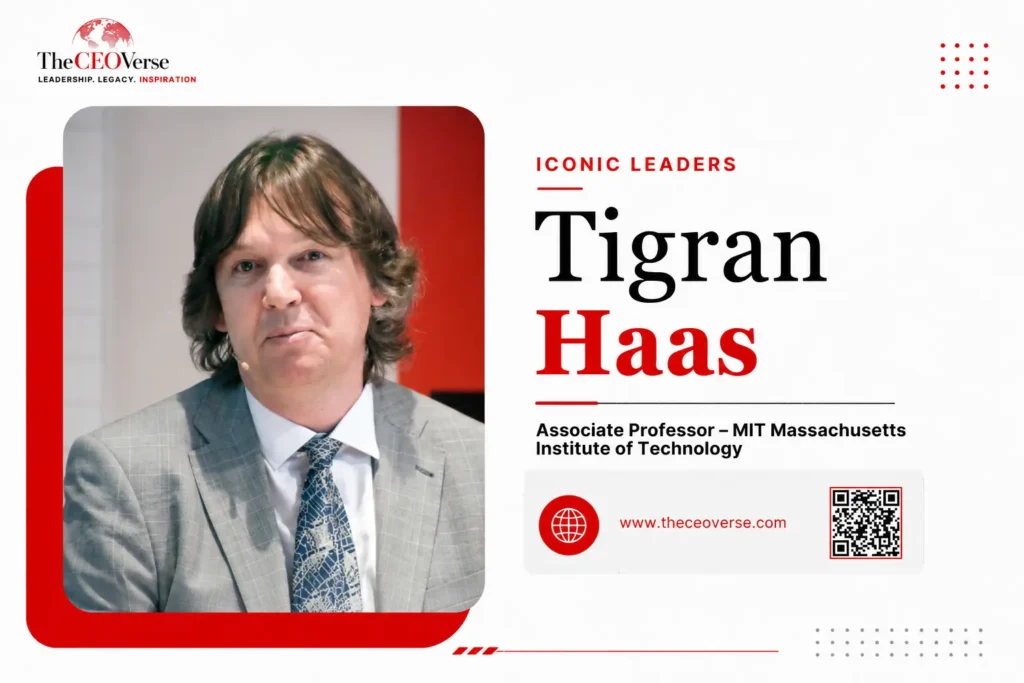
Most architects spend their careers perfecting a single structure. Tigran Haas realised early on that what happens between buildings — the streets, the public spaces, the invisible fabric of how people actually live — was the harder and more interesting problem.
That shift, from architecture to urbanism, wasn’t a detour. It was the whole point.
Today, Tigran is Associate Professor of Urban Planning and Urban Design at KTH – The Royal Institute of Technology in Stockholm, and a Guest Research Fellow at MIT’s Norman B. Leventhal Centre for Advanced Urbanism. Two of the most respected institutions in the world, and he operates across both without making it sound like a credential — more like a natural consequence of following the work wherever it leads.
A Background That Made Academia Feel Inevitable
His father was a university professor of theoretical physics. His mother spent her career as a lab researcher and biotechnology specialist at MIT and the FDA. Tigran insists his path into academia was accidental — “those that cannot make it in the real world, they end up teaching” — but that’s the kind of self-deprecating humour that usually comes from someone who made very deliberate choices and doesn’t feel the need to explain them.
His doctoral work was in environmental science and regional planning in the US. The complexity of cities had already taken over by then.
The Work Itself
Over 100 scholarly articles. 50 conference papers. 10 books. 3 research anthologies. More than 15 PhD students supervised, and over 125 at the masters level.
The numbers are significant, but Tigran points to something quieter as his most formative experience — eight years of teaching project and strategic management at KTH in Stockholm and ZSEM in Zagreb. That’s where he learned how teams actually function, how to lead through ambiguity, and how to assess work environments honestly. Everything he’s built since — research centres, labs, long-term projects — runs on what he figured out in those classrooms.
He has also served as steward to four honorary doctors at KTH: Richard Florida, Saskia Sassen, Edward Glaeser, and Manuel Castells. If you know urban thinking, that list tells you something about the circles Tigran moves in and the weight of the conversations he’s been part of.
On Cities, Places, and What Actually Matters
KTH’s Centre for the Future of Places, which Tigran has been central to, exists for a specific reason: to shift the focus of urban discourse from objects to places. It sounds like a subtle distinction. It isn’t.
Object-focused urbanism builds impressive things. Place-focused urbanism asks whether people actually want to be there — whether the city is liveable, healthy, and just. That question sits at the core of everything Tigran researches and teaches.
KTH as an institution backs this up. Founded in 1827, it now operates around three pillars — diversity and equality, internationalisation, and sustainability. Tigran’s work lives at the intersection of all three.
What COVID Confirmed
The pandemic didn’t change Tigran’s thinking about cities — it confirmed what he already believed. Universities, public spaces, and urban environments are social infrastructure first, physical infrastructure second. When that social layer breaks down, the rest follows quickly.
His response during the pandemic was practical: maximise what online learning could actually do, build systems flexible enough to bend without breaking, and maintain the collegiality that makes institutions function under pressure.
His read on what comes next is straightforward — hybrid teaching and research are permanent, not temporary. Office environments will change fundamentally. The 3+2+2 working week isn’t a pandemic experiment, it’s the direction of travel. And cities will need to be redesigned around that reality, not the one that existed in 2019.
Five Pillars, One Direction
Tigran lives by what he calls the 5Ps — Passion, Perseverance, Professionalism, Persuasion, and Playfulness. It’s a framework that holds up precisely because it isn’t abstract. Every piece of his career maps onto it: the long hours of research, the decades in classrooms, the willingness to work across disciplines without losing focus.
He’s currently writing five new books. He’s mid-postdoctoral fellowships at UC Berkeley, MIT, and the University of Michigan simultaneously.
The city, for Tigran Haas, was never just a place to study. It’s the most complex human project ever attempted — and he’s still in the middle of figuring it out.