A Journey Built on Borrowed Time and Night Schools
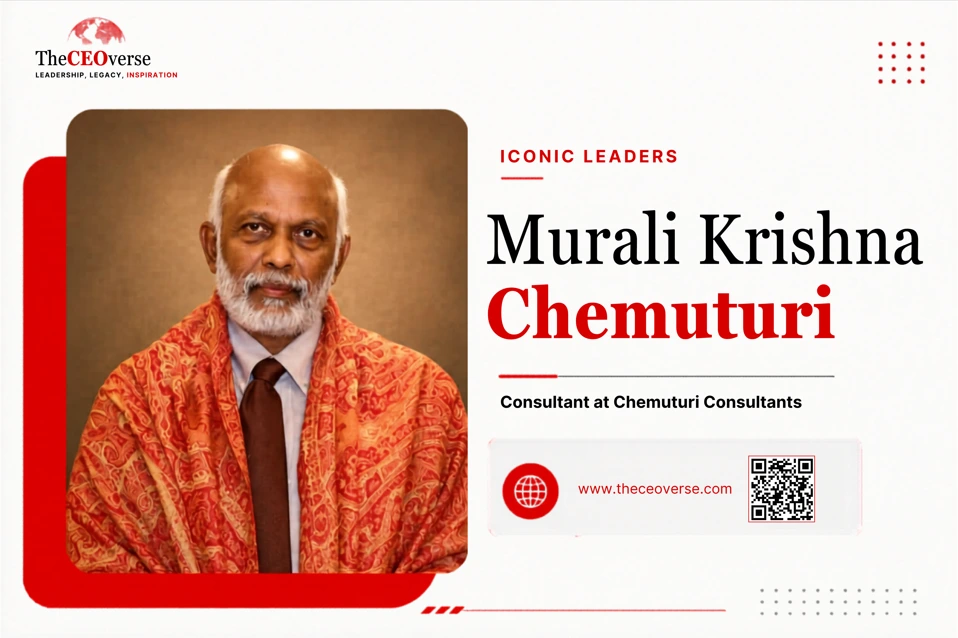
Murali Krishna Chemuturi grew up in Chityala — a small village in West Godavari, Andhra Pradesh. Middle child in a family of seven. His father never finished high school. His mother stopped at middle school. There wasn’t much of a plan beyond the land they worked and the cattle they kept.
He was almost always in the top two in his class. That part came naturally. The rest he had to build himself.
When he got a chance to join ECIL — Electronics Corporation of India Limited — as a technical assistant in Hyderabad, he took it. He was young, trained through an engineering diploma, and suddenly in a room with engineers who actually knew what they were doing. He watched them closely. Absorbed what he could. Not because someone told him to, but because he was paying attention in a way that most people don’t bother to.
The days were full, so he used the nights. He attended night school while working full-time and earned a degree in Industrial Engineering, then an MBA, then a postgraduate diploma in computers. Three qualifications, all built around a job. Nobody gave him time for it. He made it.
Principles Forged Across Generations of Change
His principles didn’t come from a business book. His father showed him what honesty looks like without ever making a statement about it. A line from Rabindranath Tagore — about tireless striving toward perfection — is one he still comes back to. A Readers Digest article told him: do it well or not at all. He took that seriously.
The one about stretching beyond capacity came from the laborers he worked with in the fields. They took on more than they could chew and chewed it anyway. He thought that was worth trying.
What he learned about management took longer. He eventually understood that supervising people isn’t the job. Integrating their efforts, clearing what’s in their way, letting the team actually deliver — that’s the job. It took years to get there. Once it clicked, it didn’t change.
The Engineer Who Turned Failing Projects Into Firsts
By the mid-1980s, Murali had become the person organizations called when something had already gone wrong. Not because he was assigned to those situations. Because he volunteered.
In 1985, he led the introduction of a Computer Aided Design system at ECIL. First of its kind in a Hyderabad manufacturing organization. In 1987, he did it again — a PC network-based material management system. First in ECIL, first in the city. He also resolved a major software issue that a well-known development company had failed on for a defence project. He doesn’t mention it much. It happened.
At TCS, he kept the same pattern going. At one point he worked 96 hours straight — short breaks every 24 hours — to get a project delivered on time. Whether that was smart is a different question. It worked.
The failed projects, the problem projects, the ones nobody wanted — those are what built him.
Three Traits That Carried Him Through Every Decade
He lists three qualities: the ability to work hard, honesty, and quick learning. That’s all. Not a long list.
The lesson was evident in surviving. He has updated his technical skills more times than he can remember—two generations of programming, three generations of project management, and three distinct conceptions of what a manager should be. He didn’t fight every time things changed. He looked at his studies. He shifted.
The candor created issues. more than once. It also helped him get out of trouble several times. He’s never been a skilled liar. He eventually gave up trying.
The hard work came from his father. It’s the one he says he inherited rather than built. Consistent, not glamorous, present in the long hours and the decades of output that followed. He still shows up.
Consultancy Grounded in Four Decades of Real Work
In 2001, Murali left corporate employment and started Chemuturi Consultants.
He’d seen what bad consultancy looked like — big firms sending fresh graduates into rooms full of experienced professionals. Bookish knowledge, no field exposure. He used to think: why can’t they just read the books themselves?
His actual work served as the foundation for his consultancy. Software engineering, process definition, ISO and CMMI certification, problem-solving, training, and project management. He worked with companies in India and the US. He created a model for predicting work in software testing and presented it at the Association of Software Engineering Excellence in Texas. For a period, his paper was the top search result on Google. At the UK Software Metrics Association in London, he gave a presentation on a framework for customer happiness. Particularly at the Union Jack Club. He inaugurated the International Software Measurement and Analysis conference in Mumbai. His paper on analogy-based estimation was later cited as evidence in the Oracle v SAP case — a dispute that ended in a billion-dollar settlement.
The work spoke. That was always the point.
A Body of Work That Reached Further Than He Did
Alongside the consultancy, Murali was writing.
Seven books on information technology. Two on management. One on personality engineering — drawn from years of watching how people actually behave under pressure, not how they say they do. He wanted to make what he’d learned transferable. Put it somewhere it could outlast him.
It worked out better than he expected. Those books are prescribed reading at the postgraduate level in over 60 universities across more than 20 countries. They’re in over 800 university libraries — Stanford, Princeton. His book on software quality assurance is in the library at CERN.
“My books had gone to places where I could not go. I am a proud producer of knowledge besides being its favourite consumer. “
That line says everything. He wrote it, not us.
A Legacy Written in Pages, Not Plans
Murali is 75. He’s not chasing the market anymore and he’s clear about that. Chemuturi Consultants will not survive him — he says this plainly, without drama.
He takes on specific work that comes to him. He mentors younger people for free. And for the past few years, he has been translating ancient Sanskrit texts into English — Ramayana, Uttara Ramayana, Garuda Purana, Bhagavad Gita, Shanti Parva, Anushasana Parva, Ashwamedha Parva. So the wisdom inside them reaches people who’d otherwise never find it.
He’s currently working on the Ashta Geetha — eight Gitas compiled into one. The man who once worked through the night for a software deadline is now doing the most patient work of his life. Different kind of deadline now.
Beyond his professional work, Murali has made quiet contributions to the communities that shaped him:
- He added a cycle parking block to a school in his native village of Chityala
- He instituted an award at the Indian Institution of Industrial Engineering, recognizing an outstanding industrial engineer selected by the National Headquarters, once yearly
- He established an award for the Computer Society of India, Hyderabad Chapter, honoring a chosen young researcher in computer sciences
The Obstacles That Shaped the Method
Money was the first obstacle. It quietly closed doors before he could even see them. He couldn’t go to the institutions he might have reached. He worked around it — night school, learning while earning, building qualifications without stopping.
Technical challenges came next. Working at the edge of what’s known means the answers aren’t written down yet. He found them through self-study, through seminars, through talking to people who actually knew things and were willing to share.
The human challenges were the messiest. Some people want to lead. Some want to put obstacles in other people’s paths. He studied personality and psychology seriously enough to write a book about it. His approach to difficult people was always the same: head down, ego in check, keep working honestly. Not exciting. It worked every time.
What He Would Tell Anyone Starting Out
Don’t chase titles. That’s the first thing. Rising fast without the foundation to hold it tends to end badly — he’s watched it happen.
Be honest. Not as a tactic. As a practice. The people who cut corners early have a way of levelling out eventually. He’s seen enough of them to say so.
Make continuous learning a permanent part of how you live, not something you do when things change and force you to. Accept the assignments that feel too large and complex. That’s where the actual growth is. Lead by integrating — not by standing above people and directing traffic.
And expand your empathy as deliberately as you expand your knowledge. That part doesn’t get said enough.
He’s lived every bit of it. That’s why it’s worth hearing.
Murali Krishna Chemuturi is the founder of Chemuturi Consultants, with four decades of experience across software engineering, project management, process certification, and organizational problem-solving. He has authored nine books on technology and management, prescribed at the postgraduate level in over 60 universities across more than 20 countries, and held in over 800 libraries worldwide including Stanford, Princeton, and CERN. He continues to mentor, consult selectively, and translate ancient Sanskrit texts into English.