From Blueprints to Building People
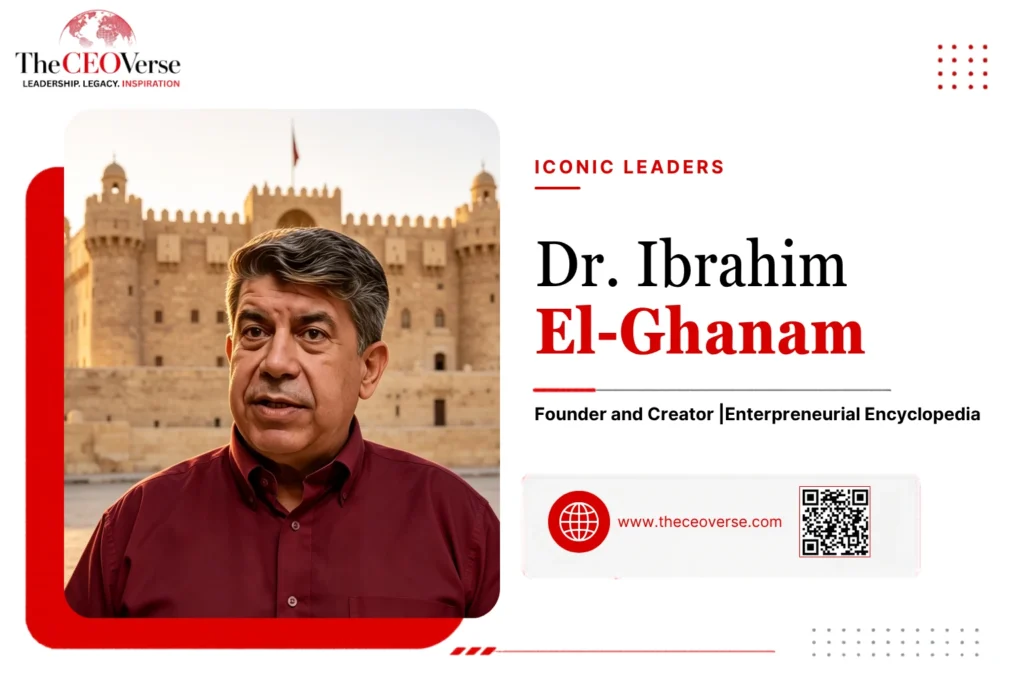
Dr. Ibrahim El-Ghanam began his professional journey far from boardrooms and business schools. Trained as an architect in Cairo during a period of rapid national development, he spent the early years of his career designing commercial complexes, community facilities, and infrastructure intended to serve generations. Those years taught him a lesson that would later shape every aspect of his work: lasting achievements are never accidental—they are built on strong foundations, thoughtful design, and a deep understanding of the environment they serve.
Yet while helping construct physical structures, he became increasingly aware of another challenge unfolding around him.
Across Egypt, he met talented, determined entrepreneurs with promising ideas who were struggling to build sustainable businesses. Their setbacks rarely reflected a lack of ambition or commitment. Instead, they often resulted from limited access to practical guidance, business frameworks designed for different environments, and support systems that failed to reflect the realities in which they operated.
That recurring pattern gradually changed the direction of his career.
He came to believe that the most enduring structures are not made of concrete and steel, but of knowledge, capability, and purpose. Buildings shape communities, but empowered people shape economies.
Over the past four decades, this conviction has guided his work as an Associate Professor at Al Ahram Canadian University, Senior Consultant and Lecturer with the Egyptian Banking Institute at the Central Bank of Egypt, and advisor to universities, government agencies, financial institutions, and international development organizations. Along the way, he has contributed to initiatives that have supported thousands of entrepreneurs while continually learning from the communities he serves.
Today, through Reyada Academy for Leadership & Entrepreneurship Development, he is leading what he considers the most meaningful work of his career: creating an open-access body of entrepreneurial knowledge designed to help current and future generations build stronger, more resilient enterprises. For him, sharing knowledge is not simply an educational mission—it is an investment in long-term economic opportunity.
Three Qualities That Define Leadership
Ask Dr. El-Ghanam what has sustained him throughout four decades of professional life, and he does not begin by speaking about expertise or achievement. Instead, he points to three qualities that have shaped every important decision he has made.
First: Listen before you lead.
Leadership begins with understanding. Every entrepreneur operates within a unique combination of culture, economic realities, relationships, and available resources. Effective solutions emerge not from assumptions, but from careful observation and meaningful dialogue. Before offering advice, he believes leaders must first understand the environment in which others are working.
“People do not need someone to impose solutions,” he often explains; “they need someone willing to understand their reality before helping them improve it.”
Second: Choose resilience over speed.
Modern business often celebrates rapid growth and immediate results. Dr. El-Ghanam sees leadership differently.
Organizations that endure are not necessarily those that expand the fastest, but those that adapt most effectively when circumstances change. Sustainable progress requires disciplined decision-making, continuous learning, and the patience to build systems capable of weathering uncertainty.
His philosophy is straightforward: depth should always come before height.
Third: Never stop learning.
Experience is valuable only when it remains accompanied by curiosity.
Some of the most important lessons of his career did not come from academic research or executive meetings, but from conversations with weavers, farmers, artisans, and entrepreneurs building businesses under challenging conditions with remarkable creativity.
Those experiences continually reinforce a principle that guides his leadership today: the moment a leader believes there is nothing left to learn is the moment that leader begins to lose relevance.
For Dr. El-Ghanam, leadership is not measured by having all the answers. It is measured by creating an environment where everyone—including the leader—continues to learn, grow, and become more capable together.
Integrity as the Only Asset That Never Depreciates
Every enduring structure rests on values that remain constant under pressure. For Dr. Ibrahim El-Ghanam, three principles have shaped every framework he has designed, every institution he has advised, and every entrepreneur he has mentored.
Integrity above all.
His father instilled a lesson that has remained his professional compass throughout life: integrity is the only asset that never depreciates.
Reputation may take decades to build and only moments to lose. For that reason, honesty and transparency are not strategic choices—they are non-negotiable standards. Whether advising a government institution, developing a leadership framework, or mentoring a first-time entrepreneur, he believes that shortcuts may accelerate progress, but only integrity creates work that endures.
Relevance over replication.
One of the defining themes of his career has been challenging the assumption that successful business models can simply be transferred from one country to another.
Every economy operates within its own cultural, financial, and institutional context. Payment practices, customer behavior, access to finance, regulatory environments, and community relationships all influence how businesses grow.
Rather than importing solutions unchanged, Dr. El-Ghanam advocates adapting proven global practices to local realities. An elegant model that cannot be implemented has little value. A practical framework that reflects people’s everyday circumstances creates lasting impact.
This philosophy later became the foundation of one of his most significant professional contributions.
Knowledge belongs to everyone.
The belief that knowledge should be freely shared lies at the heart of his work.
Practical entrepreneurial guidance should never be reserved for those with privileged access or financial resources. By making knowledge openly available, more people can avoid common mistakes, make better decisions, and create stronger enterprises that contribute to their communities.
That conviction continues to drive the development of The Entrepreneurial Encyclopedia, an open-access initiative designed to preserve practical business knowledge accumulated over more than four decades of field experience.
When Global Models Met Local Reality
The experience that transformed Dr. El-Ghanam’s professional approach did not begin with success.
It began with failure.
Early in his transition from architecture to enterprise development, he introduced internationally respected business frameworks that had produced impressive results across Europe and North America. Their academic foundations were sound, their methodologies well tested, and their reputation firmly established.
Yet when applied directly to Egyptian SMEs, the results were disappointing.
The issue was not the quality of the models. It was the context.
Many were designed for business environments with stable financing systems, different customer behaviors, and institutional structures that did not fully reflect local realities. They overlooked informal commercial relationships, limited access to capital, family-operated enterprises, and the practical constraints under which many entrepreneurs built successful businesses.
Instead of asking why entrepreneurs struggled to follow the models, Dr. El-Ghanam began asking a different question:
How are successful entrepreneurs already solving these challenges, and how can those lessons be strengthened?
The answer required leaving conference rooms behind.
For months, he visited workshops, rural communities, open-air markets, and home-based enterprises throughout Upper Egypt. He observed how local entrepreneurs balanced limited resources with remarkable ingenuity, adapting continuously to changing circumstances while building businesses deeply rooted in their communities.
Those experiences reshaped his thinking.
Rather than beginning with theory and expecting reality to adapt, he began with reality itself. Global knowledge remained valuable—but only when interpreted through local experience and practical application.
That shift became the cornerstone of his professional philosophy.
The El-Mobadara Model: From Observation to Impact
The insights gained from years of fieldwork eventually evolved into the El-Mobadara Model, a four-phase framework built around assessment, adaptation, implementation, and continuous learning.
Instead of presenting entrepreneurs with standardized solutions, the framework starts by helping them understand their own environment, resources, opportunities, and constraints before introducing proven international practices that can be adapted to fit their circumstances.
This practical approach has led to the model being adopted by government agencies, commercial banks, universities, and international development organizations, contributing to the development of thousands of sustainable enterprises across Egypt.
Its success reflects a simple but powerful principle:
Effective entrepreneurship begins not with copying success elsewhere, but with understanding where you stand today.
Looking Beyond Business Performance
While much of the entrepreneurship world focuses on finance, marketing, and operations, Dr. El-Ghanam has consistently argued that the health of the entrepreneur deserves equal attention.
Years before entrepreneur wellbeing became a widely discussed topic, he was exploring the effects of burnout, chronic stress, decision fatigue, and behavioral risk on long-term business performance.
His work recognizes that sustainable enterprises are built not only through sound strategies, but also through leaders who remain physically, mentally, and emotionally capable of making wise decisions during periods of uncertainty.
Alongside these initiatives, he continues developing The Entrepreneurial Encyclopedia—a not-for-profit, open-access knowledge platform created almost entirely through volunteer effort and personal commitment.
Built without major funding or commercial backing, the initiative demonstrates a philosophy that has guided his entire career: meaningful contributions are defined less by available resources than by clarity of purpose and consistency of effort.
For Dr. El-Ghanam, knowledge creates its greatest value only when it is shared widely enough to help others build something that lasts.
Foundations Deep Before Ambitions High
When asked what advice he would offer aspiring entrepreneurs, Dr. Ibrahim El-Ghanam rarely begins by discussing finance, technology, or rapid expansion. Instead, he starts with a question that has guided his work for decades:
What meaningful problem are you trying to solve?
Too many businesses begin with a product and then search for customers. In his experience, sustainable enterprises take the opposite approach. They begin by understanding people’s real needs and then designing solutions that create genuine value.
“The market rewards businesses that solve meaningful problems,” he says. “Everything else follows.”
His second message is equally direct.
Growth without resilience is not sustainable growth—it is greater exposure to risk.
Throughout his career, he has seen promising businesses expand rapidly only to struggle because their leadership, operating systems, financial discipline, or organizational culture failed to grow at the same pace.
That is why he encourages entrepreneurs to invest first in the foundations that are often invisible: integrity, sound judgment, continuous learning, capable teams, and personal wellbeing.
He also believes entrepreneurs should study failure as carefully as they study success. Success explains what worked in one situation. Failure often reveals the risks that should never be ignored.
Finally, he encourages every entrepreneur to remain grounded in local realities while maintaining a global perspective.
International ideas can inspire innovation, but lasting success comes from adapting them thoughtfully rather than copying them blindly. Every market presents unique opportunities, challenges, and cultural dynamics. Understanding that reality is the first step toward building something that endures.
Legacy Is What You Enable Others to Build
Throughout his career, one principle has remained constant:
“Build foundations, not facades.”
Architecture taught Dr. El-Ghanam that impressive structures can conceal hidden weaknesses if their foundations are compromised. He believes the same principle applies to leadership, entrepreneurship, and institutional development.
Rapid growth, public recognition, and impressive financial results may attract attention, but without integrity, capable people, effective governance, and a clear sense of purpose, they rarely withstand the test of time.
True leadership focuses on strengthening what cannot always be seen.
It develops people before pursuing expansion.
It builds resilient systems before celebrating growth.
It invests in long-term capability rather than short-term visibility.
Another belief has shaped his life’s work just as profoundly:
The best way to help people is to make them capable of helping themselves.
Temporary assistance may solve today’s challenge, but education, critical thinking, and practical capability create opportunities that last for generations.
That conviction has influenced every framework, every training program, and every knowledge initiative he has developed over the past four decades.
For Dr. El-Ghanam, leadership is not measured by how indispensable a person becomes. It is measured by how many others become capable of leading without them.
The Horizon Ahead
Although his professional journey spans more than forty years, Dr. El-Ghanam believes his most significant contribution is still taking shape.
His immediate focus is completing The Entrepreneurial Encyclopedia, transforming it into a living, continuously evolving, open-access resource for entrepreneurs, educators, mentors, and development practitioners around the world.
The long-term vision extends well beyond publication.
He hopes to expand the initiative through international collaboration, invite contributions from experienced practitioners, translate its content into multiple languages, and make it accessible both online and offline so that knowledge remains available regardless of geography or connectivity.
At the same time, he envisions Reyada Academy strengthening partnerships across Africa, the Middle East, and other emerging economies, demonstrating that entrepreneurship frameworks developed from local realities can create value far beyond the communities in which they originated.
Personally, he sees the years ahead not as a time to seek greater visibility, but as an opportunity to write, mentor, document, and quietly strengthen the work itself.
His goal has never been to remain at the center of every initiative.
It has always been to build systems that continue creating value long after their creator has stepped aside.
The Work That Needed Almost Nothing to Begin
People often assume that ambitious initiatives require significant funding, influential networks, or large organizations behind them.
When asked what made his open-access knowledge project possible, Dr. El-Ghanam offers a different answer.
Conviction.
Volunteer effort.
Persistence.
Years of disciplined work carried out during evenings, weekends, and every available moment.
To him, beginning with limited resources was never a disadvantage. It became one of the initiative’s greatest strengths.
Without commercial pressure or external agendas, every decision could remain guided by a single question:
Will this genuinely help entrepreneurs build stronger, more sustainable businesses?
That question continues to shape every article, every framework, and every contribution.
His advice to the next generation reflects the same philosophy that has guided his own journey:
You do not need perfect conditions to begin.
You do not need extraordinary resources.
You do not need permission.
Start where you are.
Use what you have.
Solve one meaningful problem well.
The most enduring movements rarely begin with abundant resources. They begin with one person who chooses to create value for others—and refuses to stop.
More than four decades after leaving architecture behind, Dr. Ibrahim El-Ghanam still considers himself a builder.
The materials have changed.
Concrete has given way to knowledge.
Buildings have become people, institutions, and opportunities.
Yet the purpose remains exactly the same: to build strong foundations that enable others to create, grow, and lead long into the future.
Some people leave behind impressive buildings.
Others leave behind stronger people.
Dr. Ibrahim El-Ghanam hopes his greatest construction will be the generations of entrepreneurs who continue building on the foundations he helped create.