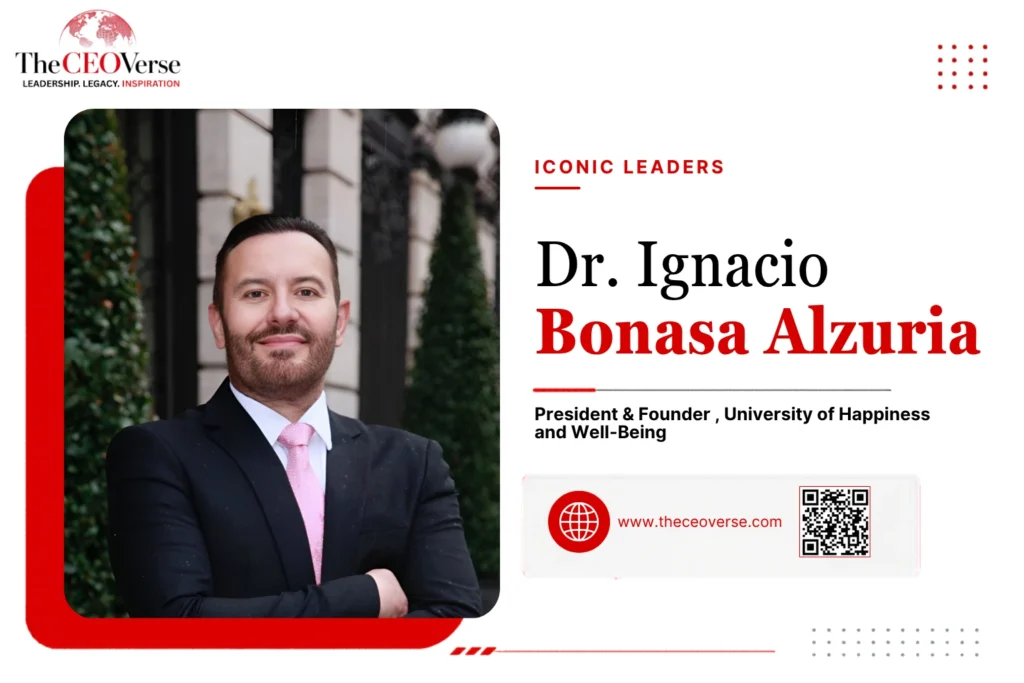
A LIFE DEVOTED TO PUTTING THE HUMAN BEING BACK AT THE CENTRE
Dr. Ignacio Bonasa Alzuria, President and Founder of the University of Happiness and Well-Being, on banking, rebirth, and the belief that success and soul were never meant to be opposites.
There are careers that can be told through titles and milestones. Dr. Ignacio Bonasa Alzuria’s cannot. His has to be told through a question that has followed him for years: what is success worth if it does not help people live with greater meaning, dignity and hope.
Today he leads the University of Happiness and Well-Being, an institution he describes not as a job but as the most complete expression of his life’s purpose. Around it sit a cluster of smaller ventures, Liderarte, DVT, the Parliament of Ibero-American Leaders, the European Association of Well-Being, and the upcoming Ibero-American Academy of Doctors, each different in shape, all pulling from the same root.
At A Glance
President & Founder of the University of Happiness and Well-Being, Founder of Liderarte, international keynote speaker, author of 11 books, contributor of more than 200 published articles, and recipient of multiple international academic and leadership distinctions, Dr. Ignacio Bonasa Alzuria has dedicated his career to advancing human-centered leadership, well-being, education, and organizational transformation.
From Banking Discipline To Building A University Of Purpose
The path to a University of Happiness and Well-Being did not start in a classroom. It started in banking. Senior executive roles, teams under his charge, decisions made where consequences arrived immediately. That world taught discipline, strategic thinking, commercial instinct.
It also unsettled him. Talented people hit every target while quietly running themselves into the ground. Organizations tracked everything except the inner state of the people producing results. A company could look impressive on paper and still be humanly impoverished underneath.
He left. Not gradually, but as a full break from a career already built and recognized. He calls it a personal rebirth rather than a professional pivot. Liderarte came first, built around art, emotion and leadership. The University followed, the point where experience, research, education and purpose finally converged.
Banking gave him structure. Entrepreneurship gave him courage. Art gave him sensitivity. Research gave him depth. Service gave the rest of it meaning.
The Leadership That Moves Without Applause
Ask what made him effective as a leader and he does not reach for charisma or vision statements. Three things: courage, sensitivity, perseverance.
Courage, in his telling, is not the dramatic kind. It is the willingness to begin again, to question what looks unquestionable, to make calls that will not be understood right away. Leadership often means walking before the path is visible.
Sensitivity is the second piece. Not softness, the capacity to read past what people say, to notice fear, fatigue, talent gone unspoken, hope gone quiet. Strategic intelligence with a human conscience, he calls it.
The third is perseverance, carefully qualified. Meaningful projects rarely arrive with applause. They survive through resistance and slow, repeated effort. But the perseverance that works is intelligent. It knows when to adjust the sails without abandoning the destination.
Leadership Is Not A Throne, It Is A Responsibility
Five words anchor what guides him: dignity, coherence, service, gratitude, hope.
Dignity means treating people as more than resources, as individuals with a story and an emotional reality that does not disappear at work. Coherence is the discipline of keeping what he thinks, says and does aligned. Service is the idea he returns to most: leadership is not a throne. It is a responsibility.
Gratitude guards against arrogance, since no achievement belongs entirely to one person. Mentors, colleagues, students, people who believed in the work before it produced anything, sit behind every milestone.
Hope is the one he calls most important, and a specific kind. Not passive hope. Active hope, the decision to create possibility where others only see limits. The belief that people and organizations can reset, relearn, recover whatever they had lost.
A Root System Disguised As Separate Projects
The University’s work spans executive education, international conferences, research, publications, leadership development and organizational well-being programs, built around a view of well-being touching the body, thought, emotion, transcendence, social life, professional life, finances and technology.
It does not teach happiness as a formula. It creates conditions, for people to understand themselves, strengthen what they already have, and lead with something resembling purpose.
That work does not stay contained to one institution. Liderarte carries it through art. The European Association of Well-Being pushes it into organizational practice. The Parliament of Ibero-American Leaders turns it into dialogue across countries. DVT, Turn the Table, applies it to reinvention. The forthcoming Ibero-American Academy of Doctors will hold knowledge to the same standard, that it has to serve.\
Different projects, different shapes. Same root.
Released From A Version That Had Grown Too Small
The hardest period was not a failed venture or a public setback. It was walking away from a career that was already working, already secure.
Leaving meant giving up an identity built over years. Financial pressure, doubt, a loneliness that comes from choosing a direction others cannot yet see the logic of. External certainty disappeared before internal certainty had fully arrived to replace it.
What brought him through it was a harder question than “what can I do.” He asked instead what he was there to contribute. He leaned on people who paired affection with honesty. He studied, wrote, kept moving. Art helped too, music, theatre, the reminder that transformation is something a person can actually live through.
One line from that period has stayed with him: life does not always break our plans to destroy us. Sometimes it is releasing us from a version of ourselves that had already grown too small to hold what we were becoming.
Recognition As A Window, Not A Mirror
Over the years, Bonasa has collected an unusually long list of academic and institutional honors, honorary doctorates, additional doctoral qualifications, distinctions tied to leadership, education, well-being and humanitarian service, along with hundreds of published articles and eleven books.
He does not linger on the list. A recognition should never become a mirror where a person admires themselves. It should be a window, one that shows the people still waiting to be served. The distinction that actually matters is smaller than any award: a student saying a program changed how they live, a leader learning to care for their team, someone recovering hope because an idea reached them at the right moment.
Adjusting The Sails, Turning The Table Every Time
Two phrases anchor how he thinks about difficulty. The first: he cannot change the direction of the wind, but he can adjust the sails to reach his destination. Responsibility without the fantasy of control.
The second is the name of one of his own ventures. Turn the Table. Refuse to let adversity have the final word. A setback might be carrying a lesson. A crisis might be revealing a vocation waiting underneath. A closed door might be forcing a more honest path into view.
Underneath both ideas sits his 4A model: Learning, Attitude, Soul, Action. Learning opens the mind. Attitude decides how reality gets faced. Soul supplies the humanity. Action is the one that actually matters, since without it, inspiration just sits there, unfinished.
Inspired By Those Who Stayed Tender After Suffering
What moves him is not success in the abstract. People who rebuild without losing their tenderness, who suffer without turning bitter, who succeed without losing their humility, who lead and still keep listening.
Art holds a specific place here. Opera, zarzuela, theatre, capable of revealing the entire human condition, ambition, love, loss, courage, betrayal, redemption, hope, in the space of an evening, work a classroom might take years to unpack. Part of why art occupies the place it does inside Liderarte and inside his broader idea of education.
Students and collaborators complete the list. Every time someone chooses to grow, forgive, or start again, it is a reminder of why the University exists at all.
Success And Soul Are Not Meant To Be Opposites
The next stage is not about scale. It is about relevance, deeper research, stronger academic partnerships, more international presence, models that hold up inside organizations and education systems, not just inside a mission statement.
The surrounding projects are tightening into a single ecosystem rather than a loose collection. Liderarte keeps bringing art into leadership. The European Association keeps building standards. The Parliament keeps opening channels between countries and generations. DVT keeps pushing reinvention as a culture rather than an event.
Personally, he wants to keep writing, teaching, researching. Not accumulating more projects, connecting the ones he already has around a single legacy, built on the idea that success and soul were never supposed to be opposites.
Preparation Builds A Career, Character Builds A Leader
His advice to leaders earlier in the climb is unsentimental. Do not mistake visibility for value, titles for service, or speed for direction. Build preparation, yes, but build character alongside it. Learn to speak, but learn to listen first.
Do not wait until you feel fully ready. Most of the decisions that matter get made with courage before certainty arrives. Mistakes will happen. The failure is repeating them without learning anything.
Protect your soul, he tells them plainly. Some achievements cost too much if they require betraying your values, neglecting the people you love, or becoming someone you no longer recognize. Success is supposed to expand a person’s humanity, not shrink it.
Surround yourself with people who celebrate your light without feeding your ego, who tell you the truth without putting out your dreams. Not people who applaud everything. People who help the vision earn the right to serve whoever it is meant for.
An Invisible Thread Connecting Every Fall And Every Reinvention
Looking back, he does not see a clean trajectory. Decisions, risks, falls, encounters, reinventions, and running through all of it, one invisible thread: the decision to put the human being back at the center.
The University is not simply an institution. It is a promise, that knowledge can heal, that leadership can carry care, that organizations can have a soul, and that success can be measured by more than what gets achieved, by what gets awakened in other people along the way.
He is not indifferent to the recognitions or the publications. But he does not want to be remembered for a curriculum. He wants to be remembered for helping people believe in themselves again, for bringing humanity into rooms where only results used to get discussed, for defending joy without pretending pain does not exist.
His own summary of it: projects with soul, built to keep generating hope long after he is no longer there to explain them.