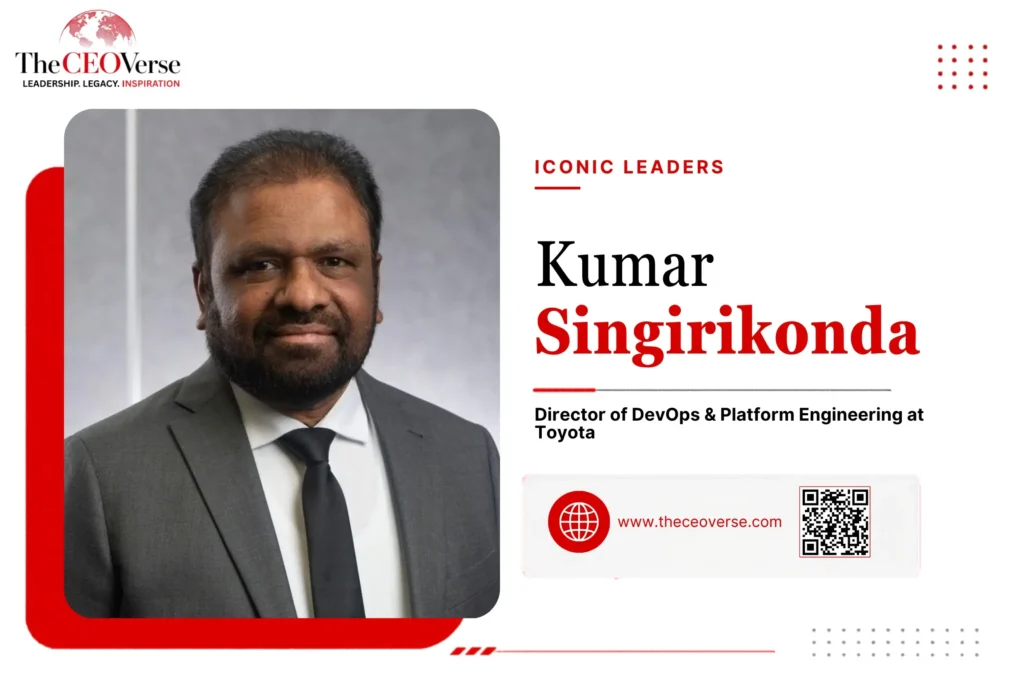
Kumar Singirikonda: From a Curious Engineer to an Enterprise Technology Leader, Author, Mentor, and Voice for Intelligent Engineering
In the modern enterprise, technology leadership is no longer defined solely by the ability to build sophisticated systems. It is measured by something more demanding. The ability to make technology simpler, businesses more resilient, teams more capable, and innovation more meaningful.
At the intersection of these priorities stands Ekambar Kumar Singirikonda, widely known as Kumar, a technology transformation leader whose professional interests span DevOps, platform engineering, Site Reliability Engineering (SRE), cloud infrastructure, automation, FinOps, and artificial intelligence. As Director of DevOps & Platform Engineering at Toyota, Kumar works in a field where reliability, scale, and operational discipline are not abstract ambitions but essential business requirements.
His journey reflects the evolution of a technology professional who began by solving technical problems and gradually moved toward a broader responsibility. Understanding how people, processes, architecture, and business strategy must work together to create lasting value.
For Kumar, the future of engineering is not simply about deploying software faster. It is about building organizations that learn continuously, respond intelligently, and make every technological investment count.
From Technical Curiosity to Enterprise Leadership
Kumar’s journey began with curiosity.
In the early stage of his career, Kumar approached technology primarily as an engineer. Understand the problem, investigate its causes, find a solution, and make the system work better. But as he accumulated experience, he began to recognize that the technical answer was often only the beginning.
A technically elegant solution could still fail if it did not address the organization’s real needs. A modern platform could still become a burden if nobody understood its value. An automation initiative could still disappoint if it automated the wrong process. Singirikonda increasingly found himself looking beyond the immediate technical problem and asking what the organization was actually trying to accomplish.
That shift became one of the most important turning points in his professional development.
He began connecting technology decisions with people, processes, architecture, and business strategy. His career subsequently expanded across DevOps, infrastructure, cloud engineering, DataOps, platform engineering, automation, SRE, observability, and technology transformation.
For Singirikonda, each discipline became another piece of a much larger picture. His curiosity did not allow him to remain confined to one technological specialty. Instead, it pushed him toward understanding how different engineering capabilities could work together to transform the way an enterprise operated.
Kumar still describes curiosity as one of the three qualities that have shaped him most deeply. The other two, resilience and ownership, would become equally important as his responsibilities grew.
Learning Through Complexity
As he moved into increasingly complex enterprise environments, the nature of his challenges changed.
Singirikonda encountered technology landscapes shaped by years of development, accumulated dependencies, established processes, competing priorities, and legacy infrastructure. Those environments taught him that transformation could not be achieved simply by introducing newer technology.
He had to understand the people using systems, the teams maintaining them, the business processes depending on them, and the risks involved in changing them.
That experience helped form the leadership principle that Kumar continues to emphasize today. Start with the outcome, not the technology.
For Singirikonda, the first question should never be which tool or platform should be adopted. It should be what business problem needs to be solved and what measurable outcome the organization wants to achieve.
He evaluates those outcomes through customer value, business value, operational sustainability, and long term scalability. That philosophy has allowed him to approach technology decisions without becoming distracted by technology for technology’s sake.
It is also why Singirikonda places such emphasis on ownership. He believes engineers should take responsibility for outcomes rather than simply completing assigned tasks.
That distinction became particularly important as he moved from individual technical responsibilities into enterprise leadership.
The Toyota Chapter: Simplifying the Enterprise
Kumar’s role as Director of DevOps Engineering at Toyota North America brought together many of the experiences he had accumulated throughout his career. His responsibilities have involved DevOps engineering, platform transformation, automation, reliability, and the development of high performing engineering teams. Singirikonda is essentially a leader driving transformative initiatives at Toyota, with expertise spanning DevOps, cloud engineering, edge computing, and system performance.
At Toyota, he has had the opportunity to work on technology challenges where scale and operational discipline matter enormously.
One of the most meaningful examples in Singirikonda’s own account is legacy platform transformation.
He describes leading efforts involving platforms that had reached the end of their useful life. Retiring such platforms required far more than identifying old technology. Kumar had to understand dependencies, develop migration strategies, coordinate multiple teams, manage operational risk, transition ownership, and ultimately decommission systems without compromising business continuity.
For Singirikonda, that experience reinforced an important lesson. Transformation is sometimes about building something new, but it can also be about having the discipline to remove what no longer creates sufficient value.
By rationalizing platforms and reducing unnecessary complexity, Kumar has focused on creating both financial and operational value. His approach reflects his belief that technology leaders should understand not only how systems function, but also why they exist and what they cost.
In Singirikonda’s hands, modernization becomes less about chasing novelty and more about making deliberate choices.
Leadership Forged Through Difficult Decisions
Kumar’s professional growth has not come without challenges.
Large transformation programs bring competing priorities, resource constraints, legacy dependencies, organizational resistance, and unexpected failures. He has experienced these realities firsthand, and they have influenced the way he defines resilience.
For Singirikonda, resilience does not mean pretending that obstacles do not exist. It means remaining committed to the intended outcome while continuing to account for the people and circumstances involved.
That attitude is closely connected to Kumar’s third defining quality. Ownership.
When he accepts responsibility for an initiative, he views the result as a commitment rather than simply another project assignment. Success belongs to the team, but accountability cannot be delegated away when circumstances become difficult.
This philosophy has also shaped how Singirikonda develops his teams. He encourages people to take ownership of outcomes, make decisions, learn from mistakes, and continuously improve.
He believes every incident should teach something. Every manual process should prompt the question of whether it can be automated. Every costly platform should invite an examination of whether it still creates enough value.
Singirikonda’s DevOps Vision Grew Beyond Tools
DevOps has remained one of the defining disciplines of Kumar’s career, but his interpretation of DevOps extends well beyond deployment pipelines and automation tools.
Singirikonda focuses on building standardized, scalable engineering platforms that improve developer productivity, deployment velocity, reliability, and operational efficiency.
That focus reflects the evolution of Kumar himself.
The engineer who once solved individual technical problems eventually began asking how entire teams could avoid repeatedly solving the same problems. Platform engineering became one answer. Provide reusable capabilities that make it easier for engineers to build, deploy, operate, and scale applications.
His work also brings DevOps together with SRE, observability, and operational resilience. He has emphasized measurable improvements in areas such as Mean Time to Detect and Mean Time to Recover, while focusing on automation and incident reduction.
The objective for Singirikonda is not simply to make technology faster. It is to make engineering organizations more dependable. That distinction has become increasingly important to Kumar as his thinking has evolved toward the next generation of DevOps.
Looking Beyond Automation Toward Intelligence
Singirikonda’s current interests increasingly center on what happens when traditional automation meets artificial intelligence. He envisions an engineering environment in which platforms do more than execute predefined instructions. He sees a future in which systems can understand patterns of behavior, detect anomalies, correlate events, recommend remediation, and eventually perform carefully controlled self healing actions.
For Kumar, this represents the evolution of DevOps from automation toward intelligent and increasingly autonomous engineering. But his vision is not about replacing engineers. It is about changing what engineers spend their time doing.
If repetitive operational work can be automated intelligently, he believes engineers can devote more energy to architecture, innovation, problem solving, and strategic initiatives. If AI can help identify relationships between seemingly unrelated system events, engineers can potentially diagnose incidents more quickly. If platforms can respond intelligently to known classes of problems, organizations can become more resilient.
Singirikonda’s interest in AI therefore follows naturally from his earlier work. Automation was never the destination for him, it was a means of improving outcomes. AI represents another step in that same journey.
Turning Experience into a Book
Kumar’s desire to share practical knowledge eventually led him to become an author. His book, DevOps Automation Cookbook, was published by BPB Publications in 2024. The 376 page book contains practical guidance covering infrastructure as code, Terraform, Git, continuous integration, testing, Docker, Kubernetes, security, configuration management, and compliance.
The book reflects Singirikonda’s own professional philosophy. Rather than writing exclusively about the theory of DevOps, he wanted to provide practitioners with usable recipes and techniques. His objective was to help engineers automate infrastructure provisioning, streamline deployments, improve testing, strengthen security, and scale their workflows.
In many ways, Kumar’s book represents the transition from practitioner to teacher.
The knowledge Singirikonda had accumulated through years of working with complex technology environments was no longer confined to the organizations in which he worked. Through writing, Kumar could share those lessons with engineers at different stages of their careers. The book became another form of Singirikonda’s leadership. Not leading through organizational authority, but through knowledge.
A Career of Industry Recognition
The impact of Kumar’s authorship was recognized when DevOps Automation Cookbook received the 2024 NYC Big Book Award. Ekambar Kumar Singirikonda has been honored as the winner in the Specialty Books category.
Kumar publicly described the recognition as an acknowledgment of a book designed to help DevOps engineers, system administrators, and developers automate, scale, and secure their workflows.
His professional recognition has extended beyond authorship.
Singirikonda was named DevOps Enterprise Leader of the Year in the 2025 DevOps Dozen awards. This was a remarkable recognition for his leadership at Toyota, specofically highlighting his work around automation, reliability, innovation, and enterprise transformation.
He is also the recipient for several other honours, including Visionary Leader of the Year, Author of the Year, technology and innovation recognitions, and other industry titles.
Yet Singirikonda’s own approach to recognition remains closely tied to the people around him. His leadership philosophy consistently places team development and collective achievement alongside individual accomplishment.
Most Meaningful Achievement Are People
For Kumar, perhaps the most important measure of leadership is not a platform launched or an award received. It is what happens to the people he leads. He has repeatedly emphasized that seeing engineers develop into stronger technical and organizational leaders is one of the achievements he values most. That belief has shaped his approach to mentorship.
Singirikonda understands that technology changes continuously. A tool that is essential today may be replaced tomorrow. An architecture that works in one environment may become inadequate in another. But people who learn how to learn can continue adapting.
He therefore encourages curiosity, resilience, and ownership in others. The same qualities he identifies as central to his own journey.
His mentoring work has become an extension of his professional mission. Kumar is not only interested in building stronger systems, he wants to help build professionals capable of creating stronger systems themselves.
That creates a different kind of legacy. A technology platform can eventually be replaced. A person who has learned how to lead, mentor, and solve difficult problems can carry that influence into many future organizations and teams.
His Perspective Into the Wider Technology Community
Singirikonda’s influence has also expanded beyond his responsibilities at Toyota.
His work has included speaking, writing, podcast participation, professional community involvement, and advisory activities. Kumar joined the CDO Magazine Global Editorial Board, contributing his perspective on developments in data and analytics and participating in a wider community of technology leaders.
He has also significantly contributed by the means of advisory involvement with the University of Texas at Austin’s McCombs School of Business and participation with the Harvard Business Review council. These roles give Kumar an opportunity to examine technology from perspectives beyond his immediate engineering responsibilities.
For Singirikonda, advisory leadership is another extension of his transformation journey. Having worked directly with enterprise technology, he can bring practical experience into conversations about leadership, innovation, data, engineering, and organizational change.
Service Beyond Technology
Singirikonda’s professional identity extends beyond technology. He serves on the Board of Directors of Gift of Adoption Funds, an organization that provides grants to help families pursuing adoption. For Kumar, this represents a form of leadership thats grounded in service rather than engineering metrics.
The connection to his professional philosophy is nevertheless clear. Singirikonda consistently describes leadership through the language of responsibility, ownership, and contribution.
Whether he is working to simplify an enterprise technology environment, mentoring an engineer, contributing to an advisory board, or supporting a nonprofit organization, Singirikonda’s approach centers on creating meaningful impact. That consistency is one of the less visible but more revealing elements of his journey.
Building the Next Chapter
Kumar Singirikonda has already moved through several distinct identities. Engineer, technology transformation leader, DevOps executive, author, speaker, mentor, advisor, and community contributor. But these are not the endpoints.
His attention is now increasingly focused on intelligent engineering, AI enabled operations, operational resilience, and leadership development. Kumar wants to help organizations move from reactive operations toward proactive and increasingly autonomous engineering while ensuring that people remain central to the transformation.
That ambition is consistent with the path Singirikonda has followed from the beginning.
Curiosity took him beyond individual technical problems.
Experience taught him to connect technology with business outcomes.
Transformation taught him resilience.
Leadership taught him ownership.
Writing gave him a way to share what he had learned.
Mentorship gave him a way to multiply that knowledge through other people.
And AI is now giving Kumar another frontier to explore.
The Road Ahead
Ultimately, Singirikonda’s journey is less about the number of technologies he has mastered than the transformation he hopes to leave behind.
He wants to leave stronger teams, simpler technology, better customer experiences, greater operational resilience, and measurable business value.
That philosophy explains why the different parts of his career fit together so naturally. His legacy platform work is about simplification. DevOps leadership is about enabling engineers. SRE focus is about resilience. FinOps perspective is about responsible value creation. His book is about sharing practical knowledge. Kumar’s mentorship is about developing people. His advisory work is about contributing beyond his immediate organization. His service work is about using leadership for a broader purpose. And his interest in AI driven automation is about preparing engineering organizations for what comes next.
Kumar Singirikonda began his career by solving technology problems. Over time, he learned that the most valuable solutions often extend beyond the technology itself. Today, Kumar is building something considerably larger. Organizations that can learn, adapt, automate, operate reliably, and create measurable value.
For Kumar Singirikonda, the journey is far from finished. The engineer who began with curiosity is still curious. The leader who learned through complexity is still learning. And the transformation he is pursuing now, from automated engineering toward intelligent, resilient, increasingly autonomous organizations, may prove to be the most consequential chapter of his career yet.