TheCEOVerse • Iconic Leaders
Cover story
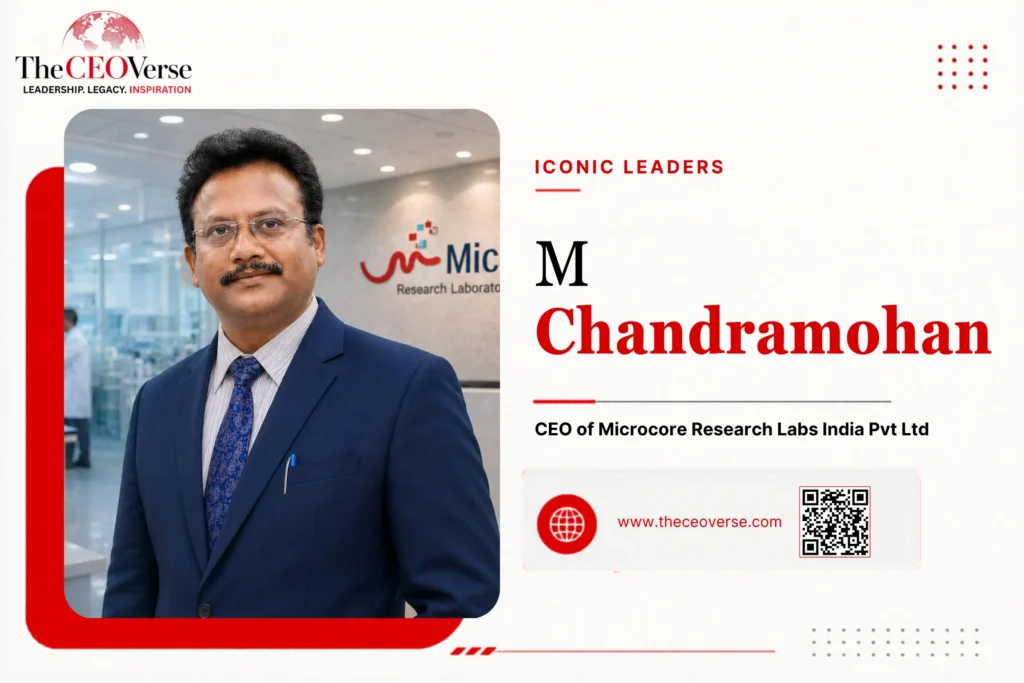
M Chandramohan
CEO of Microcore Research Labs India Pvt Ltd
The Next Frontier in Biotech Nutraceuticals - Powered by MICROCORE
Chandramohan: Transforming India’s Biological Wealth into Global Healthcare Innovation
Every transformative innovation begins with a question that refuses to let go. It is rarely a grand revelation or a dramatic breakthrough. More often, it is an ordinary observation that lingers in the mind of someone curious enough to ask, Why? For Mr. M Chandramohan, that question emerged not inside a sophisticated research laboratory but within the familiar surroundings of a South Indian home.
Like countless others, he had often heard family members remark that idlis prepared by elderly hands were invariably softer, lighter, and more flavorful than those made by younger generations, despite identical ingredients and recipes. Most accepted it as experience or tradition. He saw something entirely different. A scientific mystery waiting to be explored.
That simple curiosity would evolve into a defining moment in a journey spanning more than two decades of scientific discovery, industrial biotechnology, and entrepreneurial innovation. Today, as the Founder and Principal Scientist of Microcore Research Labs India Pvt. Ltd., Mr. M Chandramohan is leading research that transforms overlooked biological resources into clinically validated healthcare innovations. Yet behind every patent, every laboratory breakthrough, and every commercial success lies a philosophy that has remained unchanged since the beginning: science achieves its greatest purpose only when it improves human life.
Unlike many entrepreneurs who identify market gaps first and build businesses around them, Mr. Chandramohan’s path has always been driven by scientific inquiry. His ambition was never merely to commercialize technology. It was to understand nature deeply enough to unlock solutions capable of addressing some of healthcare’s most pressing challenges while remaining sustainable, accessible, and meaningful. For him, research is not a destination but a continuous journey, one where every hypothesis opens the door to another question, every experiment deepens understanding, and every discovery carries the responsibility of creating lasting societal value.
Where Curiosity Became Conviction
Mr. Chandramohan’s formal scientific journey began at Presidency College, Chennai, where he completed his Master’s degree in Applied Microbiology in 2001. While his academic training strengthened his understanding of microorganisms, it also encouraged him to look beyond textbooks and laboratories. He became increasingly fascinated by India’s rich heritage of traditional food science, a domain that had nourished generations long before microbiology became an established scientific discipline.
Fermented foods such as idlis and dosa were perfect examples. Celebrated for centuries for their digestibility, nutritional richness, and suitability for people of all ages, these everyday foods represented complex microbial ecosystems operating with remarkable precision. Yet despite their cultural significance, few researchers had examined them through the lens of modern microbiology. For Mr. Chandramohan, this represented an opportunity to bridge two seemingly different worlds: indigenous knowledge and contemporary science.
He believed that traditions surviving across generations often possessed scientific foundations that simply awaited validation. Rather than dismissing inherited practices as folklore, he viewed them as living laboratories capable of revealing new biological insights. That perspective would soon define the trajectory of his career.
Decoding the Science Behind Tradition
Determined to understand the biological processes behind traditional fermentation, Mr. Chandramohan undertook an extensive study of the microbial ecology involved in naturally fermented rice-lentil batter. His research focused on the invisible communities of microorganisms transferred during hand-mediated fermentation. Over several months, he carefully examined how naturally occurring microbial populations influenced the quality, texture, and consistency of fermented foods. The findings proved both fascinating and significant.
He discovered that elderly individuals typically carried richer populations of beneficial bacteria, particularly Leuconostoc mesenteroides on their skin. These naturally occurring microorganisms played an essential role in fermentation by producing carbon dioxide and organic acids that improved batter aeration, softness, digestibility, and overall sensory quality. Conversely, frequent use of antimicrobial hygiene products among younger individuals often reduced beneficial microbial diversity. The resulting decrease in microbial transfer produced denser batter with less effective fermentation.
What had long been regarded as a household observation suddenly became a compelling example of microbiological science at work. The research also broadened his understanding of probiotics. Instead of limiting their significance to gut health, he recognized that beneficial microorganisms existed throughout our surrounding environment and had quietly supported traditional food systems for generations. For Mr. Chandramohan, this discovery reinforced a powerful belief: traditional wisdom and modern science were not opposing forces but complementary partners capable of enriching one another.
Seeing Possibility Beyond the Laboratory
His curiosity soon expanded beyond fermentation alone. As he explored microbial ecosystems further, he observed broader patterns linking fermented diets with improved digestive health, stronger immunity, enhanced nutrient absorption, and overall metabolic well-being. Communities that regularly consumed naturally fermented foods appeared to benefit from biological processes that increased vitamin synthesis, improved mineral bioavailability, and supported healthier gut microbiomes long before these concepts became central to contemporary nutrition science. These observations reshaped his thinking.
Rather than viewing fermentation simply as a food-processing technique, he began seeing it as a platform capable of generating scalable healthcare innovations. He envisioned standardized microbial cultures that could preserve traditional biological intelligence while ensuring consistency, reliability, and commercial viability.
Motivated by this vision, he began developing targeted probiotic inocula, including stabilized preparations of beneficial bacterial strains capable of delivering controlled fermentation outcomes. His work demonstrated that indigenous microbiology could successfully transition from household practice into industrial biotechnology without sacrificing its biological integrity. Yet even these accomplishments only strengthened a much larger question in his mind.
If microorganisms could transform ordinary ingredients into functional foods, what other biological resources remained hidden in plain sight? Could nature itself hold sustainable solutions for chronic diseases, nutritional deficiencies, and future healthcare challenges? Those questions would gradually redefine both his scientific ambitions and his professional future.
Beginning of a Larger Mission
While many promising researchers pursued doctoral studies or academic careers overseas, Mr. Chandramohan’s circumstances required a different decision. As the eldest son of a lower-middle-class family, he felt financial pressures that demanded he begin earning immediately after graduation. Although advanced research abroad remained an aspiration, supporting his family became a responsibility he embraced without hesitation. Rather than viewing this as a compromise, he transformed it into an opportunity.
He deliberately chose industrial research over a purely academic path, convinced that working in biotechnology would expose him to real-world scientific challenges while allowing him to develop solutions that could reach society more quickly. That decision would soon take him to one of India’s most influential biotechnology companies, a place where his scientific thinking would mature, his technical expertise would deepen, and his entrepreneurial aspirations would quietly begin to take shape.
The laboratory had answered many of his early questions. Industry, he believed, would challenge him to ask far greater ones. It was the beginning of a journey that would eventually lead to the creation of Microcore Research Labs, an institution founded on the belief that India’s biological wealth, when combined with scientific rigor and unwavering purpose, could generate innovations capable of improving lives far beyond its borders.
Where Science Met Scale
For every scientist, there comes a defining moment when theory must prove itself in the real world. For Mr. M Chandramohan, that moment arrived in 2001 when he joined Biocon as a Scientist. It was more than just the beginning of a career; it was the realization of a long-held aspiration.
As a young researcher, he had closely followed the extraordinary journey of Kiran Mazumdar-Shaw and admired how she had transformed an ambitious vision into one of India’s most respected biotechnology enterprises. To him, Biocon wasn’t simply a workplace; it was where cutting-edge science met industrial purpose. It was an environment where ideas were expected not only to be innovative but also scalable, commercially viable, and capable of making a meaningful impact.
Walking into Biocon, he found himself surrounded by some of the brightest scientific minds in the country. Researchers from premier institutions, engineers, microbiologists, process specialists, and biotechnologists all worked together with a single objective: to push the boundaries of biotechnology. For a naturally curious mind like his, it was the perfect classroom.
“I always believed knowledge grows faster when you’re surrounded by people who constantly challenge your thinking,” he reflects. “Biocon gave me that environment.”
Instead of feeling intimidated by the intensity of the ecosystem, he embraced it wholeheartedly.
A Researcher Who Never Watched the Clock
Some people build careers around job descriptions. Mr. Chandramohan built his around questions. The projects entrusted to him demanded far more than routine laboratory work. They involved optimizing complex fermentation systems, improving microbial productivity, enhancing process efficiency, and solving manufacturing challenges that directly influenced large-scale production. Every day brought a new problem waiting to be solved.
He quickly developed a reputation for being the scientist who willingly accepted the most difficult assignments, not because he sought recognition, but because every challenge represented another opportunity to learn. Long hours became second nature. While the workday officially ended for many, his often continued well into the night. Saturdays, Sundays, public holidays, even festivals frequently found him inside the laboratory rather than away from it.
It wasn’t driven by pressure from management. It was driven by an insatiable desire to understand. Colleagues affectionately nicknamed him the “Little Master” and a “workaholic,” titles he accepted with quiet humility because, for him, research never felt like work.
“If I had an idea,” he says, “I couldn’t simply leave it for tomorrow. I wanted to know whether it would work.”
That relentless curiosity became one of the defining characteristics of his career.
Learning to Listen to Microorganisms
During his years at Biocon, Mr. Chandramohan immersed himself in fermentation science, working across diverse biological systems involving enzymes, antibiotics, recombinant technologies, primary metabolites, and secondary metabolites.
Yet what fascinated him most wasn’t just the engineering; it was the biology behind it. He became increasingly convinced that microorganisms communicate their health long before instruments detect a problem. While many researchers focused heavily on numerical process parameters, he spent equal attention observing microbial morphology the physical structure and growth patterns of living cultures.
- How did the cells grow?
- Were they forming pellets?
- Were they branching differently?
- What subtle visual changes preceded changes in productivity?
These questions gradually evolved into one of his most valuable scientific insights. Through years of observation across laboratory, pilot, and production-scale fermentations, he established strong relationships between microbial morphology and fermentation performance. The way microorganisms physically developed often provided early indications of productivity, yield, and process efficiency.
This systems-level understanding significantly improved troubleshooting and optimization across multiple fermentation platforms. It also gave birth to a principle that continues to shape his thinking even today:
“Metabolic engineering must align with engineering design.”
For Mr. Chandramohan, biology could never exist independently of process engineering. Successful innovation demanded an understanding of both.
Thinking Beyond the Experiment
The laboratory became more than a place for experimentation; it became a place for disciplined thinking. Each project reinforced an important lesson: great innovation rarely comes from isolated breakthroughs. Instead, it emerges through countless small improvements, careful observation, and the patience to refine an idea until it reaches its full potential.
Media optimization became one such area of fascination. He spent countless hours studying how microorganisms responded to different nutritional environments, gradually realizing that even subtle changes in nutrient composition could dramatically influence microbial metabolism and productivity.
More importantly, he learned how one scientific question naturally led to another. Every successful experiment generated new possibilities. Every unexpected result opened another avenue for exploration. Those years taught him not just how to conduct research, but how to nurture ideas to take a single observation and patiently develop it into a scalable scientific solution. He often credits this period with shaping the way he still approaches innovation today. Science, he believes, is less about finding quick answers and more about asking better questions.
A Dream That Refused to Stay Small
As rewarding as his work at Biocon was, another thought had quietly begun to grow alongside his scientific career. He found himself increasingly drawn toward India’s extraordinary biological diversity. Everywhere he looked, he saw untapped opportunity.
- Agricultural by-products
- Food-processing residues
- Natural biomaterials
Resources routinely discarded as waste despite containing remarkable biological potential.
The scientist in him couldn’t stop asking a simple question:
What if these overlooked materials could become tomorrow’s healthcare solutions?
It was an idea that extended far beyond fermentation.
He envisioned developing sustainable nutraceuticals, functional food ingredients, and bioactive compounds derived from India’s own natural resources innovations that could improve human health while reducing environmental waste. It wasn’t simply about building products.
It was about building an entirely different philosophy of biotechnology. A philosophy rooted in sustainability. A philosophy that believed India possessed everything necessary to become a global leader in evidence-based healthcare innovation. Slowly, entrepreneurship stopped feeling like a distant ambition. It began feeling like an inevitable next step.
The Hardest Decision of All
Leaving a secure career is rarely easy. Leaving one you genuinely love is even harder. For Mr. Chandramohan, Biocon had given him everything a young scientist could hope for: world-class exposure, brilliant mentors, intellectually stimulating work, and opportunities to contribute to meaningful industrial research.
Yet there remained one dream he couldn’t ignore. He wanted to build something of his own. Not another manufacturing company or commercial enterprise. He wanted to build a research institution where scientific curiosity would always come before commercial convenience an organization capable of transforming indigenous knowledge, biological waste, and natural resources into globally respected healthcare innovations.
The decision carried enormous uncertainty. He came from a lower-middle-class family with no entrepreneurial background. There were no family businesses to inherit, no investors waiting to fund an ambitious scientist, and no financial safety net waiting should things go wrong.
Friends questioned his decision. Colleagues warned him about leaving stability. Many believed he was taking an unnecessary risk by walking away from one of India’s most respected biotechnology companies. But Mr. Chandramohan saw the situation differently. Every entrepreneur, he believed, reaches a moment when conviction must become action. Dreams remain dreams until someone is willing to sacrifice certainty for possibility.
With immense gratitude for everything Biocon had taught him and with equal determination not to replicate or compromise any of the proprietary technologies he had worked on there, he submitted his resignation.
He walked away carrying something far more valuable than a designation.
He carried knowledge.
He carried experience.
Most importantly, he carried a vision. It was a vision that would soon become Microcore Research Labs, an organization built not merely to participate in India’s biotechnology story, but to help redefine it through purpose-driven science, sustainable innovation, and an unwavering belief that the greatest discoveries often begin where others see only waste.
When Conviction Was the Only Capital
Every entrepreneurial story has a defining leap a moment when comfort is exchanged for uncertainty and security gives way to conviction. For Mr. M Chandramohan, that leap didn’t begin with investors waiting in the wings or a detailed business roadmap backed by generous funding. It began with something far less tangible but infinitely more powerful: an unwavering belief that India could create world-class biotechnology innovations rooted in its own natural wealth.
In 2007, that belief took shape as Microcore Research Labs India Pvt. Ltd. The company wasn’t founded because the market demanded another biotechnology enterprise. It was born because Mr. Chandramohan saw a gap that few others were willing to acknowledge. India possessed extraordinary biodiversity, abundant agricultural resources, and generations of traditional knowledge. Yet when it came to high-value nutraceutical ingredients, the country continued to depend heavily on imports.
To him, that simply didn’t make sense.
“If nature has already given us the raw materials,” he often reflects, “our responsibility is to discover their value through science.”
It was an ambitious vision. But turning it into reality would prove far more difficult than imagining it.
Building a Dream Without a Safety Net
Starting Microcore was anything but glamorous. No lavish laboratories were waiting to be occupied. No large research grants. No institutional backing. No venture capital. Every piece of laboratory equipment represented months of careful financial planning.
Every scientific instrument was purchased only after asking a difficult question: Can we really afford this now?
Like countless first-generation entrepreneurs, Mr. Chandramohan found himself wearing multiple hats. He was the founder, the scientist, the researcher, the strategist.
Often, even the person managing everyday operational decisions. Money was scarce, but ideas were abundant. To sustain the company financially, he turned to biotechnology consulting, a decision that would shape both Microcore’s future and his own evolution as a leader.
During the day, he worked with pharmaceutical, biotechnology, food processing, healthcare, and manufacturing companies across India, helping them solve complex scientific and industrial problems.
By night, he returned to his own laboratory. Every consulting assignment became something more than a professional engagement. It became another funded experiment. Another microscope was purchased, a prototype developed, and a scientific question explored.
Recalling his yesteryears, he doesn’t describe those years as exhausting. He describes them as necessary.
“There wasn’t really an option to wait for the perfect time,” he says. “The research had to continue.”
Choosing Research Over Personal Comfort
Entrepreneurship is often celebrated for its successes. Far less attention is given to the sacrifices that quietly make those successes possible. For Mr. Chandramohan, building Microcore demanded choices that extended well beyond business.
While many of his peers pursued lucrative corporate careers, accepted overseas opportunities, or steadily climbed the executive ladder, he chose a far less predictable path. Almost everything he earned found its way back into research. His savings and provident fund settlement. Even insurance policies accumulated over years of work. Instead of investing in personal comforts, he invested in laboratory infrastructure. Instead of building financial wealth, he built scientific capability. Years passed before those investments produced visible commercial outcomes.
Some experiments consumed months before failing. Research programs that required complete redesign. Technologies that refused to cooperate despite repeated attempts. Each setback demanded more than technical expertise. It demanded emotional resilience. Yet failure never discouraged him for long. To a scientist, an unsuccessful experiment is rarely the end of the story. It is simply data pointing toward a better solution. That mindset became one of the defining characteristics of Microcore’s culture. Failure wasn’t feared. It was studied.
Waste to Wealth
At first glance, it sounds like an environmental initiative. In reality, it is a scientific philosophy. Mr. Chandramohan began looking at agricultural residues, fruit peels, bran, husks, marine resources, poultry by-products, and food-processing waste with entirely different eyes. Where most people saw disposal problems, he saw biological opportunity. Every discarded material carried hidden chemistry. Hidden nutrition and therapeutic potential. The challenge was discovering how to unlock them responsibly.
Long before sustainability and circular economies became global business buzzwords, he was already asking a simple but profound question:
“What if the next breakthrough healthcare ingredient is hiding inside something we routinely throw away?”
That single question transformed the direction of Microcore’s research. Instead of chasing trends, the company began investigating India’s vast biological diversity through rigorous scientific screening. Hundreds of natural materials were collected, examined, compared, and validated.
Many produced no meaningful results. A handful revealed extraordinary promise. Those discoveries slowly laid the foundation for one of Microcore’s most valuable scientific assets: an extensive in-house research library of dietary fibres derived from more than 450 Indian agricultural waste materials, representing years of painstaking investigation.
Science Before Business
One of the defining differences between Microcore and many emerging biotechnology companies lay in its priorities. Mr. Chandramohan never wanted products that merely sounded innovative. He wanted products capable of standing up to scientific scrutiny. That meant resisting shortcuts. Instead of rushing technologies into the marketplace, the company invested years in validation. Every innovation had to earn its credibility.
There were moments when commercial opportunities could have arrived much sooner by compromising on research timelines. He chose not to. Because trust, he believed, takes years to build but only moments to lose. That philosophy occasionally slowed business growth. It also strengthened Microcore’s reputation. Gradually, customers stopped seeing the company as another ingredient manufacturer.
They began seeing it as a research organization whose products carried scientific depth rather than marketing claims. For Mr. Chandramohan, that shift mattered far more than rapid expansion.
Redefining What ‘Made in India’ Could Mean
As Microcore’s research matured, so did its purpose. The mission was no longer limited to discovering novel bioactive compounds. It became about proving something much bigger. That world-class biotechnology didn’t have to originate elsewhere before arriving in India. It could begin here. The company started focusing on developing indigenous alternatives to imported nutraceutical ingredients products manufactured from Indian resources, validated by Indian science, yet capable of competing on the global stage.
Among the areas receiving particular attention were natural dietary fibres, microcrystalline cellulose, and technologies involving natural eggshell membrane, each developed through environmentally conscious processes designed to maximize biological integrity while minimizing waste.
For Mr. Chandramohan, these weren’t simply scientific achievements. They represented a different way of thinking about national innovation. Every successful technology strengthened India’s scientific self-reliance. Every indigenous ingredient reduced dependence on imports. Every commercial breakthrough demonstrated that sustainability and scientific excellence could exist together. The deeper his journey progressed, the clearer his purpose became.
He hadn’t set out merely to establish another biotechnology company. He was quietly building an institution that challenged long-held assumptions about where innovation could originate and what it could achieve when purpose, perseverance, and science moved in the same direction.
That conviction would soon find its strongest validation yet, as years of patient research culminated in one of Microcore’s most significant breakthroughs and partnerships, proving that ideas nurtured in a modest laboratory could eventually reshape an entire segment of India’s nutraceutical industry.
When Research Found Its Moment
For years, Microcore’s work remained largely invisible to the outside world. While many companies focused on launching products quickly, Mr. M Chandramohan and his team continued doing what they had always done: asking difficult scientific questions, refining technologies, validating data, and patiently building intellectual property. Progress was steady, but it was never rushed.
Every experiment added another piece to the puzzle. Every challenge strengthened the science behind it. Slowly, years of research began to mature into technologies with the potential to redefine India’s nutraceutical landscape. Among those breakthroughs, one stood out as particularly significant. Natural Eggshell Membrane (NESM).
Most people see an eggshell and discard it without a second thought. Mr. Chandramohan saw something entirely different. Hidden within the delicate membrane was a remarkable combination of naturally occurring collagen, elastin, glycosaminoglycans, chondroitin sulphate, hyaluronic acid, and bioactive peptide components known to support joint health, mobility, connective tissues, and healthy ageing. The real challenge, however, wasn’t discovering its potential.
It was finding a way to extract and preserve these delicate biological compounds without compromising their natural integrity. That required years of experimentation. The Microcore team developed proprietary, chemical-free separation and purification processes that retained the biological functionality of the membrane while making it suitable for large-scale nutraceutical applications. It was painstaking work, but it reflected everything the company had stood for since its inception: letting science lead the way, even when the journey was longer.
A Partnership Validates Years of Perseverance
Scientific breakthroughs become truly meaningful when they leave the laboratory and begin improving lives. That opportunity arrived in 2022, when Microcore entered into a strategic partnership with one of India’s leading pharmaceutical manufacturing organisations, Akums Drugs & Pharmaceuticals Ltd. For Mr. Chandramohan, it represented much more than a business collaboration.
It was the moment years of quiet perseverance finally found industrial scale. Microcore brought decades of scientific research, proprietary technologies, and intellectual property. Akums contributed world-class manufacturing capabilities, formulation expertise, regulatory strength, and nationwide commercial reach. Together, they transformed an indigenous scientific innovation into commercially available healthcare solutions.
The collaboration demanded far more than technology transfer. Every stage from laboratory optimisation and pilot-scale validation to manufacturing, quality assurance, formulation development, and regulatory compliance required meticulous attention. Preserving the biological activity of delicate natural compounds while ensuring consistency at industrial scale was no small achievement.
The successful commercialization of Natural Eggshell Membrane demonstrated something that Mr. Chandramohan had believed for years. India didn’t have to rely exclusively on imported nutraceutical ingredients. Given the right combination of research, patience, and collaboration, indigenous innovation could compete confidently on the global stage. For him, that success wasn’t measured only in products launched or partnerships signed. It was proof that an idea nurtured through years of persistence could eventually create value far beyond the laboratory walls.
Leading with Science
Spend a few minutes speaking with Mr. Chandramohan, and one thing becomes immediately apparent. He rarely talks about success in terms of titles, awards, or commercial milestones. Perhaps that perspective comes from his own journey. As a biotechnology consultant, he spent years working with more than 500 organisations across pharmaceuticals, biotechnology, food processing, healthcare, agriculture, and manufacturing. Those experiences exposed him to companies of every size and every stage of growth.
He observed visionary founders capable of inspiring extraordinary change. He learned from middle management teams whose disciplined execution turned ambitious strategies into measurable outcomes. He watched organisations succeed because they invested in people as much as they invested in technology. Just as importantly, he witnessed others struggle despite possessing brilliant ideas. The lesson stayed with him. Scientific excellence alone cannot build a lasting institution. It must be supported by ethical leadership, disciplined systems, financial responsibility, continuous learning, and teams empowered to do their very best work. That philosophy continues to shape Microcore’s culture today.
The Measure of Success
Ask Mr. Chandramohan what entrepreneurship has taught him, and his answer is refreshingly simple. Success is rarely immediate. Sometimes, it arrives years after everyone else has stopped believing in the idea. His own journey bears testament to that truth. There were moments when investors questioned the commercial viability of research-driven biotechnology. Looking back, he doesn’t describe those setbacks as failures. He sees them as part of the education that ultimately strengthened both the company and the individual behind it.
It is also why his advice to aspiring entrepreneurs remains deeply practical. Build something because it solves a meaningful problem, not because it promises quick financial returns. Protect your integrity, especially when shortcuts seem tempting.
Creating a Legacy Beyond Business
For Mr. Chandramohan, the future has never been limited to expanding Microcore’s commercial footprint. His vision is considerably broader. He hopes to strengthen collaborations with pharmaceutical companies, healthcare institutions, academic researchers, and scientific organisations around the world not simply to develop more products, but to accelerate meaningful healthcare innovation. He also feels a deep responsibility toward the next generation of scientists and entrepreneurs.
Having navigated years of uncertainty himself, he understands how transformative the right encouragement can be. If his experiences can help a young researcher pursue a difficult idea with greater confidence, he considers that an achievement in its own right. Yet perhaps the most personal aspect of his vision lies beyond business altogether. He believes success carries responsibility.
As organisations grow, they should contribute not only to economic development but also to scientific advancement, education, healthcare awareness, humanitarian causes, and opportunities for young innovators who may lack access to resources.
Equally important to him is the role of compassion. Science may improve the quality of human life, but values such as humility, gratitude, empathy, and service ensure those achievements are used wisely. It is a philosophy that has quietly guided his own life, and one he hopes will continue shaping Microcore long after his own journey.
A Legacy Written in Purpose
Every entrepreneur hopes to leave something behind. Some leave companies. Others leave products. A fortunate few leave institutions that continue creating value long after their founders step away. That is the legacy Mr. M Chandramohan is striving to build.
Not simply a successful biotechnology company, but an institution where science is driven by integrity, innovation is measured by impact, and commercial success never overshadows social responsibility. His story is remarkable not because it is free from hardship. It is remarkable because hardship never became the defining chapter.
From a young microbiology student intrigued by the science hidden inside traditional food fermentation to the founder of a research-driven biotechnology company developing globally relevant healthcare innovations, every stage of his journey has been connected by the same unwavering belief that science should exist to serve humanity.
Today, Microcore Research Labs stands as a reflection of that belief. It represents years of persistence over convenience. As biotechnology continues to shape the future of healthcare, entrepreneurs like Mr. M Chandramohan remind us that the most meaningful innovations are rarely born from abundant resources alone. They emerge from curious minds willing to ask difficult questions, resilient hearts prepared to endure uncertainty, and an enduring commitment to creating something that genuinely improves lives.
For Mr. Chandramohan, the journey is far from over. There are still discoveries waiting to be made, new technologies to be developed, and new lives to be touched. And if the past has shown anything, it is this: when purpose guides science, possibilities become limitless.
Connect With M Chandramohan
Latest News





Recent Issues