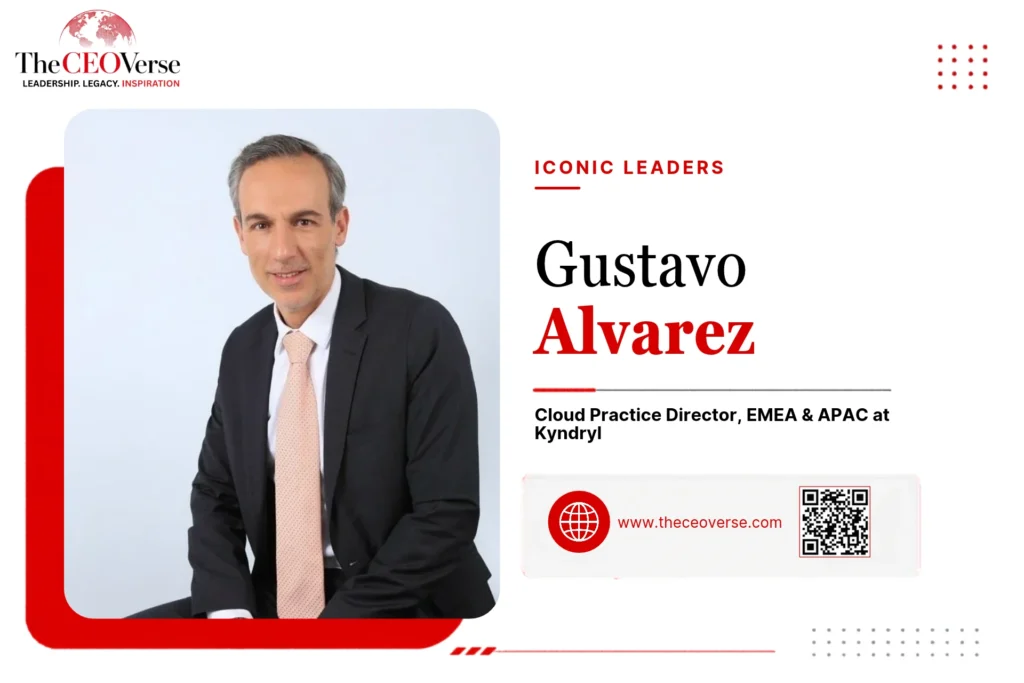
The Global Leader: How Gustavo Alvarez Builds Businesses Across Cultures and Continents
The Young Entrepreneur
Most leaders can point to a moment when their career began. For Gustavo Alvarez, it began before he could have called it a career. “My journey began when I was 10 years old,” he says. “I always had a passion for business and for sales.”
At 12, that passion became practice. He started selling things that people needed. The detail is minor, but it describes the instinct that has run through his working life. He was never interested in selling for its own sake. He wanted to find what someone actually needed and connect them to it.
An analytical streak led him to engineering. He studied Industrial Engineering at Tecnológico de Monterrey from 1994 to 1998, served as treasurer of a student organization, and graduated with academic honors. What held his attention was never the machinery alone. “I became fascinated by the connection between technology, business and people,” he recalls.
His first job confirmed it. Joining Lucent Technologies in 1999 as an Account Manager, he was selected for an intensive one year sales program in Miami and went on to receive the Top Sales Performance award in Latin America. The lesson that stayed with him was a practical one. “Even the most sophisticated technology matters only when it solves a real problem,” he says. He has measured proposals against that standard ever since.
Schools, Borders and a Wider Lens
By 2003, Gustavo wanted a broader education in how organizations are run. He moved to Toronto for an MBA at the Schulich School of Business at York University, where he also became President and Co-founder of the Latin America Business Association. In 2004 he took a finance specialization at Central European University on an exchange program. “It strengthened my interest in strategy and leadership,” he says of that period.
After graduating he was chosen from among 1,000 MBA candidates worldwide for a development program at Johnson & Johnson. As Product Manager from 2005 to 2006, he delivered 125% year on year growth in the South of Mexico. The stint was short, but it showed him that his approach worked outside the technology sector too, and that every market has its own logic that has to be learned before it can be led.
A Defining Alignment with Big Blue
In June 2006, Gustavo joined IBM as Sales Manager for IT Services in Mexico, the start of a 15 year relationship with the company. He led Infrastructure Services with a team of more than twenty people, exceeded quota for four consecutive years and grew the business 300%. In 2008 he received the company’s Golden Circle recognition. He later redesigned the go to market strategy for Networking and Security Services, which produced another 300% of growth over two years, and led a 13.2 million dollar LATAM integration project that earned the IBM Worldwide Bell Award.
Asked about those years, he talks about people rather than awards. “I am proud of several business milestones, but particularly of the teams behind them,” he says. In 2012 he took on cloud resiliency and networking for Latin America, scaling “as a service” offerings and reaching quota in both years while growing the business 105%. Those years gave him the commercial fundamentals he still relies on. Building a pipeline, owning a number and bringing a team along with him.
Leading Transformation in Nairobi
The next move tested those fundamentals in a different setting. At the start of 2014, IBM asked him to become Country Manager for Technology Services in East Africa, based in Nairobi. He would run sales, alliances, pre sales, delivery and operations, which is to say the whole business and its profit and loss.
He is candid about how it felt. “One of the hardest challenges has been repeatedly starting in unfamiliar environments,” he says. “A successful approach in one region does not automatically work in another.” What had worked in Mexico could not simply be carried across. He had to listen, learn how customers and colleagues there made decisions, and earn the confidence of a team that had good reason to wait and see.
Over two years the business grew 160%, and the team delivered the region’s first positive net profit. “It was an important lesson in what a committed team can accomplish in a challenging environment,” he says. It also shaped his view of leadership. “Leadership is not about having all the answers. It is about asking better questions, bringing talented people together and executing with discipline.”
Running the Largest Unit in the Middle East and Africa
In 2017, Gustavo moved to Dubai as Hybrid Cloud Services Leader for the Middle East and Africa, responsible for the largest regional business unit. Over nearly five years it grew 120% and its profitability improved by 22%. He also served as a Board Member for IBM Services integration, which gave him a seat in strategic decisions about how the wider company was organized.
By then his work was less about any single product than about running a large, geographically dispersed business. Setting priorities, managing margins, deciding where to invest and keeping partners and clients aligned. In 2019 he attended an INSEAD program on leading major client partnerships, a subject he considers central to the job. “Customers need straightforward advice, including when the right answer is more modest than the most ambitious proposal,” he says.
A New Company, a New Market Position
In September 2021, as IBM prepared to spin off its infrastructure services business, Gustavo joined what became Kyndryl as Sales Director for the Middle East. A newly independent company has to establish its own client relationships and its own reputation, and he set about building the organization that would do it, a team of more than twenty professionals across the region.
The first half of his tenure was the strongest in five years, with 230% year on year growth. He also originated and developed what was at the time the largest deal signed in Saudi Arabia. “Numbers tell only part of the story,” he says. “Developing professionals who went on to take larger responsibilities, building relationships that endure beyond individual contracts and helping organizations navigate major technological change have been equally meaningful achievements.”
In January 2023, his responsibilities widened to Cloud Director for Strategic Markets across EMEA and Asia, covering growth, sales, offerings, delivery and customer success. Cloud Hyperscaler Services grew 63% year on year under his leadership. He also acted as an executive deal coach on major opportunities across EMEA and Asia Pacific, helping colleagues shape complex proposals and manage relationships at the most senior level. Business leadership communities in the Middle East took note of his work, recognizing his record in sales, business development and team building.
What Six Countries Teach a Leader
Across a career of more than twenty five years, Gustavo has worked in Latin America, Africa, the Middle East, Europe and Asia Pacific, and has lived in six countries. Ask him what that has given him as a leader, and he does not talk about airports or time zones. He talks about listening.
“Working across cultures taught me to listen before judging and to understand what motivates people,” he says. In practice, that means recognizing that a team in Nairobi, a client in Riyadh and a sales organization in Mexico City do not respond to the same incentives, the same pace or the same style of communication. A leader who applies one formula everywhere will be polite, and ineffective.
Each transition, he says, required the same sequence. “Each transition required me to learn a new market, build trust with new teams and adapt my approach.” Trust came first, because without it a new leader gets compliance rather than candor. Relationships came next, built over many conversations rather than a single pitch. Growth was the result of the first two rather than a substitute for them.
It also changed how he builds teams. He sets high expectations and then gives people the support and trust to meet them, a balance he believes travels better across cultures than any management technique. He hires people who challenge him, and he measures part of his own success by who goes on to bigger roles. “Your legacy is not only the deals you close,” he says. “It is the leaders you help develop.”
Start with the Outcome
If there is one principle that connects these chapters, it is the order in which he asks questions. “I consistently return to one principle. Start with the outcome, not the technology,” he says. “Before recommending a solution or making a decision, I ask what problem we are solving, what measurable value success will create and whether we have the right people to deliver it.”
The third question is the one he thinks gets skipped most often. For Gustavo, a plan that is sound on paper still depends on the people carrying it out. He also treats trust as a working asset rather than a slogan. Customers should hear honest advice, even when it is more modest than what they expected, and teams should have transparency, accountability and the freedom to challenge ideas, including his own. “Innovation succeeds when strategy, technology and people move forward together,” he says. “If any one of those elements is missing, even a technically excellent initiative can fail.”
His own description of his career is revealing. Technology is the industry where he has worked, but when he lists his strengths he points to growth, P&L management, strategic partnerships, high performing teams and measurable results. Those are the skills that have carried him from Mexico to East Africa to the Gulf, and they are the ones he expects will matter most in the years ahead.
Beyond the AI Experiment
Nowhere does his business first outlook show more clearly than in how he talks about artificial intelligence. He is not skeptical of it. He sees a gap between how much organizations have tried and how much they have actually changed.
“Many companies have experimented with AI, but relatively few have embedded it into core processes at scale,” he observes. In his view, the challenge is rarely the model or the tool. It is the discipline around it. Choosing the right problems, preparing data and infrastructure, integrating with the systems that already run the business, and making sure someone is accountable for the result.
His approach is deliberately narrow at the start. Identify a small number of high value use cases, deliver early results, and then scale what works. “Closing that gap is a major opportunity,” he says. He believes the winners in the next phase will not be those who experimented first. “The next phase of transformation will be defined less by who experiments with AI first and more by who deploys it securely, responsibly and at scale.”
That framing brings in the questions that senior executives and boards care about. Where does the data reside? How is it secured? What happens to critical operations if something fails? “Data residency, cybersecurity, integration and operational resilience will remain fundamental,” he says. In his view, these are business questions as much as technical ones, and the organizations that answer them early will move faster than those that treat them as an afterthought.
He applies the same logic to modernization more broadly. Many of his clients run mission critical systems that cannot be switched off while something better is built. The task, as he describes it, is to modernize without unnecessarily disrupting the systems that run their core operations. Depending on the client, that might mean moving workloads to cloud platforms, strengthening disaster recovery, optimizing cost or preparing for AI. What matters is that each step can be tied to a result a business leader can measure. “The differentiator is not a single product,”em> he says. “It is the ability to connect advisory, implementation and ongoing operations, and to translate complex engineering decisions into outcomes that business leaders can measure.”
Back in the Middle East
In August 2026, Gustavo became Director and Consult Partner for the Middle East at Kyndryl, based in Dubai. After several years leading a business that spanned EMEA and Asia, he is back in the region where he built some of his most significant results.
His remit is to create new strategic client relationships and help organizations turn cloud and AI ambitions into operational reality. In practical terms, that means working with executive teams on where to invest, and with partners and internal specialists on how to deliver. “I am working with teams and partners on opportunities spanning cloud modernization, business continuity, enterprise AI and automation,” he says. “My emphasis is on identifying a small number of high value use cases, delivering early results and then scaling what works.”
The region suits that approach. Governments and large enterprises in the Middle East are investing heavily in digital capability, and they tend to ask pointed questions about outcomes, timelines and sovereignty. Gustavo welcomes this. A client who asks for measurable value is, in his experience, a client who will also value honest advice.
He brings something else to the role. Knowledge of how a global company works from the inside. Having run regional businesses, sat on an integration board and coached deal teams across two continents, he can connect a client’s local priorities with the partners, offerings and delivery capabilities that sit behind them.
Looking Five Years Ahead
When he looks ahead, Gustavo describes his ambition in terms of relationships rather than products. “Over the next five years, I want to help strengthen Kyndryl’s position as a trusted partner for organizations navigating the convergence of cloud, AI and mission critical operations,” he says. In his markets, that means moving from isolated projects toward long term partnerships built around measurable business value.
He pictures teams that combine industry knowledge, strong alliances and disciplined execution. The goal is for clients to innovate confidently while protecting the systems on which their businesses depend. It is a modest sounding goal, but it reflects what he has seen in practice. Clients are willing to try new things when they trust that the basics are secure.
He is just as focused on who will lead those teams. “I want to develop a strong pipeline of future leaders who can combine commercial judgment, technical understanding and genuine customer focus,” he says. He sees that as part of the job rather than an extra, because the markets he serves will keep changing and the organization needs people who can adapt with them.
Curiosity, Resilience and Empathy
Gustavo names three qualities that have shaped his path. The first is curiosity. “Technology and leadership never stand still,” he says, and his executive education at Harvard, MIT, Columbia and INSEAD reflects a habit of returning to the classroom whenever the work changes. The second is resilience, which he learned in unfamiliar markets, difficult commercial cycles and transformations where the route was not obvious. “Setbacks are information, not a reason to abandon the objective.” The third is empathy, which came from working across cultures and learning to understand what motivates people before deciding how to lead them.
Resilience has an everyday form too. He has led through organizational change, ambitious growth targets and periods when established business models were being disrupted, and he has learned to separate what he can control from what he cannot. “I can control preparation, how honestly I communicate and how consistently I support my team,” he says.
Outside work, he cycles and competes in triathlons. He describes them as a reminder of the same lesson. “Progress comes through consistency, preparation and the willingness to keep going when things become difficult.” His family and his years of living abroad give him perspective, and he treats success as a long process, not a single title or transaction.
Advice for Those Who Follow
Asked what he would tell someone aiming for a senior position, Gustavo gives four points.
First, become genuinely interested in your customers’ businesses. “Understand their economics, their risks and the decisions their leaders are trying to make,” he says. Technical fluency matters, but the ability to link technology to a business result is what builds lasting influence.
Second, invest in people. Hire individuals who challenge you, give them room to grow and take pride when they surpass you.
Third, keep reinventing yourself. “The industry I entered is radically different from the one we operate in today, and AI will accelerate that change,” he notes. His advice is to stay curious, remain humble and be willing to unlearn approaches that no longer work.
Fourth, keep perspective. Ambition is valuable, but integrity, relationships and health make achievement sustainable.
The Measure of the Work
Gustavo Alvarez’s career includes growth figures that run from 63% to 300% across several markets, along with recognitions such as the IBM Worldwide Bell Award and what was then the largest deal signed in Saudi Arabia. He prefers to describe the pattern behind them. In each new place he started by listening, then built a team, kept faith with the client and held the organization to a clear standard of execution.
The boy who sold what people needed at 12 now leads client relationships and teams across a region, and the question he asks has not changed much. What does this person need, and how do we deliver it? As organizations try to turn AI and cloud ambitions into something that shows up in their results, that question may prove more useful than any single technology.