The Art of Being Remembered: Sonia Tamrakar and the Science of Customer Experience
A Front Desk in Mangaluru
Every career has a first door. For Sonia Tamrakar, it was the lobby of a Taj hotel in Mangaluru, a coastal city in Karnataka, in 2007. She stood at the Front Office as a supervisor, in a property belonging to one of the most respected names in Indian hospitality. Her days were shaped by arrivals and departures, early flights and late check outs, anniversary surprises and the occasional crisis that arrived without warning.
A front desk is an unforgiving classroom. Guests are tired, hurried, excited or irritated, and sometimes all four at once. Within a few weeks, it teaches what no textbook can. The guest in front of you is rarely asking only for a room key. They are asking whether you noticed them.
That early lesson stayed with her. Hospitality, she says, taught her that service is about much more than delivering a product or completing a transaction. It is about creating experiences, building trust, understanding individual needs, and delivering on expectations again and again. She absorbed in her first role the idea that now sits at the center of her professional life. The best service is felt long before it is measured.
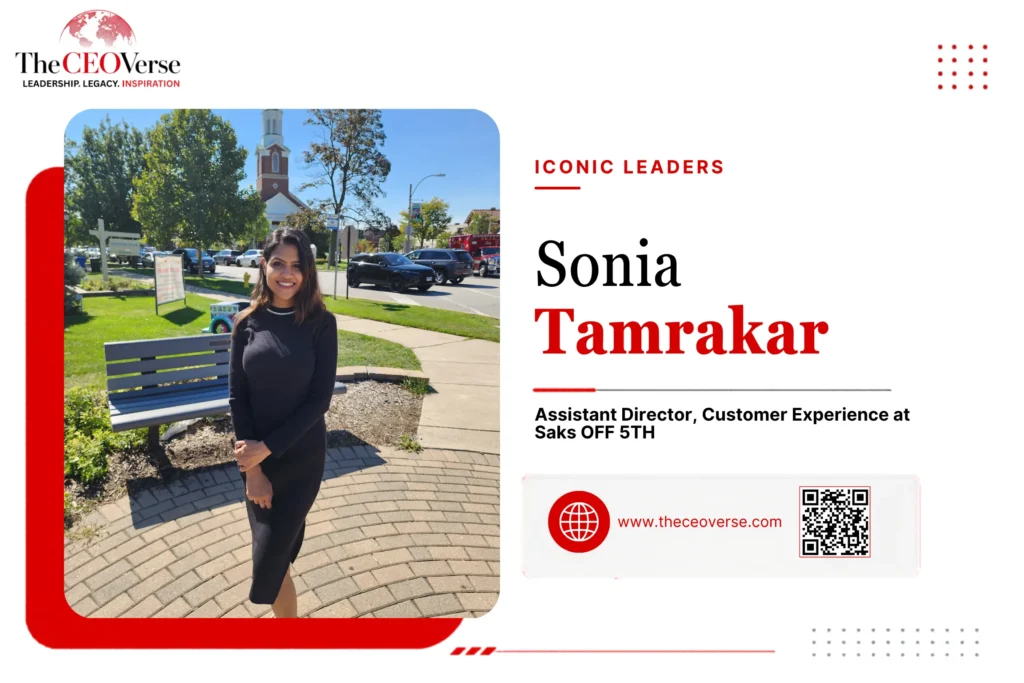
Today she is Assistant Director of Customer Experience at Saks OFF 5TH, an Advisory Board Member at Cygnett, a doctoral candidate, and a 2026 Bronze Globee® winner. Nearly two decades and two continents separate her from that first lobby, but the line between the two is unbroken.
The Apprenticeship of Many Cities
Careers in hospitality are often built on movement, and Sonia’s took her across India. After Mangaluru came Hyderabad, where she joined the Taj as a Front Office Executive in 2009. A year later she was in Pune, working as a Duty Manager at Royal Orchid Hotels. This was a different kind of responsibility. She opened and closed the property, watched over shift changes, supervised site checks, and decided which issues she could solve and which needed to be escalated.
Duty management teaches judgment. When something goes wrong at midnight and the general manager is asleep, someone has to decide, and the Duty Manager is that someone. In Pune she handled VIP guests, a delicate discipline whose aim is to give attention without intrusion, so the guest feels prioritized rather than managed.
These were years of accumulation. Each city brought a new guest profile, a new team culture and a new set of expectations. She was not yet a senior leader, but she was building the quality that senior leadership later depends on, which is range. Her time at the Taj also earned her early recognition, including a COO’s Club Award, a marker of a young professional whose work was already being noticed.
Mumbai: Where Service Became a Craft
In 2011 Sonia moved to the Mumbai Metropolitan Region as a Guest Relations Executive with Renaissance Hotels. Over the next three years she grew into Assistant Manager of the Executive Lounge at the Powai property. The executive lounge is an unusual corner of a hotel. It is intimate, and it caters to guests who return often and notice everything. A lounge manager succeeds by remembering preferences, anticipating needs and keeping standards high without making the standard feel rigid.
The work was not about grand gestures. It was about the small signals that tell a traveler a hotel has been paying attention, such as a remembered name, a favorite table, or a problem solved before it was mentioned. Photographs from the period show theme dinners, a Holi celebration and a “Power of Woman” event. They hint at something that would define her leadership, which is a belief that a service team is a community and not merely a roster.
In late 2014 she joined the JW Marriott Mumbai Sahar as part of the pre-opening team, one of the more demanding assignments in hospitality. A pre-opening is a hotel’s birth. Nothing runs smoothly yet, systems are untested, and teams are still learning to work together. She began as Assistant Manager of the Executive Lounge and, over four and a half years, grew into the role of Executive Lounge and Guest Relations Manager. She led a team across both functions, improved service quality at the front desk and the lounge, and set staffing levels that balanced business demands against the human limits of her people.
Marriott invested in her growth. She travelled to Malaysia for the “At the Helm” Front Office training, a program designed to sharpen hospitality leaders. Her Guest Voice Champ recognition came from a system that rewards teams for the quality of guest feedback, and it had special meaning because it showed that the people she served were noticing the difference. In a lighter moment, her team took first place in a dance competition among Mumbai’s Marriott hotels. Dance, like hospitality, depends on coordination and trust.
Looking back, she describes these years as the ones that taught her how experiences are designed. Lounge service is choreography. A guest’s mood, a staff member’s readiness and an operational detail all have to line up for a moment to feel effortless. That insight, that effortlessness is engineered, now underpins her work in customer experience.
A Turn Toward the Business Side
By 2019, after more than a decade in the field, Sonia was ready for a new challenge. She left hotels for the commercial side of business. In May of that year she joined G4S India as a Sales Manager in Gurugram, where she was responsible for a territory and its growth. She developed business plans, maintained relationships with existing customers to support revenue and retention, and built territory strategies that looked for chances to upsell, cross-sell and move into new business units. She became comfortable with Salesforce and the other tools that drive modern sales operations.
It was a significant change of lens. In hospitality, the guest is in front of you. In business to business sales, the customer is an organization, and the relationship unfolds across meetings, proposals and long cycles. Yet she found that the underlying skill was the same. She had to listen well, understand what the other person truly needed, and deliver on promises. Her work earned her a place at FICCI events in 2019, where industry leaders and professionals gather.
She then moved to Prologic First as a Sales Manager, managing the order cycle for business development. Prologic sells hospitality software, and her job was to suggest the best solutions for a customer’s needs. Her background was a natural fit. She had worked the front desk and the executive lounge, so she knew what hotel teams struggle with and could recommend technology from the point of view of someone who had lived the problems.
In 2021 she returned to G4S Secure Solutions India as a Key Account Manager, a role that rewards patience and trust, because a single client relationship can matter enormously to a company. She held it until August 2022. Across these years she gained what many CX leaders lack, which is a clear understanding of how revenue, retention and customer satisfaction are connected in commercial terms.
The Test of a Lifetime
No account of Sonia’s journey would be complete without the pandemic. During COVID-19 she served as a Director at IFCR, a position she names as one of the most formative of her career. Organizations everywhere were asked to do the impossible. Priorities changed from week to week, operational pressures were unprecedented, and leaders had to make decisions without the luxury of complete information.
She does not describe this period in heroic terms. What she took from it is a realistic lesson about leadership. A plan matters less than the ability to stay adaptable, make thoughtful decisions and communicate clearly. People look to leaders for direction in moments of uncertainty, and she learned that confidence often comes from honesty about what is and is not known.
The pandemic was especially hard for the service industries she had spent her life in. Hospitality and retail depend on human contact, and suddenly that contact was a risk. Leaders had to rethink what service means when proximity is not possible. The experience reinforced her belief that service rests on understanding people rather than on a fixed set of rituals.
A New Country, a New Counter
In October 2022, Sonia took on a new role in a new country. She joined Macy’s in Florida as Manager of Sales and Customer Service, a position that expanded into assistant store manager responsibilities. American retail has its own pace, its own customer expectations and its own metrics. She had to learn them quickly, and she counts the differences between retail and hospitality among the ongoing challenges of her career.
At Macy’s she was responsible for customer service, hiring and retention strategy, store operations and the shopping environment. She took on significant operational responsibility, including multi million dollar budget commitments, and worked to maintain profit, weekend compliance and controllable expenses so that the store’s overall scorecard performance would hold up. She also ran the in-store hiring process from first conversation to onboarding. She met prospects, conducted interviews, worked to boost new hire engagement and set out to lower attrition.
The people side of the job suited her, and a line she shares from Helen Keller captures her approach. Alone we can do so little, and together we can do so much. Her photographs from that time show training sessions, a team farewell and moments with her colleagues, and they reflect her instinct that a store’s atmosphere is made by the people working in it.
Retail also sharpened her understanding of customer behavior. A shopper’s experience is shaped by many small elements. These include whether the shelves are in order, how quickly a question gets answered, whether a problem is resolved without the customer having to repeat their story, and whether staff feel prepared and valued enough to care. A seamless customer journey, she came to believe, is built in operations, not in slogans.
Bridging the Boardroom and the Shop Floor
One of the defining strengths of Sonia’s leadership is her ability to translate complex business information into practical, frontline solutions. In high visibility roles at Macy’s and now at Saks OFF 5TH, she has carried real operational weight while keeping her attention on execution, service standards and team performance.
Her view is that strategy only creates value when employees understand it, have the right tools to carry it out, and feel supported by their leaders. A plan drawn up in an executive meeting can look flawless on paper and still stumble at the register on a busy Saturday. Whether she was managing hotel guest experiences, supporting corporate accounts or leading retail teams, her focus has stayed consistent. She connects executive strategy with frontline reality, and she can do it credibly because she has stood on both sides of that divide.
Saks OFF 5TH: Where Experience Becomes Strategy
In August 2024 Sonia became Assistant Director of Customer Experience at Saks OFF 5TH in Florida, a role that brought together everything she had learned. She oversees performance reviews and service quality initiatives meant to raise customer satisfaction. She handles escalated customer requests and complaints and works to resolve them quickly enough to turn frustration into loyalty. She has developed retail presentations that lifted brand visibility and customer engagement, and she has collaborated on events that increased customer enrollment and strengthened ties with the community.
Her approach rests on a particular skill, which is taking voice of customer insights and turning them into action. Customers speak through surveys, complaints, comments and behavior. The harder part is deciding what the organization should do about it. Sonia converts those signals into coaching for teams, improvements in operations and, where needed, shifts in culture. A central part of her work is closing the perception gap between what leadership intends and what frontline employees and customers actually experience.
The results have been recognized. In the fourth quarter of 2024 she received the Connected Service Award for outstanding customer service, sales and loyalty. That same quarter, her store took home the national award for the best Saks OFF 5TH store in the country. She also led a Fine Jewellery trunk show that was noted for exceptional sales, customer service and loyalty. In the second quarter of 2025 she won another Connected Service Award, this time for outstanding clientelling, loyalty and customer service as reflected in Net Promoter Score.
When she talks about these honors, she turns attention away from herself. She credits her CX team, and the wider team of colleagues around her, for the work behind each one. Awards, she suggests, are what happen when a team trusts its leader and each member believes their contribution matters.
The Mirror Effect
If one idea defines Sonia’s thinking, it is what she calls “The Mirror Effect.” The principle is simple but powerful. The care, empathy and respect that employees experience inside an organization are reflected in the service they extend to customers. A team that feels ignored will struggle to make customers feel valued, and a team that feels heard tends to pass that feeling along.
This changes how she reads the numbers. Net Promoter Score and Voice of Customer feedback are often treated as isolated performance metrics, a scoreboard to be checked each quarter. Sonia treats them as indicators of frontline team health. A dip in satisfaction may be less a customer problem than a signal about how people are being equipped, recognized and supported. In the language of the service profit chain, the health of the workforce and the health of the business are linked.
Her remedy is practical rather than sentimental. She advocates non-monetary recognition, structured development and a workplace culture in which employees feel their contributions matter. Her LinkedIn profile speaks of emotional labour, because frontline work asks people to manage their own feelings in order to serve others. A leader who ignores that cost will eventually see it in turnover and in the quality of service. A leader who recognizes it can turn everyday associates into confident, engaged and proactive brand ambassadors.
Honored for Impact: The Bronze Globee®
In 2026, Sonia’s work earned recognition on a wider stage. She received the Bronze Globee® Award for Woman of Influence in Business, presented through the Globee® Awards for Impact. The honor reflects her commitment to people centered leadership and to connecting employee engagement with customer experience excellence.
For Sonia, the award is more than a trophy. It highlights the importance of the question she keeps returning to, namely how organizational culture and employee recognition can shape business outcomes. She describes it as both a professional milestone and encouragement to keep advocating for workplaces where people and performance grow together. It also stands as a quiet answer to a question she once might have been asked, whether a career built on listening could stand beside careers built on spreadsheets. The judges’ verdict suggests it can.
The Principle Beneath the Practice
Ask Sonia what guides her decisions, and her answer is straightforward. Understand the people and the purpose behind every decision. Business results matter, but lasting results come when customers, employees, operational realities and long term goals are weighed together.
Listening is where she starts. Before proposing a solution, she wants to understand the situation, find the real challenge underneath it, and hear from the people closest to it. Frontline employees, she points out, often hold the most useful insights because they live inside customer expectations and operational constraints every day.
She is equally clear that being people centered is not the same as being soft. Empathy and accountability, in her view, belong together. Hard decisions should still be made, but with fairness, transparency and an honest account of their consequences. When people understand the reason behind a decision and feel respected in the process, trust follows, and so does shared responsibility.
The Scholar and the Inventor
Many professionals reach a senior position and settle into it. Sonia chose to deepen her thinking instead. She is pursuing a Doctor of Business Administration at National Louis University, with research focused on employee engagement, non-monetary recognition and customer satisfaction.
The questions driving her research grow directly out of her experience. How does workplace culture influence customer outcomes? What motivates frontline employees? How can organizations create environments where both employees and customers thrive? She is especially interested in how frontline employees themselves describe the link between their working conditions and the way they treat guests, and she hopes the qualitative insights from this work will inform wider discussions about leadership and service performance.
The academic path also reflects a habit of mind. She wants to explore professional questions through structured research rather than rely only on personal experience, which is a humble stance for a leader with nearly two decades behind her. It acknowledges that instinct, however well trained, benefits from evidence. Balancing doctoral research with a demanding job is not easy, and she is candid about the discipline it requires. It has strengthened her time management and made her a more careful reader of the data that crosses her desk, so the practitioner and the scholar now inform each other.
Her contribution is not confined to research papers. Sonia holds innovation patents related to customer journey management and retail experiences, which turns her observations about how customers move through a brand into formal intellectual property. She also contributes industry perspectives through her advisory and professional affiliations, including membership in the Customer Experience Professionals Association, a global community of CX practitioners.
A Seat at the Advisory Table
Alongside her work at Saks OFF 5TH, Sonia serves as an Advisory Board Member at Cygnett. She sees advisory work as a different kind of contribution from operational leadership. Her role is not to run the company but to ask useful questions, offer a cross-industry perspective, and help connect broad strategic objectives with practical realities.
Her view of Cygnett’s next five years is characteristically balanced. Sustainable growth, she believes, depends on more than expansion. It requires a clear value proposition, consistent execution, a deep understanding of what customers value, and investment in people. She also encourages a habit of continuous learning inside organizations. Markets change, and companies that listen to customers and learn from their own operational experience are better placed to respond with thought rather than panic. She is careful to add that she wants to contribute while respecting the company’s existing strategy, leadership and priorities, which is the mark of an adviser who understands the limits of the role.
The Hardest Hills
Sonia does not present her path as a straight line. She names the pandemic as one of the hardest periods of her career. She also points to the challenge of working across two industries that operate at different speeds. Retail and hospitality both put customers first, but they do it with different rhythms and different pressures, and learning to see both the differences and the shared principles took patience.
Then there is the weight of doing it all at once. Building a career, adapting to a new country and pursuing a doctorate are not light commitments. She says these challenges taught her that progress is rarely linear. Difficult periods expose gaps in knowledge, test assumptions and push people toward new ways of thinking. She also insists that she never faced them alone, since successful outcomes usually depend on teamwork and the support of others.
Her record shows what that attitude can produce. She started as a front-office supervisor in a coastal Indian city and now holds a leadership role in American luxury retail, with an advisory seat, patents, a doctoral program and a Globee® beside her name. None of that happens without resilience, though she tends to describe it as a habit rather than a talent. When things are uncertain, she focuses on what can be understood, what can be improved and how people can work together toward the next step.
Three Qualities, and a Wider Example
If she had to name the traits that shaped her path, Sonia chooses three: resilience, empathy and a commitment to learning. They are connected. Resilience lets her stay steady while conditions shift. Empathy lets her listen carefully and weigh the needs of both employees and customers. Learning keeps her open to feedback and keeps her from mistaking experience for the whole truth.
Her career also carries a message beyond her own story. Effective leadership, she shows, requires more than analytical ability or operational expertise. It requires empathy, resilience, continuous learning and a genuine commitment to developing others. As a woman who has led across hospitality, corporate services, retail and academia, she demonstrates how women in leadership can drive operational efficiency, foster inclusive workplaces and connect frontline employee care directly to sustainable business growth. For younger women watching from the front desk or the shop floor, she is proof that the road from there to the table where strategy is decided can be walked.
Advice for the Next Generation
Asked what she would tell someone who wants a strong position in the industry, Sonia offers practical counsel in a few parts. First, build credibility. Titles may open doors, but trust is earned by how you treat people, how you act under pressure and whether you keep your commitments.
Second, learn from the frontline. Employees who deal directly with customers understand their needs and frustrations in ways that reports often miss. Third, stay adaptable. Her pandemic experience taught her that success depends on responding to change without losing sight of core values, and strong leaders are willing to reconsider their assumptions.
She also urges emerging leaders to keep learning. Develop communication, analytical and people-management skills, ask for feedback, and pursue education that challenges your thinking. Finally, she asks people not to measure success only by how fast they climb. The better measure is the value you create, the relationships you build and the people you help develop. A professional reputation, she says, is made through repeated actions over time.
Leaving People Stronger
Nearly twenty years after her first shift at a Taj front desk, Sonia Tamrakar still describes her work in the same human terms. She talks about customers who want to be understood, employees who want to be valued, and leaders who must make hard decisions without losing sight of either. Her résumé spans hotels, security services, hospitality software, department stores and off price luxury, but one idea runs through all of it. Experiences are made by people, and people deserve to be listened to.
For her, leadership is a constant journey of responsibility, learning and service. The goal is not simply to reach a prominent position. It is to use the opportunities that come with it thoughtfully, and to leave people, teams and organizations stronger than she found them. In an era when so much of business talks about scale and speed, her career is a reminder that investing in people remains one of the most effective ways to create better customer experiences and lasting business success. It is also a reminder that the most durable advantage may be the simplest one, the ability to make a person feel that someone noticed.