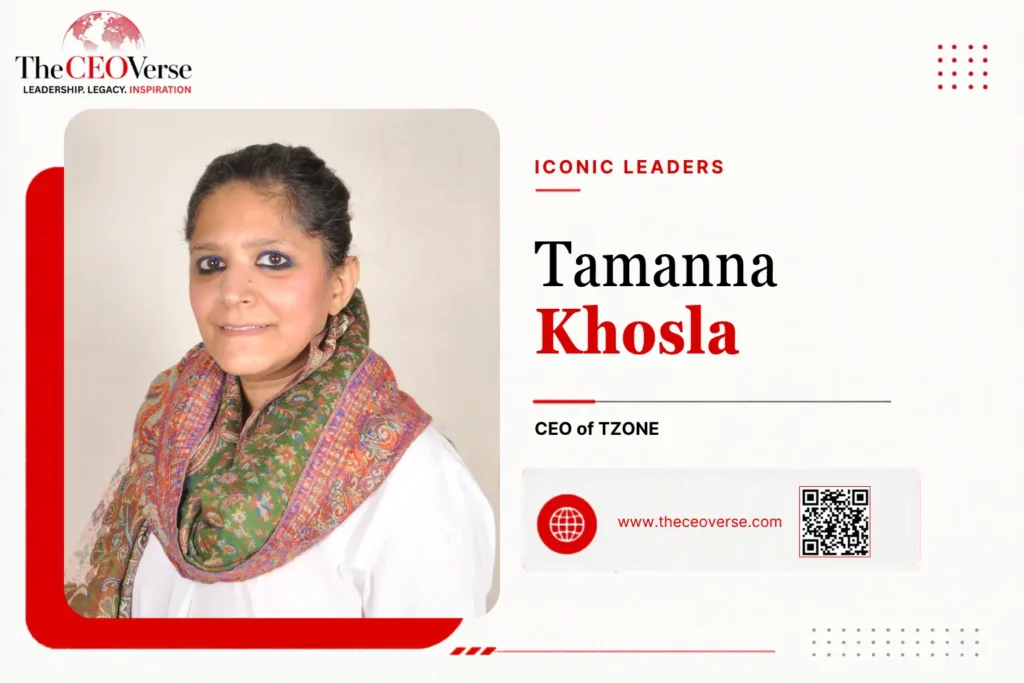
Dr. Tamanna Khosla: Building a Second Career Out of a Broken First One
A political philosopher turned legal scholar turned institution builder, still fighting the same fight she started decades ago.
From Classroom Exit to Ten Published Books
Dr. Tamanna Khosla’s academic path did not follow a straight line. What began as childhood curiosity about the sciences shifted, by her senior secondary years, into political science and the humanities. She went on to study political science at Lady Shri Ram College, where an interest in feminism and international relations took root. Her master’s at Jawaharlal Nehru University sharpened that focus further, pulling her into questions of politics, oppression, and gender. By the time she reached her M.Phil and PhD, law and philosophy had entered the picture too.
A doctorate led to a teaching position at Delhi University. It did not last. She was removed from the role, a decision she attributes to academic animosity, and says a clique within the system then blocked her from finding another academic post. Most people would have stopped there. She wrote ten books instead, completed a law degree, and rebuilt herself as a public intellectual, legal scholar, and feminist voice outside the institutions that had shut her out.
Faith As The Constant Behind Every Decision
Ask her what guides her toward the right outcomes, and the answer has nothing to do with frameworks or data. It is faith. She credits belief in a higher power and in spiritualism as the one constant that has never let her down when a decision needed to be made.
Goodness, Faith, and the Quiet Art of Reading People
Three things, by her own account, have shaped her path more than anything else: a belief in goodness, a trust in God, and an ability to read people accurately without ever letting them know she’s doing it. That last one is the quieter skill, the kind that doesn’t announce itself in a room but shapes how she navigates every relationship in it.
The Ability to Anticipate What Comes Next
She describes herself as someone who can see a solution before most people have finished naming the problem. It’s a bold claim, offered without hedging on her part, and one she connects to a specific habit rather than pure instinct: learning from anyone, anywhere. Situations, people from any country or age, even organisms, all of it feeds into how she approaches a problem, by her own account.
A Research Institute Built Only For Outliers
Her current project is a research organization with a specific hiring philosophy: only nerds and geniuses, drawn from anywhere in the world. The mandate, as she describes it, is broad by design, spanning contemporary global issues and extraterrestrial questions alike, with the goal of developing new philosophy and legal frameworks. The throughline is oppression, tackled across race, class, gender, and continent.
Building The Financial Runway For A New Institution
Her five-year vision centers on funding. The goal, in her words, is to garner enough funds to hire the right people, the kind of people she wants building this new institution with her. Money, she says, should not be the reason someone capable of doing this work has to go without what they need. It is a vision built around removing one obstacle rather than expanding in every direction: get the resources in place first, and let the people she hires work without that constraint hanging over them.
Decades Of Resistance, Faced Alone
The obstacles she describes are not abstract. Severe oppression, she says, came from her own family and from Indian society and academia, sustained over decades. She frames it as a fight she faced as a woman, without support from a single person around her. The only help she names is God’s.
Emulation Without Imitation, Respect Without Exception
Her advice to anyone chasing a prominent position in this space comes in two parts. First: don’t envy people smarter than you, learn from them, but don’t copy them, their work belongs to them. Second, while money has its place, it shouldn’t become the primary motivation when the goal is building something rooted in freedom and egalitarianism. In her view, nerds and geniuses deserve both respect and the freedom to pursue ideas without unnecessary constraints, a principle she hopes her organization will continue to uphold.