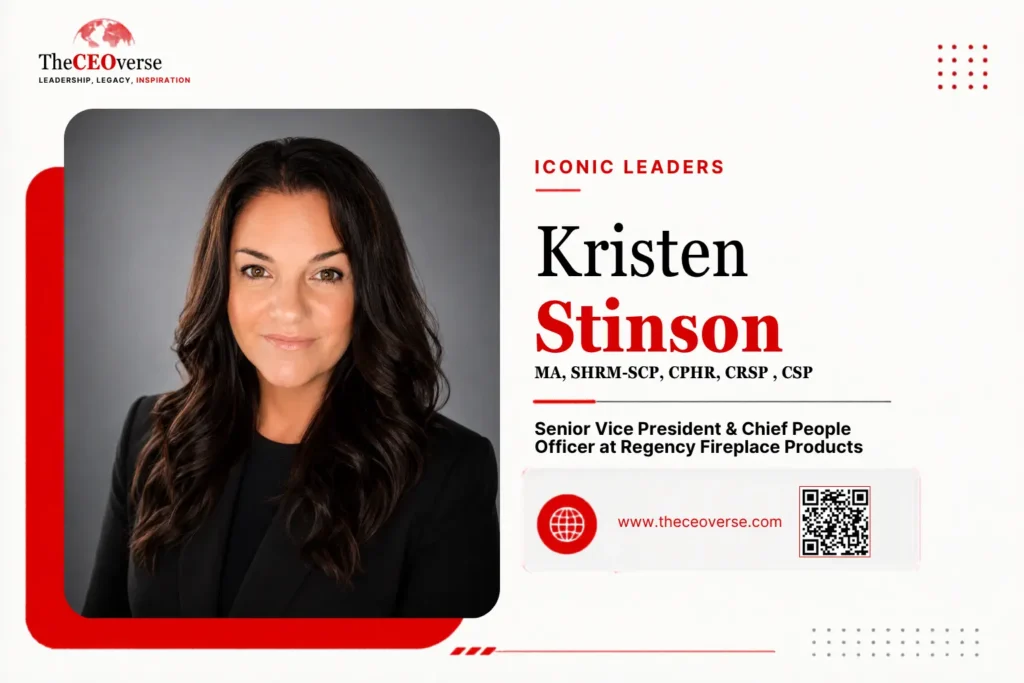
Kristen Stinson: Title Comes Last, Character Comes First
She did not arrive at the Chief People Officer role through a single defining moment. It was accumulated — sector by sector, organization by organization, one hard decision at a time.
The Career That Started Where Work Is Honest
Kristen Stinson’s career did not begin in the boardroom. It began in health and safety — the part of HR that is least theoretical, where poor decisions show up in incident reports rather than engagement surveys. That grounding mattered. It gave her an understanding of workplace culture that was operational before it was strategic, and it shaped the leadership approach she has carried into every role since.
Over three decades, she has worked across manufacturing, energy, forestry, and industrial sectors, leading people functions at Interior Health Authority, Finning, Tolko Industries, Conifex Timber, bp, and now Regency Fireplace Products. The industries are different. The underlying challenge, she has found, is consistent: organizations that grow without deliberately building their cultures tend to pay for it later.
She holds a Master of Arts in Work, Organization, and Leadership from Athabasca University and a Bachelor of Human Resources and Labour Relations. Her designations — CPHR, SHRM-SCP, CRSP, CSP— represent ongoing investment in the field. Today, as Senior Vice President and Chief People Officer at Regency Fireplace Products, she oversees People & Culture, Health, Safety & Environment, Branch Operations, Technical Services, IT, and Research & Development across the enterprise.
She has held most of this portfolio before, in different forms, across different industries.
The Philosophy She Has Carried for Thirty Years
Stinson has said it plainly: sustainable business success comes from aligning people, purpose, and performance. That realization came early, in health and safety roles where the gap between stated values and actual workplace behavior was impossible to ignore. It became the foundation she has carried into every role since.
Her approach frames leadership as stewardship rather than authority. People perform differently when they believe their work matters and that the person leading them is invested in their success, not just their output. Acting on that consistently, across thirty years and six organizations, is harder than it sounds.
Strong workplace cultures are intentionally designed, not organically grown. Clear values, consistent leadership behavior, communication that connects individual contribution to organizational direction — when employees can see how their work fits, they bring more to it. When they cannot, the gap shows up in turnover and in the slow erosion of institutional knowledge.
She applies a growth mindset as a practical stance on adaptability, not general optimism. Organizations that cannot adjust when the environment shifts do not survive the shift. The same is true of leaders.
What Thirty Years of Work Looks Like on Papers
In 2025, the recognitions came in a cluster. Regency Fireplace Products was named an Excellence Awardee at the Canadian HR Awards for Canadian HR Team of the Year. Stinson was personally recognized as an Excellence Awardee in the Woman of Distinction category at the same event. The Manufacturing Safety Alliance of British Columbia awarded the organization both the Topaz and Sapphire Safety Awards for health and safety leadership.
She was also named one of the “Top 10 Chief People Officers of 2025” and featured in Women of Impact: The Most Influential Leaders to Watch in 2026.
The safety recognitions carry specific weight. Topaz and Sapphire designations from the MSABC are not given for having a safety policy on paper. They reflect sustained, measurable performance — the kind that requires an entire organization to actually change how it operates, not just how it reports. That distinction matters.
The Traits That Held Under Pressure
When asked to identify the personal qualities that have contributed most to her success, Stinson names three: resilience, empathy, and integrity. The order is worth noting. Resilience comes first — the capacity to absorb complexity and lead through it without losing direction. Empathy comes second, the ability to understand what people are actually experiencing rather than assuming. Integrity comes third, not because it is least important, but because it is the one that becomes load-bearing over time.
She does not present these as a framework. They are qualities she has tested under pressure, across sectors, and through organizational transformations that required hard choices with incomplete information. Most leaders claim all three. Fewer have the track record to back it.
Forty-Five Years of Premium, One Culture
Regency Fireplace Products was founded in 1979. It designs, manufactures, and markets premium fireplace products sold across North America, Europe, Asia, Australia, and New Zealand. The products are known for energy efficiency, engineering quality, and customization — a market where craftsmanship and technical performance are expected to coexist.
What Stinson emphasizes, when describing what distinguishes the company, is not the products alone. It is the internal environment. A commitment to continuous improvement, employee development, and a safety culture that now has external recognition behind it. These are not soft considerations in a manufacturing organization. They affect retention, production quality, and the ability to attract people who have options.
Regency operates with strong dealer partnerships and a global distribution footprint. The people infrastructure behind that scale is what she was brought in to build and sustain.
Building the Infrastructure Behind the Growth
At Regency, the current work spans more ground than a single initiative. Leadership development, employee engagement, automation integration, advanced manufacturing — these are running in parallel, not in sequence. The people side includes expanding inclusion efforts and building talent development pathways that give employees real options for growth within the organization, not just stated ones.
The automation investment and the talent investment are not in tension. Organizations increasing manufacturing sophistication still need people who can operate, maintain, and improve those systems — and those people need to be developed, not just recruited. Stinson is building the infrastructure with that trajectory in mind. The safety systems being strengthened already carry award-level performance behind them. The goal now is to protect that standard while the organization scales.
Five Years. One Direction.
Her long-term vision for Regency is sustainable growth, stronger global industry positioning, and a workplace culture that earns the employer-of-choice designation rather than just claiming it. The framing is deliberate. Growth and culture are not naturally self-reinforcing — they require active management to stay aligned, and organizations that let one drift while chasing the other create problems that compound quietly before they surface loudly.
Over the next five years, the aim is to continue advancing manufacturing capability, customer-focused product development, and an internal environment where employees have real opportunities to grow — not just stated ones. Both require execution, not declaration.
What She Learned From the Hard Periods
Stinson is direct about the difficulty of leading through transformation and uncertainty. Economic shifts, labor market pressure, and changing workplace expectations across thirty years have required adaptation that was not always comfortable or clean. What she identifies as the most important lesson from those periods is staying grounded in values when external pressure creates incentives to abandon them.
Transparent communication comes up consistently in how she describes getting through difficult stretches. Not because it solves underlying problems, but because it maintains the credibility needed to keep people moving in the same direction when the path is not clear. She has also said that challenges tend to create conditions for innovation, if leaders are willing to approach them that way rather than treating them as threats to manage.
That does not make complexity easy. It makes it workable.
Title Comes Last, Character Comes First
Her advice to aspiring professionals is direct: focus on continuous learning, build real relationships, develop emotional intelligence before assuming it will come naturally, and lead with authenticity rather than performance. Leadership is not conferred by title — it is earned through influence, through what people experience in your presence, and through the decisions made when the easier option is available.
She is specific about character. Technical expertise gets people into leadership roles. What they do with those roles depends on something else entirely. The ability to inspire trust, communicate clearly, and create environments where people can actually do their best work — these are the things that separate effective leaders from executives who simply hold the position.
She also speaks about mentoring not as an obligation but as one of the most concrete contributions a leader can make. Organizations build over time because experienced people invest in those behind them. That is not sentiment. It is how institutions sustain themselves.