The Architect Who Rebuilt Human Capacity
He trained as an architect. Years spent building physical infrastructure across Egypt taught him something that had nothing to do with materials — that no structure survives without sound foundations and honest design.
Around him, capable people kept failing at business. Not from lack of effort. From a lack of systems, context-appropriate guidance, any real understanding of how enterprises actually grow. No amount of concrete fixes that.
The realization came slowly, then all at once — the most powerful structures are not made of concrete. They are made of knowledge, capacity, and purpose. He stopped designing buildings. Started designing livelihoods, institutions, leadership mindsets instead.
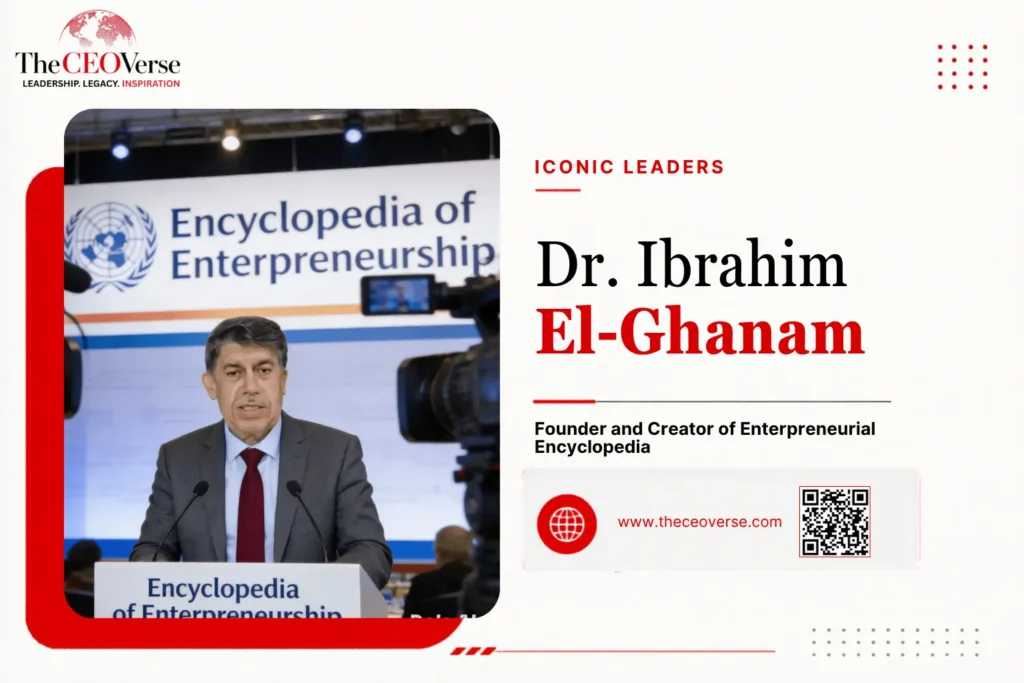
Four decades followed — enterprise development programs, thousands of leaders trained, a consulting role with the Central Bank of Egypt and several international bodies. Now his full attention belongs to The Entrepreneurial Encyclopedia. One line has carried through all of it, unchanged: no one should have to pay the same price in failure that earlier generations already paid.
The Three Questions Behind Every Decision
Before adopting any framework, model, or approach, three questions come first. Does it fit the local reality? Can people actually use it? Does it solve the real problem in front of them?
He does not assume that what works elsewhere will work here. Relevance over replication, is how he puts it. Excellence without relevance is wasted effort — lasting impact comes from meeting people where they are, not where an imported textbook assumes they should be.
That filter has shaped every model, every curriculum, every initiative since.
From One Region’s Struggle to a National Model
The Upper Egypt SME Development Program created more than 2,000 sustainable enterprises and over 8,000 jobs in regions that had gone underserved for years.
Out of that work came the El-Mobadara Model — a four-phase framework for SME support, built around local conditions rather than borrowed theory. Government agencies adopted it. So did banks. So did NGOs, nationwide.
More than 250 master trainers and institutional leaders came out of the same effort, and they now carry the work forward to tens of thousands of entrepreneurs across the region. A regional struggle turned into national infrastructure.
Alongside all of it sits The Entrepreneurial Encyclopedia — the first comprehensive public knowledge resource of its kind, covering early failure signs, entrepreneurial psychology, founder health, and future-ready models, built on almost no budget.
Curious Even When Nothing Was Going Wrong
Most people ask why when something fails. Grounded curiosity, in his case, asks it just as often when something is working — a habit that rarely switches off.
There is also a stubborn practicality at play. What works matters more than what sounds impressive. What serves many matters more than what flatters a few.
And underneath both sits long-term stewardship — the question of what remains after his direct involvement ends. Foundations over quick wins. Even when quick wins would sell easier.
The Work He Refused to Shortcut
Context-tailored frameworks come first, built from direct local understanding and tested in real markets rather than adapted from generic international models.
Then there is territory most of the industry avoids outright — entrepreneurial psychology, early warning signs of business collapse, founder well-being. Few address any of it, despite how much it determines whether a founder survives the first hard years.
The Entrepreneurial Encyclopedia is the third piece. An open knowledge architecture, built to be permanent, accessible, and independent of any single institution’s control.
None of the three came easy. None were meant to.
Forty Years Compressed Into One Free Library
The Encyclopedia is where all of his current effort goes — a structured, evolving public library compiling forty years of frontline experience. What works. What fails. Why.
Particular attention goes to fields mainstream business education tends to skip: red flags of failure, behavioral patterns, regenerative business, emerging technologies for SMEs.
It runs on almost no funding. Not-for-profit, by design. The ambition is not modest despite that — to become the most reliable, accessible reference for entrepreneurs anywhere in the world.
Building Leaders Nearby While Knowledge Travels Far
Reyada Academy is meant to become the leading regional hub for context-appropriate leadership and enterprise development over the next five years, training institutions across the Arab world to adapt and share knowledge on their own terms.
The Encyclopedia’s ambitions travel further. Full launch is planned for 2026. Multilingual versions after that. Eventually, a global collaborative network where practitioners contribute verified lessons directly, keeping the resource current without any single person having to write all of it.
Two Obstacles, One Refusal to Take Shortcuts
Early attempts to apply Western frameworks locally failed. Repeatedly. It took years before the lesson landed — nothing borrowed wholesale would hold up here, and the only way forward was building from the ground up.
The second obstacle never really ended. Building a global knowledge resource on close to zero budget means constantly choosing rigor over scale, independence over promotion, purpose over visibility. None of those trades are easy to keep making, year after year.
But the constraint cuts both ways. It is also what keeps the work unbiased, focused, aimed at public good instead of growth for its own sake.
What He Would Tell Anyone Chasing His Position
Master the reality you serve before you master the tools you use. That is where the real value sits, according to him — not in the tools themselves.
Study failure as carefully as success. The most useful insights are usually hidden in what went wrong, not in what worked.
Build something that outlasts you. Prominence comes and goes. What you enable others to build is what actually remains.
Stay useful. If the work solves real problems for real people, recognition follows on its own.