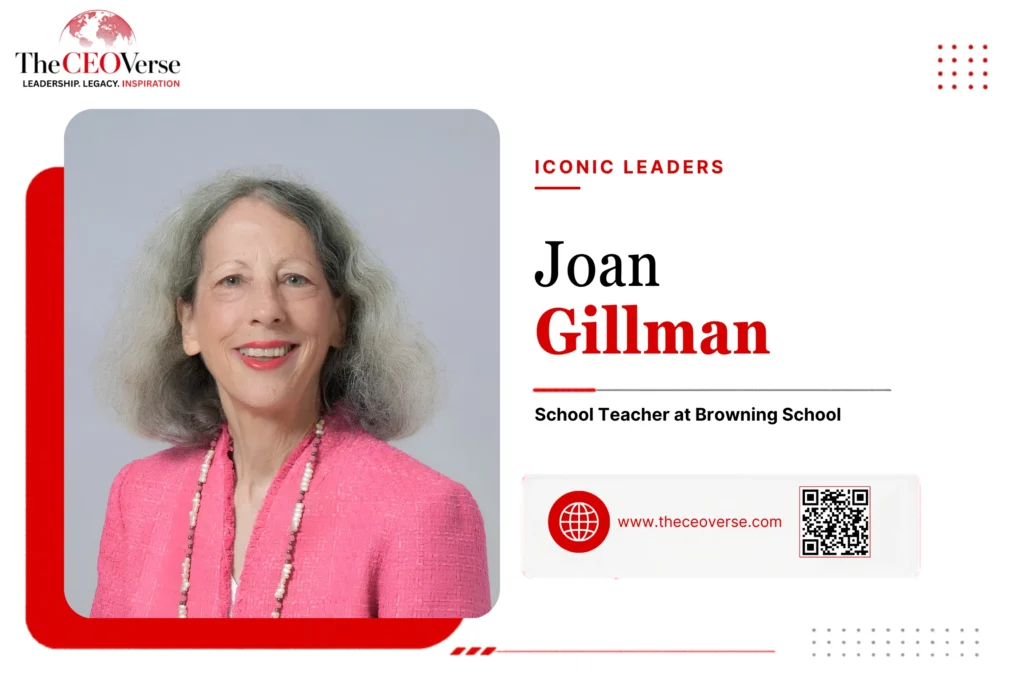
Joan Gillman: Building a Legacy Where Curiosity Becomes Capability
A snowstorm can be beautiful enough to simply watch. For Joan Ava Gillman, it was always something more. As a child, she wanted to know its temperature, measure the barometric pressure, calculate how quickly the snow was accumulating, and photograph what she was seeing. Wonder, for her, was never passive. It came with questions, measurements, experiments, and an urge to understand.
That instinct appeared everywhere in her childhood. She mixed powders and liquids in the bathroom sink in hopes of creating something new, built shoebox robots with her older brother, and constructed an entire miniature city from Kenner building sets and Lincoln Logs. The siblings called their creation Kinderkamack Village. What might have looked like ordinary childhood play was already revealing the mindset that would define Gillman’s professional life: observe closely, build freely, ask questions, and make room for others to participate.
More than four decades later, that same mindset continues to shape her work as a Lower and Middle School Science Teacher at The Browning School in New York City. It has also carried her into recognition as a Marquis Who’s Who honoree and IAOTP Top Educator of the Decade, as well as into a new role as a United Nations representative.
Yet the most enduring thread through Gillman’s story is not the collection of titles or distinctions. It is her conviction that curiosity belongs to every child, and that education works best when students are given the opportunity to experience knowledge rather than simply memorize it.
Curiosity Became the Starting Point
Gillman’s approach to education was taking shape long before she entered a classroom professionally. During high school, a community service requirement introduced her to experiences that quietly revealed where her strengths could make a difference.
She taught elementary schoolchildren how to play the recorder, tutored small groups who needed additional help with mathematics, and organized playground games with a deliberate goal of inclusion. Even something as simple as arranging a kickball game became an exercise in making sure every child had an opportunity to participate rather than allowing the naturally athletic students to dominate.
That instinct toward inclusion continued to develop. At her local Jewish Community Center, she taught swimming to children with special needs, patiently helping students overcome their fear of the water. During the week, she substituted as a ballet teacher, discovering another way to watch young learners develop confidence through movement.
These experiences established an idea that would remain central to her teaching: every student deserves an opportunity to shine. For Gillman, inclusion was never a separate initiative added to education. It was part of the way education itself should work.
Hands-On Learning Became a Defining Philosophy
The experience that most decisively shaped Gillman’s teaching philosophy came while she was completing her Master’s degree in education. As a student teacher at P.S. 47, a junior high school for the deaf, she worked with profoundly deaf science students in grades seven through nine.
Her cooperating teacher demonstrated how sophisticated scientific concepts could become accessible through tactile and visual experiences. During one electronics unit, students did not simply study circuits from a textbook. They constructed a miniature amusement park, complete with working rides and attractions, and wired their own models.
For Gillman, the lesson extended far beyond electronics. She saw firsthand how powerful science could become when students could build, touch, test, and observe what they were learning. The experience established a principle that would remain visible throughout her career: science is not only something students hear about. It is something they can experience with their own hands.
A Four-Decade Career Without a One-Size-Fits-All Classroom
Gillman’s formal teaching career began in 1980, after she earned her Bachelor of Arts in Education, summa cum laude, from Felician College, now Felician University, in Rutherford, New Jersey. She went on to earn a Master of Arts in Education from New York University’s School of Education, Health, Nursing, and Arts Professions, now known as the Steinhardt School of Culture, Education, and Human Development, in 1982.
Her professional journey subsequently moved through schools across New York and New Jersey. She began as a fifth grade teacher at St. Angela Merici School in the Bronx, followed by roles at Joytown Kent Elementary School, the Bede School in Englewood, New Jersey, and the Professional Children’s School in New York, where she spent two decades teaching all subjects for grades four and five, as well as sixth grade math and science, and running the Middle School Council.
Her path later included Anna C. Scott Elementary School in Leonia, New Jersey, and Yeshivat Noam in Paramus. In 2008, she joined the Calhoun School in New York City as a fifth and sixth grade science teacher, remaining there for a decade. In 2018, she joined The Browning School, where she currently teaches science across second, fourth, and sixth grades and leads the K8 Green Team.
Across these different environments and age groups, one principle remained unchanged: education cannot be designed around a single model for every learner. Gillman has often compared this to clothing. If a one-size-fits-all approach does not work for clothes, she argues, it certainly does not work for education.
The responsibility, in her view, belongs with the educator. Students arrive with different needs, experiences, strengths, and ways of processing information. Effective teaching therefore requires finding the approach that helps each individual student unlock understanding.
Straw Rockets Turn Failure Into Another Attempt
Gillman’s teaching philosophy becomes particularly visible through the experiences she creates for students.
Her Fourth Grade Straw Rocket unit is one of her signature examples. Students build rockets using straws, clay nose cones, and fins, then experiment with launch angles and measure how far their designs travel outdoors. They return to analyze the results, consider what happened, and make adjustments before trying again.
Failure is not treated as the end of the experiment. It becomes information.
A first launch provides students with evidence. A second launch gives them the opportunity to apply what they learned. That cycle of testing, adjusting, and trying again allows scientific thinking to become something students experience rather than simply define.
Her second grade engineering unit takes a similarly immersive approach through a story about a family of elephants. Two young elephants become stranded on the far side of a bridge, and students are challenged to design and construct a structure capable of supporting two adult elephants and two calves using recycled materials and craft supplies.
Within one project, students encounter science, engineering, mathematics, and art. More importantly, they encounter the kind of interdisciplinary problem-solving that Gillman believes education must increasingly embrace.
With middle school students, she begins units with phenomena intended to spark curiosity, connects new material to what students already know, and gives them opportunities to test hypotheses and draw their own conclusions through laboratory work. She also makes herself available most mornings before school for students who need additional support.
The underlying message remains consistent: if an idea does not make sense the first time, the learning process should not end there.
Environmental Leadership Extends Beyond the Classroom
Gillman’s influence reaches beyond science lessons through her leadership of The Browning School’s Green Team. Under her guidance, the student-led initiative has developed into an active platform for environmental awareness, leadership, service, and community engagement.
Students participate in a weekly “Green Action of the Week,” organize cleanups in Central Park, take part in Biodiversity Week challenges, hear from guest speakers, and organize fundraising efforts supporting causes ranging from hurricane relief to broader environmental initiatives.
For Gillman, environmental education is closely connected to leadership development. Young people become changemakers when they develop compassion for living things and recognize that their actions can contribute to something larger than themselves.
The impact sometimes extends beyond the activities themselves. Students have told Gillman that lessons about global water scarcity inspired them to join the Green Team. Such moments demonstrate the kind of educational influence she values most: an idea introduced in the classroom becoming motivation for action outside it.
Teaching Through Moments That Changed the World
A career spanning forty-four years has inevitably included moments when teaching became about far more than curriculum.
Her first year in the South Bronx presented one such challenge. In a fifth grade classroom with student abilities ranging from second grade to tenth grade, Gillman was simultaneously managing six different reading levels. Even before she had established herself professionally, she was learning how deeply adaptability and commitment could matter in a classroom.
In 1986, the Challenger space shuttle disaster brought another defining moment. Her sixth grade students had been following the mission with excitement, particularly because a teacher was among the astronauts. When the disaster occurred, Gillman suddenly found herself helping eleven-year-olds process grief, fear, and difficult questions.
The experience reinforced the significance of the teacher’s role in a student’s life. Science remained part of the conversation, but so did honesty, emotional awareness, and the responsibility to communicate difficult realities carefully.
Decades later, the COVID-19 pandemic presented a completely different challenge. Hands-on science had to move onto screens.
Gillman responded by turning homes into temporary laboratories. She sent students and parents lists of household materials in advance, then conducted investigations and demonstrations online, guiding families through the experiments step by step. Parents later told her they were surprised by how interactive she made remote learning feel.
The experience reinforced a principle that had been present throughout her career: engagement does not depend on being physically inside a classroom. It depends on how deliberately the learning experience is designed.
Creativity Has Always Had Another Stage
Gillman’s creativity is not confined to science education. She is also a classically trained pianist and violinist who performs with the Bergen Philharmonic Orchestra, the North Jersey Symphony, and, during the summer months, The August Symphony Orchestra.
At least four times each year, she volunteers her musical talents at nursing facilities, performing classical piano and violin for residents.
The setting changes, but the purpose remains familiar. Whether she is helping a child understand a scientific concept or bringing music to an older audience, Gillman’s work is deeply connected to the idea of lifting people through meaningful experiences.
Scholarship Gave the Work a Wider Reach
Gillman’s contribution to education extends into professional scholarship and curriculum development. She has written for publications including the STANYS Bulletin and Science and Children, published by the National Science Teaching Association.
Her curriculum “Straw Rockets Are Out of This World” was published by Science and Children in 2013 and later reprinted in the 2016 book Bringing STEM to the Elementary Classroom. She also contributed materials to Corwin Publishers’ What Teachers Want to Know About Teaching Climate Change.
Her interests have reached across subjects and disciplines. In 2011, she developed a curriculum focused on the Great Japanese Earthquake and Tsunami, which earned her a grant from Cornell University’s East Asian International Studies program. Her scientific curiosity even extended beyond Earth when she was recruited as a teacher ambassador for NASA’s Mars Atmosphere and Volatile Evolution, or MAVEN, mission.
Gillman has also served as a Subject Area Representative for the elementary level in New York City on behalf of the Science Teachers Association of New York State. As a Subject Area Representative, her responsibilities included monthly leadership meetings, guest-speaker recruitment, and presenting workshops at STANYS conferences. She has also participated in educational conferences hosted by organizations including the National Science Teaching Association, NSTA STEM Conference, the Science Council of New York City, the NYSAIS Diversity Symposium, and STEMTeachersNYC.
She helped plan the SCONYC conference in 2024 and remains an active member of SEEDS, Science Educators for Equity, Diversity, and Social Justice, an organization dedicated to transformative and equitable science education.
Her commitment to professional development has also included certification as a National Geographic educator in 2019 and completion of a five-week course in 2022 to become a certified Modern Classroom Project educator.
Recognition Followed a Philosophy Already in Motion
The recognition Gillman has received in recent years reflects the scale of a philosophy that had been developing quietly for decades.
In 2017, the Calhoun School honored her with its Urhy/Thompson Award, recognizing faculty who embody the spirit of a beloved colleague. The honor remains one of the happiest moments of her career.
Marquis Who’s Who has recognized her among its Top Educators and Who’s Who of Professional Women, while also honoring her with a Lifetime Achievement Award and recognition in its Who’s Who of Humanitarians and Philanthropists. Her work has appeared in Fortune Magazine’s October/November 2025 issue, Forbes Magazine, Insight Magazine, National Digest Magazine, and World’s Leaders Magazine. Kappa Delta Pi, the international education honor society, named her a Legacy Member.
Her 2024 recognitions included the CXO Time Award for Most Inspiring Educator in Science Education, inclusion in CXO Time’s Visionaries of Success list as one of the Top 10 Leaders Shaping the Future, and recognition by CIO Views Magazine among the Top 10 Empowering Women Leaders of the Year.
In 2025, The Executive Lens named her among its Top 5 Women to Know in its Icons of Influence feature, while MSN News featured her in “5 Female Leaders Who Went from Vision to Victory.”
The International Association of Top Professionals has been particularly significant in her recent recognition. IAOTP named her Top Educator of 2025, followed in 2026 by recognition as Top Educator of the Decade, inclusion among its Top 50 Fearless Leaders and Top 25 Global Impact Leaders, and most recently, Woman of the Year.
From School Leadership to Global Dialogue
The scope of Gillman’s work expanded further in 2026.
She joined the Forttuna Education Council’s Global Advisory Board, becoming part of an international group of leaders focused on business growth, human well-being, and institutional excellence.
Then, in March 2026, she was appointed a United Nations Representative to the AWWG at the United Nations Economic and Social Council, or ECOSOC. Reflecting on the appointment, Gillman described it as both a privilege and a responsibility, one that gives her the chance to take part in global dialogue, policy advocacy, and multi-stakeholder collaboration tied to the United Nations Sustainable Development Goals, with particular attention to sustainable development, inclusive growth, and international cooperation. She spoke of her gratitude for the trust placed in her and her eagerness to work alongside global leaders, policymakers, civil society organizations, and fellow representatives on initiatives built for measurable, long-term impact, and she framed the role as an extension of an ongoing commitment to service, collaboration, and a more sustainable and equitable future.
The role extends the same instinct that has shaped her educational career: thinking beyond the immediate environment and recognizing that meaningful change can begin with the ability to connect people, ideas, and action.
A Professional Home Built Around the Same Values
The Browning School provides a fitting setting for the next stage of Gillman’s work. Founded in New York City in 1888, the independent all-boys school serves more than 400 students from kindergarten through twelfth grade and is guided by four central values: Curiosity, Honesty, Dignity, and Purpose.
Those values align closely with the principles Gillman has carried throughout her career. Browning’s commitment to equitable, research-based educational practices is integrated into its curriculum and focused on meeting the developmental needs of its students while ensuring they feel respected, encouraged, and challenged.
The school began implementing the Next Generation Science Standards across its Middle School science courses in the summer of 2024. Gillman has worked with colleagues to update both middle school and lower school curricula accordingly.
Even after forty-four years in education, she continues to evolve with the field rather than relying solely on experience accumulated over time.
The Next Classroom Is Already Taking Shape
Gillman’s career is approaching another milestone: fifty years in teaching.
Her next season will bring a new professional configuration. She will step away from teaching across two divisions and focus solely on the lower school, while adding kindergarten to her teaching roster for the first time.
There is something fitting about that development. Her journey began with a child measuring snowstorms, experimenting at a bathroom sink, building robots, and creating miniature cities. Now, after decades of teaching students across multiple age groups, she is moving closer to the youngest learners, those whose curiosity is still taking its earliest shape.
Her vision for education remains equally forward-looking. She advocates for increasingly interdisciplinary curricula because learning does not happen in isolation, just as the world itself does not operate within isolated subjects.
She also credits professional development with keeping her energized throughout her career. Workshops, courses, conferences, and the willingness to continue learning have allowed her to remain enthusiastic after forty-four years in a demanding profession.
Her advice to educators and leaders is therefore grounded in practice rather than abstraction: keep learning because the field will continue changing; maintain a sense of humor because difficult days are inevitable; and never hesitate to ask for help, regardless of experience.
A Legacy Measured in Curiosity Put Into Action
Titles and honors can document the trajectory of a career, but they cannot fully measure its influence.
A more meaningful measure can be found in the student who joined the Green Team after learning about global water scarcity. It can be found in the deaf science student who once helped build a working amusement park ride and, decades ago, showed a young student teacher the power of hands-on learning.
It can be found in every straw rocket that traveled farther after a second attempt, every young learner who discovered that failure could provide useful information, and every second grade student who learned engineering by trying to build a bridge strong enough for four elephants.
Joan Ava Gillman’s legacy is ultimately built around a deceptively simple idea: curiosity becomes powerful when someone is given the space, tools, encouragement, and dignity to pursue it.
From the child who measured snowstorms to the educator preparing for her fiftieth year, her professional journey has never required curiosity to be left behind. Instead, she has turned it into a method of teaching, a foundation for leadership, a pathway to inclusion, and a way of helping young people understand that the world is not merely something to observe.
It is something they can question, investigate, build, improve, and ultimately help shape.