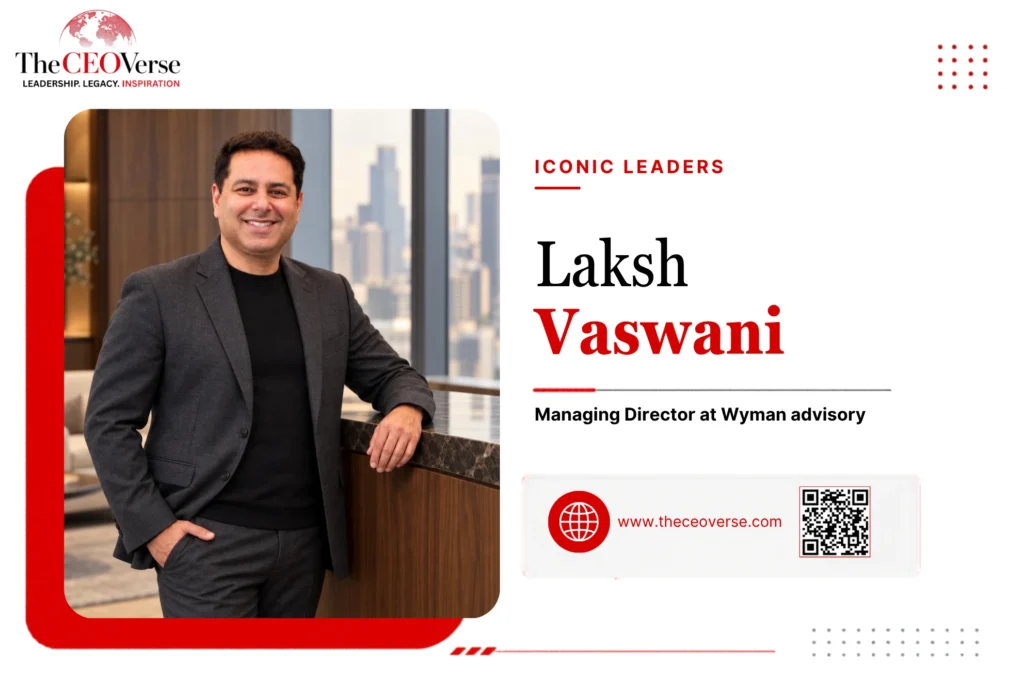
The Laksh Vaswani Effect: Steady in the Storm, Building in the Calm
He learned business at his father’s side across five countries. Today he leads global transformations, designs control into growth, sees AI as the next great leap in human work, and measures his legacy in the leaders he leaves behind.
The biryani goes in first, because the biryani cannot be hurried. Rice, spice and meat are laid down in layers, sealed, and left to do their slow work while everything else in the kitchen moves around them. Then come the galouti kebabs, minced so fine they dissolve on the tongue, carrying more than fifteen spices out of the old kitchens of Lucknow. Nargisi kofta. Sarson ka saag with makki di roti and a pale slab of white butter. And because Laksh Vaswani has never cooked for only one country at a time, a Senegalese chicken yassa sharp with lemon, a pan of shrimp fra diavolo that sends the bravest guest reaching for water.
The house fills with friends, family and laughter. Someone else asks for the recipe and will never make it. Vaswani moves between the stove and the table, tasting, adjusting, refilling glasses, and somehow still in the middle of every conversation.
His friends assume he improvises. He does not. Every dish has its hour. The kitchen runs on a sequence nobody sees, and the evening feels effortless precisely because it is not.
That is also how he runs a business. Vaswani is the Managing Director of Wyman Advisory, where he advises the leadership of global systemically important banks on transformation, operating model design, data and artificial intelligence. His real specialty is harder to fit on a business card. He is the person organizations call when something large has to change, and has to keep working while it does.
The apprentice
He learned it young, and on the move. His father ran a multinational business, and Vaswani trained beside him as an apprentice from Africa to Dubai, Sydney, Hong Kong and finally London, changing schools across five countries. Other boys learned geography from atlases. He learned it from invoices, shipping schedules and the faces across a negotiating table.
Being the new boy five times teaches a child things no classroom does. How to read a room before speaking. How to make a friend in a language you are still learning. How to notice that the rules everyone follows are rarely the rules written down.
Two lessons from his father stayed with him. The first was that every market runs on its own rules, and you learn them before you try to change anything. The second was simpler. A business exists to create value. Discipline that does not help it do that is not discipline. It is drag.
The builder
New York has been his base for more than 25 years, and for most of them he has commuted like everyone else, on the subway and the PATH train, taking calls from London and Tokyo before the city is fully awake. It is hard to lose touch with how the world works when you stand in it every morning.
Vaswani has led large global transformations at BNY Mellon, MUFG, USAA, Morgan Stanley, Thomson Reuters and the New York Stock Exchange, working alongside teams from Accenture, McKinsey, Bain, Deloitte and EY. He has lived in more than fifteen countries, managed teams spread across time zones and cultures, and rolled out AI and other innovations.
At BNY Mellon, where he received a Star Award presented by the bank’s chief executive, he earned a nickname that still makes him laugh: the bank’s James Bond. The comparison had less to do with tuxedos than with a habit of being sent into the situations nobody else wanted, and coming back with the problem solved.
Much of that work was done in the first line of defense, inside the business itself, where risk is not a report but a decision someone makes every hour. Controls designed into a process from the start make it faster, cheaper and more trustworthy. Controls added afterward make it slower, costlier and resented. The same holds for governance, and now for AI. Built in, it is an advantage. Bolted on, it is a tax. Banks have to manage risk and make money at the same time, and the ones that design for both win.
“Risk management that doesn’t help the business grow isn’t protection. It’s overhead.”
Laksh Vaswani
The storm and the calm
His scope has always resembled that of a chief operating officer or chief administrative officer, with no fixed edges. What that demands, he says, is two temperaments in one person. In a crisis, someone has to keep a clear head, steady the people around them and steer. In calm weather, the same person has to plan for the next storm, set the vision and then actually build it. Most leaders are good at one. The rare ones practice both.
He learned the second half the hard way. Early in his career, he promised outcomes instead of engineering the systems that would deliver them, and watched the plan come apart under scrutiny. He has built everything since on the correction.
“Credibility isn’t what you say. It’s what survives stress-testing three years after you’ve left.”
The AI vision
Ask Vaswani about artificial intelligence and he does not reach for warnings. He reaches for history.
“In 1900, four in ten Americans farmed. Today it’s under two in a hundred, and nobody starved. AI will be the same if we govern it instead of fearing it.”
Laksh Vaswani
To him, the doomsday talk is familiar noise. Every great technology has arrived with a chorus predicting ruin, and every one has also proved capable of real damage when left uncontrolled. Both things are true, and neither is a reason to stand still. The work is to stay in control of the tool and ahead of it.
His vision for AI in finance follows directly from his philosophy of design. Build the data foundation first, because a model is only as honest as the data beneath it. Build governance into the architecture from day one, so that speed and safety arrive together. Then let it lift people out of repetitive work and toward judgment, creativity and service. He has helped bring AI into large institutions, and holds the IAPP’s Artificial Intelligence Governance Professional (AIGP) designation and the DAMA CDMP Master, held by just 427 people worldwide as of July 2026.
The legacy
For many years, the work Vaswani cares about most has not appeared on any balance sheet. He has mentored more than sixty professionals, often through long Sunday-morning emails to people just starting out. Some of those people now serve as Chief Risk Officers and Chief Compliance Officers. Others have become vice presidents and executive directors, and many have carried what they learned into entirely different fields. He counts all of them.
Friends know him as the person to call when something breaks, at any hour, because he will answer, listen, and then say the calm, practical thing nobody else in the room was able to say.
He co-authored Pivotal Leadership: A Masterclass in Innovation and Persuasion, a bestseller on Amazon and USA Today, and speaks at international industry events. He regards those as the loud part of the same effort. The quiet part is passing on judgment: how to think in a crisis, how to plan in the calm, how to protect a team while it does its best work.
“He did not just teach us compliance. He taught us how to lead when everyone else is panicking.”
Chief Risk Officer, multinational banking group, and former mentee
The tracks
On April 22, 2013, at the Grove Street PATH station, a woman lost consciousness and fell onto the tracks. Vaswani jumped down after her. With help from others on the platform, and with the incoming train brought to a halt, he got her clear. His injuries later required surgery. The Port Authority Police honored him at a ceremony near the 9/11 memorial at the Journal Square PATH station, and those who covered the story called him a hero.
Every risk framework he has ever written would classify that leap as an unacceptable exposure. He has spent his life designing systems so that no one person has to make that choice. On that platform, for a few seconds, he was the system.
What holds
Vaswani is a longtime blood donor and a member of the American Red Cross Gallon Club. With like-minded friends and charities, he builds toilets and latrines for communities that have gone without them, and helps girls and women who have survived exploitation rebuild their lives in India, Vietnam and elsewhere in Asia, and across South America and Africa.
At home, he and his wife, Reena, are raising twin sons Neel and Yash, now fifteen. When the family travels, the trips are rarely just holidays. They are lessons in reading the world, much like the ones his father once gave him.
Late in the evening, after the last guest has gone, the biryani pot sits empty on the stove. It was the first thing he started and the last thing anyone thought about. Most of what Laksh Vaswani builds works the same way. It is laid down early, sealed with care, and made to hold long after he has stepped away.