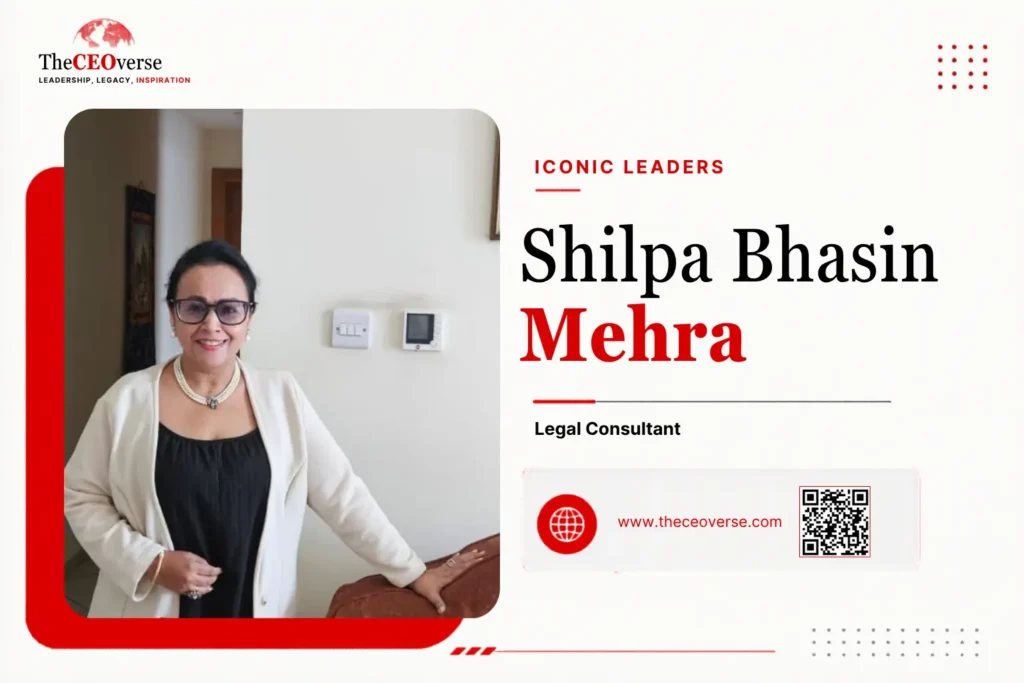
Legal Innovation & Leadership Visionary of the Year 2026
She did not choose law so much as grow into it — shaped first by a father’s example, then by years of hard practice across two countries, and eventually by a season of stillness that changed everything.
From Black Coat to Boardroom
There was nothing dramatic about how Shilpa Bhasin Mehra decided to become a lawyer. She watched her father, Dr. Lalit Bhasin, move through the world in a black coat — files piled high, an authority about him that was difficult to name but impossible to ignore. The respect the profession commanded, the problems it solved, the knowledge it demanded — all of it registered early.
She went from school to college to law college, and then straight into the chambers of K.K. Venugopal — one of the most respected names in Indian law. She sat in on Supreme Court arguments, researched cases that became landmarks, and learned from people who had spent decades at the top of the profession.
After a year, she got married and moved to Dubai. She started from scratch — studying local laws, working in firms, building her practice piece by piece. Over time she moved up, eventually holding the position of Head of Legal at multinational firms operating in the region.
Relationships Over Resumes
Ask Shilpa what has consistently driven her results and she does not lead with credentials. Laws can be learned. Documents can be drafted. Research that once took days now takes minutes.
What cannot be replicated is the quality of a relationship. She has built her practice on genuine interest in her clients — not just in their legal problems but in their businesses and the outcomes they actually care about. The question she returns to is simple: how can I add value here?
Staying relevant matters too. The legal profession has changed more in the last decade than in the previous four. Adaptability, in her view, is not a soft skill. It is professional survival.
The Years That Rewrote Everything
In 2003, Shilpa’s life stopped. A critical illness left her in a coma for forty days. When she emerged, she was paralysed from the waist down — a condition that lasted two and a half years.
She did not disappear from her profession. Legal assignments came in, handled from home. She stayed close to the work even when she could not return to it fully.
During those years, she wrote. The thoughts she had been carrying became a book — All Battles Aren’t Legal, published in 2005, written through recovery. A second book, Unfiltered and Unapologetic, followed in 2025.
In 2010, her former employer called her back as Head of Legal. That call gave her more confidence than almost anything else in her professional life. She went back determined to give her best.
Compassion as a Professional Tool
Shilpa describes herself as a people’s person, and she means it practically. Interpersonal skill, for her, is not charm — it is the capacity to genuinely listen and help without making it transactional.
She names compassion, active listening, and willingness to help as the qualities most central to her work. In a profession where clients often arrive not knowing how to explain their own problem, the ability to hear what is not being said matters as much as legal knowledge.
Resilience is the fourth quality — and perhaps the most hard-won. It did not come from a career milestone or a professional achievement. It came from years of illness, rehabilitation, and the slow work of building back. Most people talk about resilience in the abstract. She lived it in the specific. It did not make her immune to difficulty. It made her stop being surprised by it.
Mediation First, Courtroom Never
The project Shilpa is most invested in right now is not a case — it is a shift in how people think about disagreement. She is a firm believer in mediation, but she would go further. What she wants to promote is dispute avoidance altogether.\
Her argument is straightforward. Why wait for a disagreement to harden into a dispute? Keep communication open, negotiate before positions become entrenched. Disputes are rarely in the interest of the people involved — only time and resources get spent.
She is also focused on estate planning, encouraging clients to make their wills. She holds qualifications to draft them under both UAE and Indian law. It is one of the most practical things a person can do — and one of the most consistently delayed.
New Jurisdiction, Same Steady Hand
When Shilpa moved to Dubai, she arrived as a trained Indian lawyer with strong Supreme Court experience and no knowledge of local UAE law. That is not a small gap. The legal systems are different, the business culture is different, and the professional networks she had spent years building were now thousands of miles away.
She did not try to close the gap immediately. Instead she looked at what she already had — a deep command of English law, strong contract drafting skills, and the kind of communication ability that travels across jurisdictions. She focused on international clients, handled cross-border mandates, and built from there. Local knowledge came in time.
What she carried from that experience is a simple read on challenge: the opportunity is usually already present, most people just aren’t looking for it.
Leadership Earned, Not Appointed
The advice Shilpa offers younger legal professionals does not start with strategy. It starts with foundation — legal knowledge, ethics, a reputation for reliability. In a profession where trust is the actual product, integrity is not a value to display. It is the work itself.
She is direct about communication. Effective lawyers explain complex things clearly, negotiate with confidence, and work well with people unlike them.
leadership, in her view, does not arrive with a job title. It shows up earlier, in how you carry yourself through difficult situations and whether you make the people around you better.
Finally, aspiring legal professionals should focus on creating meaningful impact rather than merely pursuing titles or status. True leadership is reflected in the ability to solve complex problems, uplift others, and contribute to positive change within both the legal profession and society at large. Those who combine expertise with integrity, empathy, and a genuine commitment to service are the ones who earn lasting respect and influence.
As Shilpa puts it: “Keep your eyes and mind open — the world is your oyster.”