The work that speaks without applause
When a flagship exhibition opens, the applause goes to the stage, the keynote speakers and the polished halls. Behind the scenes, thousands of agreements have already been negotiated, tested and stress checked. Caterers, technology partners, facility teams, logistics providers and hospitality suppliers have been lined up. Contingency plans exist for the day something goes wrong. If everything works, nobody notices.
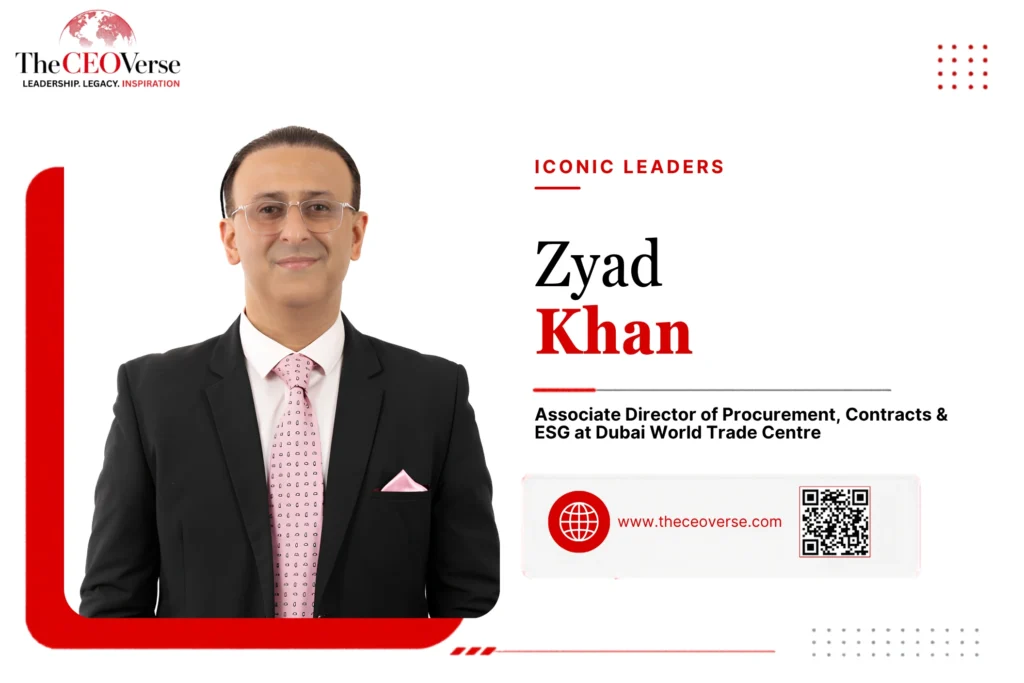
Zyad Khan has spent more than a quarter of a century in this invisible space. As Associate Director of Procurement, Contracts & ESG at Dubai World Trade Centre (DWTC), he is responsible for much of what makes a world class venue feel effortless. He holds the title of Chartered Fellow of the Chartered Institute of Procurement & Supply (FCIPS) and is regarded as one of the leading procurement voices in the Middle East and North Africa. Yet he describes his career in modest terms. It has been, he says, less a climb up a hierarchy than a steady widening of influence and responsibility.
His story is not one of overnight success or a single dramatic pivot. It is the story of a profession slowly being redefined, and of a man who spent decades helping that redefinition happen.
An accidental beginning
Zyad did not set out to become a procurement leader. His entry into the field came almost by accident, in a retail environment in the late 1990s, when he took a professional opportunity without knowing what it would become.
What began as a job slowly turned into a fascination. He noticed that every purchase, every supplier choice and every negotiated term quietly shaped how well a business performed. Procurement, he realised, was never simply about buying. It was a craft of judgement, relationships and negotiation, and it aimed at outcomes that outlast the transaction itself.
That early realisation became the foundation of everything that followed. It explains why, decades later, he still talks about commercial decisions the way a strategist talks about a chessboard, with attention to the moves that come three steps after the obvious one.
The foundations of a commercial mindset
Zyad’s early interests in cricket and debating helped develop qualities that would later serve him in procurement. Patience, composure, structured thinking and the ability to make a persuasive case. He later completed an MBA in Marketing at the University of Central Punjab. The commercial perspective he developed through this experience helped him look beyond a stated requirement to understand what customers and stakeholders genuinely need, a habit that would become a defining feature of his leadership.
Taking flight at Emirates
In June 2001, Zyad joined Emirates Airlines Catering (EKFC) as Product Group In-charge for central purchasing. His remit was food and consumable purchases for the inflight needs of Emirates Airlines and Dubai International Airport.
It was a demanding apprenticeship in operational reality. Inflight catering is unforgiving. Meals must be safe, consistent and on time, across thousands of flights, regardless of supply disruptions, seasonal shifts or last minute changes. A late delivery cannot be explained away to a passenger at thirty five thousand feet. For five and a half years, Zyad learned what it means to buy for an operation in which failure is immediate and highly visible.
This period also marked his move to the UAE, an experience he says broadened his perspective on stakeholders, expectations and operating complexity. The lessons from the aviation years were practical and lasting. Supplier reliability matters as much as price. Specifications have consequences. And the people who depend on your decisions rarely see the work that goes into them.
A retail experiment
In January 2007, Zyad made a brief but formative move. He joined The Sultan Center as Buying Manager, tasked with helping set up a discount food store chain. It was designed as a new retail concept under the Kuwait based Sultan Center umbrella, with ambitions of expanding across the Middle East and North Africa and offering a simple, cost effective shopping experience.
The stint lasted only about eight months, but it reconnected him with the retail roots of his early career and gave him a founder’s eye view of building something from scratch. A discount format forces a particular discipline. Every cost has to justify itself, and every supplier relationship has to protect a thin margin without sacrificing quality. It was a compact course in commercial economics at a stage when he was preparing for a much larger leap.
Inside the private office
That leap came in September 2007, when Zyad joined the Engineer’s Office, the private office of His Highness the Ruler of Dubai, as Manager of Operational Procurement. Over the next six years, he led a team of fifty buyers.
The scope was extraordinary. His team procured everything from construction materials and facility management services to hospitality and events requirements. It was the kind of breadth that forces a leader to stop thinking in categories and start thinking in systems. A decision in one area, whether a construction supplier, a hospitality partner or an events vendor, could ripple through timelines, budgets and reputations elsewhere.
Leading fifty buyers also taught him something that no certification could. Process can be taught, but judgement has to be cultivated. He saw how a team performs when people are trusted with responsibility, challenged to think commercially and given room to grow. This is where his belief in developing people as deliberately as one develops a career first took root. It is a theme that still runs through everything he says about leadership today.
Arriving at Dubai World Trade Centre
In November 2013, Zyad joined Dubai World Trade Centre, the organisation where he has now spent over thirteen years. The institution, a global business facilitator since 1979, is home to some of the region’s leading purpose built convention and exhibition venues and runs a calendar of international trade exhibitions and other major business events.
His responsibilities have grown with the organisation. Today he oversees contracts and procurement across an unusually wide landscape. Corporate procurement, food and beverage, events hospitality, information technology and facility management, among others. He holds ownership of revenue contracts for events and marketing campaigns across the MICE (meetings, incentives, conferences and exhibitions) and retail businesses. He also manages sponsorship initiatives in key spend categories, including cross selling opportunities at the venue.
Delivering under extraordinary pressure
Some of the most demanding chapters of Zyad’s career have involved supporting large scale international events, where the expectations are high, timelines are fixed and operational complexity leaves little room for error.
In these environments, he has managed high-stakes contracts and risk, supported by carefully developed contingency plans. Supplier capability, delivery timelines, governance and sustainability all have to work together. When an event brings together participants and visitors from around the world, a supplier failure is not simply an inconvenience; it can become a highly visible operational problem.
These experiences reinforced a principle that runs through Zyad’s approach to procurement: the function creates its greatest value when complexity is managed so effectively that the organisation can focus on its purpose. The best compliment is often that everything simply works.
The principle that guides every decision
Ask Zyad how he reaches the right outcome and he gives a deceptively simple answer. Understand the outcome before becoming attached to the solution.
In large organisations, it is tempting to get absorbed in specifications, prices, processes and deadlines. He argues that the real question lies upstream. Will this decision serve the business purpose, manage its risks and still be valuable years from now? The lowest price, he points out, may not be the lowest cost, and a contract that looks compliant may not deliver the strongest result.
He encourages his team to challenge assumptions constructively, listen to stakeholders before deciding, and then hold themselves accountable after committing. Sometimes that means questioning established practice, and he is clear that it takes courage. His standard for a successful decision is demanding. It must balance commercial value, governance, resilience and responsibility, rather than merely look successful on paper.
Three qualities, in his own telling, shaped this approach. Commercial curiosity, conviction and consistency. Curiosity keeps him asking better questions about the business behind a requirement. Conviction lets him respectfully challenge a decision when the evidence points elsewhere. Consistency, he says, is what builds trust, because trust comes from repeated, principled behaviour, especially when circumstances turn difficult. He adds a fourth, quieter ingredient. Humility, the willingness to learn from others and give capable people space to perform.
Fighting the perception problem
Every career has its obstacles, and Zyad’s most persistent one has been less about any single project than about perception. For much of his working life, procurement was seen as a process, a control point or a quick route to savings. When a function is viewed that way, its wider contribution gets overlooked.
His answer was not to argue the point but to prove it. Credibility, he explains, is earned by helping colleagues reach their goals while protecting the organisation’s interests. It comes from understanding the pressures that other departments face, and from showing through decisions and outcomes what a strategic procurement partner looks like.
A second challenge has been the constant tension between competing priorities. Cost, speed, compliance, quality, resilience and sustainability rarely point in the same direction. There is almost never a perfect answer. There is analysis, transparent trade-offs and a person willing to be accountable for the choice.
Behind both challenges sits a lesson he repeats often. Transformation is as much about people as processes. Bringing stakeholders along, leaving room for constructive disagreement and staying steady when change takes longer than planned are, in his view, the real work. Leadership, he says, is tested less by certainty than by the quality of decisions made under pressure.
Savings that last, value that compounds
His team’s standing has been recognised externally as well. Dubai World Trade Centre’s procurement and contracts department has been certified for ethical procurement by CIPS, with all twenty five of its employees awarded the CIPS Ethics qualification. For a function whose daily work involves large sums and sensitive choices, that kind of collective commitment to integrity is a statement about culture, not just compliance.
Greening the ledger
Somewhere along the way, Zyad recognised that the future of procurement would be inseparable from sustainability. He did not treat it as a reporting exercise. He treated it as a commercial discipline.
At DWTC, he has been developing a sustainable procurement roadmap aligned with Dubai’s long-term vision and the organisation’s wider operational priorities. His approach is to embed ESG considerations throughout the procurement lifecycle, from the moment a need is identified to the moment a contract is reviewed. His sustainability training and professional development support this work, but the emphasis remains on making responsible procurement part of everyday commercial decision-making.
His philosophy is often summarised through three words. People, Planet and Profit. He argues that these need not compete. Responsible sourcing, he maintains, should be a practical part of commercial decision making rather than a separate ambition sitting beside it. He is also actively involved in food security and In-Country Value (ICV) projects at DWTC, applying the same thinking to questions of local contribution and community resilience.
The teacher in the room
If procurement is Zyad’s profession, teaching is his second calling. He mentors postgraduate students at Heriot Watt University and is an ACTVET certified trainer who delivers programmes for ADNOC and DWTC cohorts, focused on procurement and negotiation models. He leads webinars and panel discussions for CIPS whenever asked and has partnered with consulting firms including Kloepfel Consulting and The Procurement Channel.
His professional contribution also extends to speaking engagements and industry discussions, where he shares perspectives on artificial intelligence in procurement, the role of data and automation, sustainability and stronger supplier relationships. He has moderated discussions with senior leaders from global organisations, served as a judge for regional supply chain excellence awards and contributed thought leadership to wider professional audiences.
His motivation is clear. Professional credibility, he believes, matters most when it raises the capability of others. He wants procurement professionals to think beyond owning a process and develop the commercial judgement to influence business decisions with confidence.
When excellence speaks for itself
The awards and honours in Zyad’s career tend to arrive almost as by products. In 2025, he was elevated to Chartered Fellow of CIPS, one of the profession’s most respected distinctions. He also holds the Certified Purchasing Professional (CPPM) credential from the American Institute of Business Management in the USA, alongside his MBA and his sustainability qualifications.
He has been recognised among the Top 50 Procurement Leaders in the MENA region, and Global Success Review included him in its 2026 feature on influential leaders shaping the future of business. The procurement and contracts function he leads has also received external recognition for its work in procurement transformation and resilient supply chains.
Zyad himself responds to such acknowledgement with measured gratitude, calling it encouraging. He prefers a different yardstick. Stronger teams, better decisions and the capability left behind when an assignment ends.
Building a procurement that sees ahead
Today, Zyad’s attention is firmly on the future. His current focus is making procurement anticipatory. Instead of waiting until a requirement reaches the sourcing stage, he wants the function to spot risks and opportunities earlier. That means closer supplier collaboration, ESG built into every stage, clearer visibility of contracts and commercial performance, and a thoughtful use of digital tools and AI.
He is careful about the limits of technology. It can accelerate analysis, he notes, but it cannot replace judgement, organisational readiness or human accountability. His advice to colleagues is to understand the problem a trend is meant to solve before following it.
His five year vision for DWTC follows the same logic. He imagines a destination that continues to strengthen its global relevance, supported by a procurement function that is insight led, digitally enabled and sustainability conscious. He pictures supplier ecosystems that can absorb disruption, data used to anticipate market movements, and talent able to think in terms of enterprise outcomes rather than departmental ones. In his words, the aim is not technology for its own sake or sustainability as a reporting exercise. It is an organisation better equipped to decide well, deliver consistently and create lasting value.
Advice for the next generation
Asked what he would tell someone aiming for a prominent position in the field, Zyad starts with a priority that sounds simple and is quietly demanding. Build substance before visibility. Learn the commercial fundamentals. Understand contracts. Develop negotiation skills and get comfortable interpreting risk. Then learn how your own organisation makes money, serves customers and defines success, because influence grows when you understand the business beyond your function.
He asks for equal investment in relationships, measured not by the number of contacts but by the quality of trust and mutual contribution. Treat suppliers fairly, challenge stakeholders respectfully, and give colleagues credit for shared achievements. Stay curious about technology, sustainability and new business models. And develop people as deliberately as you develop your own career.
The legacy that continues beyond a lifetime
Procurement rarely makes headlines, its finest triumphs are quietly woven into the seamless flow of everyday life. Zyad Khan thrives in that quiet space, yet he has consistently championed a bolder vision for his field. Through high stakes negotiations, empowering teams, inspiring students, and relentlessly raising the bar, he has proven that strategic purchasing is nothing short of a powerful catalyst for leadership.
At the heart of his philosophy lies a deeply uplifting principle. True professional success isn’t about capturing the spotlight or commanding attention, but about elevating everyone around you. It is about building an organization so robust, and a culture so vibrant, that your impact resonates long after you step away. For Zyad, leadership is about sparking enthusiasm. Passing a thriving, energized mantle to the next generation of pioneers so they can lead with pride and purpose.