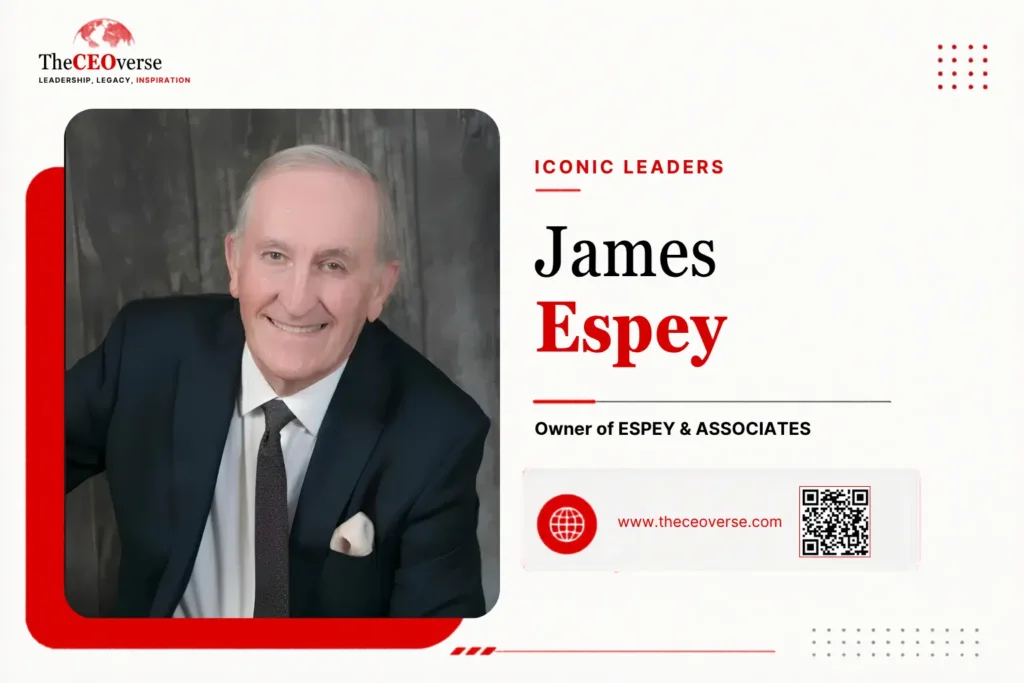
Boarding School at Six, Boardroom at Eighty
Most people who build billion-pound brands do not begin with a particularly clean start. James Espey was six years old when his parents divorced and he was sent to boarding school in Cape Town. The year was 1950. Getting home meant eight days on a train, twice a year, for ten and a half years.
He will not tell you it was difficult. He will tell you it was probably good for him. Sport helped. Being reasonably intelligent helped more. What those years gave him, beyond an education, was a working assumption that has guided everything since: focus on the future, pursue education wherever it is available, and do not waste time on what has already happened. At 83, he chairs Wiltshire Distilling Company and holds the same view he formed somewhere in those Cape Town years. The logic has not changed because, in his experience, it has not needed to.
Built on a Calculation, Not on a Single Principle
Ask Espey for the one principle that consistently delivers right outcomes and he will stop you before you finish the question. There is no such principle, he will say. What he offers instead is a calculation built from decades of brand building: have vision, hold focus, and whatever you think it will cost and however long you think it will take, double both numbers.
That is not pessimism. It is a working formula. The people who go in expecting a clean timeline and a reasonable budget are the ones who quit when reality arrives. Alongside that calculation sit three constants he has never moved on, integrity, consistency, and courage. Not as values written on a wall somewhere, but as practical tools. Without them, the calculation does not hold.
From Billion Pound Brands to a Society Built Without a Price Tag
Several billion pounds generated for the UK economy. A number of successful brands across decades. By most measures, that is a career worth accounting for. But when Espey is asked about the milestone he values most, commercial success is not where he begins.
He talks instead about the Keepers of the Quaich. A society created to honour those who have made a significant contribution to the Scotch whisky industry, and created without a profit motive. That distinction matters to him. Anyone can generate returns. Doing something for the good of an industry, without taking anything back, is a different kind of work.
The Keepers meet twice a year at Blair Castle in Scotland. The Nobility of Scotland serve as patrons. Among the speakers Espey brought to that platform: former US President Ronald Reagan, retired South African President FW de Klerk, Prince Charles, and Princess Anne. He asked Reagan personally, over lunch in New York.
The Three Convictions He Has Refused to Compromise in Six Decades
Espey identifies three things that have shaped his path more than anything else. The first is integrity, genuine rather than performative. The second is believing in people and building teams without an ego in the way. He is specific about this. TEAM, he will tell you, stands for Together Everyone Achieves More. It is not a motivational phrase to him. It is an operational principle.
The third is staying on the road. Not quitting too easily, not mistaking a short term obstacle for a structural problem, and keeping sight of the fact that you are building for the future, not for the present. These three have not shifted across six decades of brand building, boardrooms, and one not-for-profit society built at Blair Castle. They are not aspirational. They are just how he works.
Fifteen Miles from Stonehenge, Still Building
Wiltshire Distilling Company sits on Lord Margadale’s estate, fifteen miles from Stonehenge. The brand is called Witchmark, named after a local mark in the area. It uses local water, local grain, and has already earned recognition as the second highest environmentally responsible whisky company in the United Kingdom. Espey is its Chairman.
He calls it his last major project. At 83, that phrase carries weight but not resignation. The team is right, the vision is clear, and English whisky, done properly and authentically, has a future he genuinely believes in. Not every category gets a second conversation. He thinks this one does.
International Ambition, One Market at a Time
The five year target is straightforward. Espey wants Witchmark to be the leading English whisky brand worldwide. He is already looking at international markets, with India currently under serious consideration. He describes it as exciting, which coming from someone who has built brands across decades and sat across the table from heads of state, is not a word he reaches for lightly.
The approach is deliberate. Not too much too fast. The ambition is global but the execution is measured, a lesson drawn from experience rather than caution.
Negativity Was Never the Hardest Part, Bureaucracy Was
The hardest obstacles, in Espey’s view, were never dramatic. No single crisis, no defining moment of failure. The real friction was quieter, negativity that is always easier to find than to ignore, and bureaucracy that grows heavier as organisations get larger. He has operated inside both and built around both.
Staying on the road was the answer. Not a strategy, not a framework, just the refusal to stop. He has been doing that since 1950.
His Advice to Anyone Serious About Building Something Real
Espey is direct about what it takes. Most people in any industry are working primarily for themselves, not for the industry, and if you are serious about building something, you need to see that clearly. Stand out. Change jobs if the situation demands it. But when you leave, never run down the organisation you walked away from. The industry remembers, and the company you criticised today may be acquiring yours tomorrow.
Courage, commitment, tenacity. He repeats the last word deliberately. Take a minimum ten year view. Bonus cycles and short term targets have ended more promising careers than failure ever has, and too many people never build anything that lasts because they stopped looking far enough ahead.
When you travel, learn a few words in the local language, eat the local food, respect the culture you are stepping into. You may be speaking your first language, for the person across the table it could be their fourth. The world, he says, is a small village. He has believed that long enough to know it is true.